The Eastern Desert of Egypt extends over a vast area of mountains and sandy plains between the Nile and the Red Sea. Its natural riches –gold, gems and high quality stones (such as granite from Mons Claudianus, Tiberianè or Ophiatès, porphyry from Porphyritès, basanites [greywacke] from the Wâdi al-Hammâmât, etc.)– have, despite the difficulties due to harsh climatic conditions, been exploited since the Predynastic period. The Pharaohs, the Ptolemies and the Roman emperors often sent expeditions to extract these minerals and stones. The desert was also a passageway for all sorts of traffic coming from countries bordering the Red Sea and the Indian Ocean. Expeditions and commercial activities, which started from time of the Old Kingdom, greatly expanded during the Ptolemaic and Roman periods. Trade focused on spices initially, fragrant resins and gems, then in the Roman period, on a wide range of exotic products including pearls, precious stones, fabrics, etc. The archaeological sites of this region were practically inaccessible for logistical reasons until recently and they were, until now, exceptionally well preserved. Between the late 1970's and 2012, American, English, Italian and French teams were able to explore or search hundreds of sites, significantly improving our understanding of gold mining under the Ptolemies and the Byzantine emperors, granite and porphyry quarries opened by the Roman emperors, and trade with Arabia and India through the ports of Myos Hormos and Berenike...
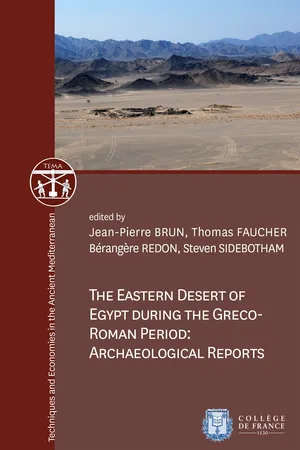
eBook - ePub
The Eastern Desert of Egypt during the Greco-Roman Period: Archaeological Reports
- English
- ePUB (mobile friendly)
- Available on iOS & Android
eBook - ePub
The Eastern Desert of Egypt during the Greco-Roman Period: Archaeological Reports
About this book
Information
Subtopic
World HistoryIndex
HistoryTable of contents
- Introductory pages
- Table of contents
- Introduction
- Coptos, Gate to the Eastern Desert
- The Control of the Eastern Desert by the Ptolemies: New Archaeological Data
- Ptolemaic Gold: the Exploitation of Gold in the Eastern Desert
- A Survey of Place-Names in the Egyptian Eastern Desert during the Principate according to the Ostraca and the Inscriptions
- Chronology of the Forts of the Routes to Myos Hormos and Berenike during the Graeco-Roman Period
- The Fortlets of the Eastern Desert of Egypt
- Quarries with Subtitles
- Some Topographical Problems around Myos Hormos: Philotera-Philoteris
- The Italian Archaeological Mission in the Eastern Desert: First Results from the Area of Wâdi Gasus
- The Exploitation of Animals in the Roman Praesidia on the Routes to Myos Hormos and to Berenike: on Food, Transport and Craftsmanship
- Roman Life in the Eastern Desert of Egypt: Food, Imperial Power and Geopolitics
- Fuelwood and Wood Supplies in the Eastern Desert of Egypt during Roman Times
- Textiles from Mons Claudianus, ‘Abu Sha’ar and other Roman Sites in the Eastern Desert.
- Textile Contrasts at Berenike
- Pottery from the Wâdi al-Hammâmât. Contexts and Chronology (Excavations of the Institut français d’archéologie orientale 1987-1989)
- Quarries, Ports and Praesidia: Supply and Exchange in the Eastern Desert
- Port of Myos Hormos and its Relations to Indo-Roman Trade
- Overview of Fieldwork at Berenike 1994-2015
- The Great Temple of Berenike
- Berenike in Light of Inscriptions, Ostraca, and Papyri
- Bi’r Umm Fawâkhir: Gold Mining in Byzantine Times in the Eastern Desert
- Documentary and Literary News on Clysma
- The Eastern Desert in Late Antiquity
Trusted by 375,005 students
Access to over 1.5 million titles for a fair monthly price.
Study more efficiently using our study tools.
Frequently asked questions
Yes, you can cancel anytime from the Subscription tab in your account settings on the Perlego website. Your subscription will stay active until the end of your current billing period. Learn how to cancel your subscription
No, books cannot be downloaded as external files, such as PDFs, for use outside of Perlego. However, you can download books within the Perlego app for offline reading on mobile or tablet. Learn how to download books offline
Perlego offers two plans: Essential and Complete
- Essential is ideal for learners and professionals who enjoy exploring a wide range of subjects. Access the Essential Library with 800,000+ trusted titles and best-sellers across business, personal growth, and the humanities. Includes unlimited reading time and Standard Read Aloud voice.
- Complete: Perfect for advanced learners and researchers needing full, unrestricted access. Unlock 1.5M+ books across hundreds of subjects, including academic and specialized titles. The Complete Plan also includes advanced features like Premium Read Aloud and Research Assistant.
We are an online textbook subscription service, where you can get access to an entire online library for less than the price of a single book per month. With over 1.5 million books across 990+ topics, we’ve got you covered! Learn about our mission
Look out for the read-aloud symbol on your next book to see if you can listen to it. The read-aloud tool reads text aloud for you, highlighting the text as it is being read. You can pause it, speed it up and slow it down. Learn more about Read Aloud
Yes! You can use the Perlego app on both iOS and Android devices to read anytime, anywhere — even offline. Perfect for commutes or when you’re on the go.
Please note we cannot support devices running on iOS 13 and Android 7 or earlier. Learn more about using the app
Please note we cannot support devices running on iOS 13 and Android 7 or earlier. Learn more about using the app
Yes, you can access The Eastern Desert of Egypt during the Greco-Roman Period: Archaeological Reports by Jean-Pierre Brun,Thomas Faucher,Bérangère Redon,Steven Sidebotham in PDF and/or ePUB format, as well as other popular books in History & World History. We have over 1.5 million books available in our catalogue for you to explore.