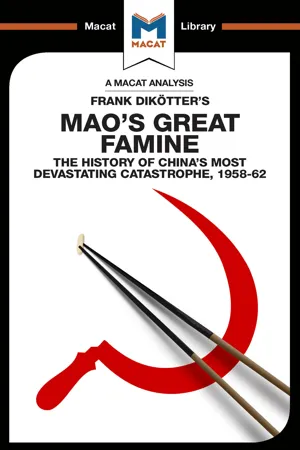
An Analysis of Frank Dikotter's Mao's Great Famine
eBook - ePub

An Analysis of Frank Dikotter's Mao's Great Famine

The History of China's Most Devestating Catastrophe 1958-62

  1. 96 pages
  2. English
  3. ePUB (mobile friendly)
  4. Available on iOS & Android
eBook - ePub

An Analysis of Frank Dikotter's Mao's Great Famine

The History of China's Most Devestating Catastrophe 1958-62

About this book

The power of Frank Dikötter's ground-breaking work on the disaster that followed China's attempted 'Great Leap Forward' lies not in the detail of his evidence (though that shows that Mao's fumbled attempt at rapid industrialization probably cost 45 million Chinese lives). It stems from the exceptional reasoning skills that allowed Dikötter to turn years of researching in obscure Chinese archives into a compelling narrative of disaster, and above all to link two subjects that had been treated as distinct by most of his predecessors: the extent of the crisis in the countryside, and the actions (hence the responsibility) of the senior Chinese leadership.

In Dikötter's view, ultimate responsibility for the catastrophe lies at the door of Mao Zedong himself; the Chairman conceived and ordered the policies that led to the famine, and he did nothing to reverse them or limit the damage that was being wrought when evidence for their disastrous impact reached him. Dikötter's ability to persuade his readers of the fundamental truth of these arguments – despite his admission that his access to sources was necessarily limited and incomplete – together with the clear structure of his presentation combine to produce a work that has had enormous influence on perceptions of Mao and of the Great Leap Forward itself.

Frequently asked questions

Yes, you can cancel anytime from the Subscription tab in your account settings on the Perlego website. Your subscription will stay active until the end of your current billing period. Learn how to cancel your subscription.
No, books cannot be downloaded as external files, such as PDFs, for use outside of Perlego. However, you can download books within the Perlego app for offline reading on mobile or tablet. Learn more here.
Perlego offers two plans: Essential and Complete
  • Essential is ideal for learners and professionals who enjoy exploring a wide range of subjects. Access the Essential Library with 800,000+ trusted titles and best-sellers across business, personal growth, and the humanities. Includes unlimited reading time and Standard Read Aloud voice.
  • Complete: Perfect for advanced learners and researchers needing full, unrestricted access. Unlock 1.4M+ books across hundreds of subjects, including academic and specialized titles. The Complete Plan also includes advanced features like Premium Read Aloud and Research Assistant.
Both plans are available with monthly, semester, or annual billing cycles.
We are an online textbook subscription service, where you can get access to an entire online library for less than the price of a single book per month. With over 1 million books across 1000+ topics, we’ve got you covered! Learn more here.
Look out for the read-aloud symbol on your next book to see if you can listen to it. The read-aloud tool reads text aloud for you, highlighting the text as it is being read. You can pause it, speed it up and slow it down. Learn more here.
Yes! You can use the Perlego app on both iOS or Android devices to read anytime, anywhere — even offline. Perfect for commutes or when you’re on the go.
Please note we cannot support devices running on iOS 13 and Android 7 or earlier. Learn more about using the app.
Yes, you can access An Analysis of Frank Dikotter's Mao's Great Famine by John Wagner Givens in PDF and/or ePUB format, as well as other popular books in History & World History. We have over one million books available in our catalogue for you to explore.

Information

Publisher
Macat Library
Year
2017
Print ISBN
9781912302505
eBook ISBN
9781351352451
Edition
1
Topic
History
Index
History

Table of contents

  1. Cover Page
  2. Title Page
  3. Copyright
  4. Contents
  5. WAYS IN TO THE TEXT
  6. SECTION 1: INFLUENCES
  7. SECTION 2: IDEAS
  8. SECTION 3: IMPACT
  9. Glossary of Terms
  10. People Mentioned in the Text
  11. Works Cited