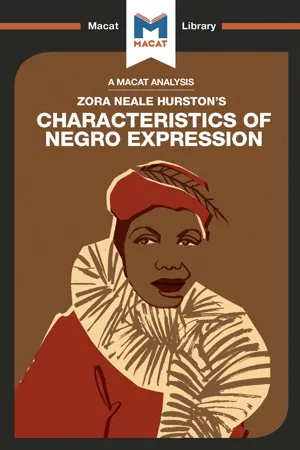
An Analysis of Zora Heale Hurston's Characteristics of Negro Expression
eBook - ePub

An Analysis of Zora Heale Hurston's Characteristics of Negro Expression

  1. 94 pages
  2. English
  3. ePUB (mobile friendly)
  4. Available on iOS & Android
eBook - ePub

An Analysis of Zora Heale Hurston's Characteristics of Negro Expression

About this book

A critical analysis of African-American novelist and anthropologist Zora Neale Hurston' 1934 essay Characteristics of Negro Expression: A crushing evaluation of the many racial prejudices of 1930s America, including a common presumption that African American art was unoriginal – merely poorly copying white culture.

Hurston's approach and premises may seem in many ways dated to modern readers, but the essay still shows an incisive mind carefully evaluating arguments and cutting them down to size. African-American art of the time did not – Hurston influentially argued – play by the same rules as white art, so it could not meaningfully be discussed by 'white' notions of aesthetic value.

Where white European tradition views art as something fixed, Hurston saw African-American art works as a distinctive form of mimicry, reshaping and altering the original object until it became something new and novel. In this way, she contended, African-American creative expression is a process that generates its own form of originality – turning borrowed material into something original and unique. By carefully evaluating the relevance of previous arguments, Hurston showed African American artistic expression in an entirely new light.

Frequently asked questions

Yes, you can cancel anytime from the Subscription tab in your account settings on the Perlego website. Your subscription will stay active until the end of your current billing period. Learn how to cancel your subscription.
At the moment all of our mobile-responsive ePub books are available to download via the app. Most of our PDFs are also available to download and we're working on making the final remaining ones downloadable now. Learn more here.
Perlego offers two plans: Essential and Complete
  • Essential is ideal for learners and professionals who enjoy exploring a wide range of subjects. Access the Essential Library with 800,000+ trusted titles and best-sellers across business, personal growth, and the humanities. Includes unlimited reading time and Standard Read Aloud voice.
  • Complete: Perfect for advanced learners and researchers needing full, unrestricted access. Unlock 1.4M+ books across hundreds of subjects, including academic and specialized titles. The Complete Plan also includes advanced features like Premium Read Aloud and Research Assistant.
Both plans are available with monthly, semester, or annual billing cycles.
We are an online textbook subscription service, where you can get access to an entire online library for less than the price of a single book per month. With over 1 million books across 1000+ topics, we’ve got you covered! Learn more here.
Look out for the read-aloud symbol on your next book to see if you can listen to it. The read-aloud tool reads text aloud for you, highlighting the text as it is being read. You can pause it, speed it up and slow it down. Learn more here.
Yes! You can use the Perlego app on both iOS or Android devices to read anytime, anywhere — even offline. Perfect for commutes or when you’re on the go.
Please note we cannot support devices running on iOS 13 and Android 7 or earlier. Learn more about using the app.
Yes, you can access An Analysis of Zora Heale Hurston's Characteristics of Negro Expression by Mercedes Aguirre,Benjamin Lempert in PDF and/or ePUB format, as well as other popular books in Literature & Literary Criticism. We have over one million books available in our catalogue for you to explore.

Information

Publisher
Macat Library
Year
2017
eBook ISBN
9781351352062
Edition
1

Table of contents

  1. Cover Page
  2. Title Page
  3. Copyright
  4. Contents
  5. WAYS IN TO THE TEXT
  6. SECTION 1: INFLUENCES
  7. SECTION 2: IDEAS
  8. SECTION 3: IMPACT
  9. Glossary of Terms
  10. People Mentioned in the Text
  11. Works Cited