Despite having no formal training in urban planning, Jane Jacobs deftly explores the strengths and weaknesses of policy arguments put forward by American urban planners in the era after World War II. They believed that the efficient movement of cars was of more value in the development of US cities than the everyday lives of the people living there. By carefully examining their relevance in her 1961 book, The Death and Life of Great American Cities, Jacobs dismantles these arguments by highlighting their shortsightedness. She evaluates the information to hand and comes to a very different conclusion, that urban planners ruin great cities, because they don't understand that it is a city's social interaction that makes it great. Proposals and policies that are drawn from planning theory do not consider the social dynamics of city life. They are in thrall to futuristic fantasies of a modern way of living that bears no relation to reality, or to the desires of real people living in real spaces. Professionals lobby for separation and standardization, splitting commercial, residential, industrial, and cultural spaces. But a truly visionary approach to urban planning should incorporate spaces with mixed uses, together with short, walkable blocks, large concentrations of people, and a mix of new and old buildings. This creates true urban vitality.
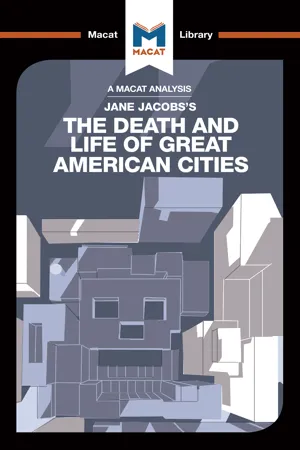
eBook - ePub
An Analysis of Jane Jacobs's The Death and Life of Great American Cities
- 98 pages
- English
- ePUB (mobile friendly)
- Available on iOS & Android
eBook - ePub
An Analysis of Jane Jacobs's The Death and Life of Great American Cities
About this book
Information
Table of contents
- Cover Page
- Title Page
- Copyright
- Contents
- Ways in to the Text
- Section 1: Influences
- Section 2: Ideas
- Section 3: Impact
- Glossary of Terms
- People Mentioned in the Text
- Works Cited
Trusted by 375,005 students
Access to over 1.5 million titles for a fair monthly price.
Study more efficiently using our study tools.
Frequently asked questions
Yes, you can cancel anytime from the Subscription tab in your account settings on the Perlego website. Your subscription will stay active until the end of your current billing period. Learn how to cancel your subscription
No, books cannot be downloaded as external files, such as PDFs, for use outside of Perlego. However, you can download books within the Perlego app for offline reading on mobile or tablet. Learn how to download books offline
Perlego offers two plans: Essential and Complete
- Essential is ideal for learners and professionals who enjoy exploring a wide range of subjects. Access the Essential Library with 800,000+ trusted titles and best-sellers across business, personal growth, and the humanities. Includes unlimited reading time and Standard Read Aloud voice.
- Complete: Perfect for advanced learners and researchers needing full, unrestricted access. Unlock 1.5M+ books across hundreds of subjects, including academic and specialized titles. The Complete Plan also includes advanced features like Premium Read Aloud and Research Assistant.
We are an online textbook subscription service, where you can get access to an entire online library for less than the price of a single book per month. With over 1.5 million books across 990+ topics, we’ve got you covered! Learn about our mission
Look out for the read-aloud symbol on your next book to see if you can listen to it. The read-aloud tool reads text aloud for you, highlighting the text as it is being read. You can pause it, speed it up and slow it down. Learn more about Read Aloud
Yes! You can use the Perlego app on both iOS and Android devices to read anytime, anywhere — even offline. Perfect for commutes or when you’re on the go.
Please note we cannot support devices running on iOS 13 and Android 7 or earlier. Learn more about using the app
Please note we cannot support devices running on iOS 13 and Android 7 or earlier. Learn more about using the app
Yes, you can access An Analysis of Jane Jacobs's The Death and Life of Great American Cities by Martin Fuller,Ryan Moore in PDF and/or ePUB format, as well as other popular books in History & Literary Criticism. We have over 1.5 million books available in our catalogue for you to explore.