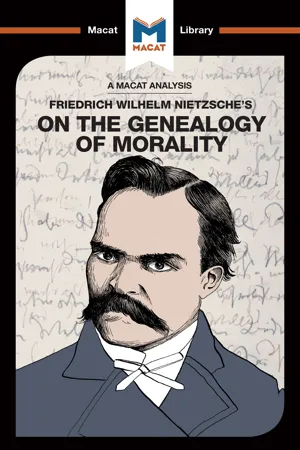
An Analysis of Friedrich Nietzsche's On the Genealogy of Morality
eBook - ePub

An Analysis of Friedrich Nietzsche's On the Genealogy of Morality

  1. 98 pages
  2. English
  3. ePUB (mobile friendly)
  4. Available on iOS & Android
eBook - ePub

An Analysis of Friedrich Nietzsche's On the Genealogy of Morality

About this book

Friedrich Nietzsche's On the Genealogy of Morality is a sustained feat of incisive interpretation. Well known as one of Nietzsche's greatest works, and as one of the most important books of nineteenth-century philosophy, On the Genealogy of Morality also provided the inspiration for the methodologies of several key philosophers of the modern age. Michel Foucault and Judith Butler, among others, cite Nietzsche as an influence specifically because of the interpretative techniques laid out in this work – techniques which are a model for the ways in which interpretation can be used to power critical thinking of the highest order.

The key aspects of interpretation are understanding, clarifying, and questioning definitions; what Nietzsche brings to the process is a sense of how important context, history and culture are to understanding any term. In the case of morals, for instance, he argues that if we are to truly understand what we mean by "good" or "evil, " we cannot ever assume the two concepts have a stable meaning, outside of a given moment in history. Indeed, to understand what they mean now, and might mean in the future, we need to trace the genealogy of concepts back to their very roots – a feat of interpretation that Nietzsche undertakes masterfully.

Frequently asked questions

Yes, you can cancel anytime from the Subscription tab in your account settings on the Perlego website. Your subscription will stay active until the end of your current billing period. Learn how to cancel your subscription.
No, books cannot be downloaded as external files, such as PDFs, for use outside of Perlego. However, you can download books within the Perlego app for offline reading on mobile or tablet. Learn more here.
Perlego offers two plans: Essential and Complete
  • Essential is ideal for learners and professionals who enjoy exploring a wide range of subjects. Access the Essential Library with 800,000+ trusted titles and best-sellers across business, personal growth, and the humanities. Includes unlimited reading time and Standard Read Aloud voice.
  • Complete: Perfect for advanced learners and researchers needing full, unrestricted access. Unlock 1.4M+ books across hundreds of subjects, including academic and specialized titles. The Complete Plan also includes advanced features like Premium Read Aloud and Research Assistant.
Both plans are available with monthly, semester, or annual billing cycles.
We are an online textbook subscription service, where you can get access to an entire online library for less than the price of a single book per month. With over 1 million books across 1000+ topics, we’ve got you covered! Learn more here.
Look out for the read-aloud symbol on your next book to see if you can listen to it. The read-aloud tool reads text aloud for you, highlighting the text as it is being read. You can pause it, speed it up and slow it down. Learn more here.
Yes! You can use the Perlego app on both iOS or Android devices to read anytime, anywhere — even offline. Perfect for commutes or when you’re on the go.
Please note we cannot support devices running on iOS 13 and Android 7 or earlier. Learn more about using the app.
Yes, you can access An Analysis of Friedrich Nietzsche's On the Genealogy of Morality by Don Berry in PDF and/or ePUB format, as well as other popular books in Literature & Philosophy History & Theory. We have over one million books available in our catalogue for you to explore.

Information

Table of contents

  1. Cover Page
  2. Title Page
  3. Copyright Page
  4. Contents
  5. The Macat Library
  6. Critical Thinking and on the Genealogy of Morality
  7. About the Author of the Original Work
  8. Ways in to the Text
  9. Section 1 Influences
  10. Section 2: Ideas
  11. Section 3: Impact
  12. Glossary of Terms
  13. People Mentioned in the Text
  14. Works Cited