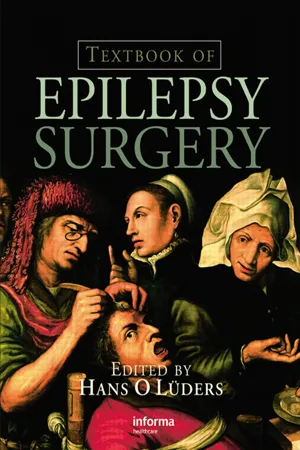
Textbook of Epilepsy Surgery covers all of the latest advances in the surgical management of epilepsy. The book provides a thorough understanding of epileptogenic mechanisms in etiologically different types of epilepsy and explains neuronavigation systems. It discusses new neuroimaging techniques, new surgical strategies, and more aggressive surgic
- 1,624 pages
- English
- PDF
- Available on iOS & Android
eBook - PDF
Textbook of Epilepsy Surgery
About this book
Information
Table of contents
- Front Cover
- Title Page
- Contents
- Preface
- Color Inserts
- Chapter 1- Epilepsy surgery in Europe before the 19th century
- Chapter 2- Epilepsy surgery in Asia before the 19th century
- Chapter 3- Epilepsy surgery in Latin America before the 19th century
- Chapter 4a- The history of epilepsy surgery in the United Kingdom
- Chapter 4b- Epilepsy surgery in Ireland
- Chapter 5- Epilepsy surgery in Germany
- Chapter 6- Epilepsy surgery in France
- Chapter 7- Epilepsy surgery in Italy
- Chapter 8a- Epilepsy surgery in Switzerland
- Chapter 8b- Epilepsy surgery in Austria
- Chapter 9- Epilepsy surgery in the Nordic countries
- Chapter 10- The development of epilepsy surgery in the Netherlands and Belgium
- Chapter 11- History of epilepsy surgery in the Middle- and East-European countries and Russia
- Chapter 12- Epilepsy surgery in Canada
- Chapter 13- A brief history of epilepsy surgery in the United States
- Chapter 14- Epilepsy surgery in Latin America
- Chapter 15- Epilepsy surgery in Africa
- Chapter 16a- History of epilepsy surgery in Southeast Asia
- Chapter 16b- Epilepsy surgery in India
- Chapter 17- Treatment of epilepsy in Australia
- Chapter 18- Epilepsy surgery in Korea
- Chapter19- Epilepsy surgery in Thailand
- Chapter 20- History of epilepsy and seizure classification
- Chapter 21- History of electroencephalography as a pre-surgical evaluation tool: the pre-Berger years
- Chapter 22- History of neuroimaging in the pre-surgical evaluation
- Chapter 23- Epilepsy surgery in literature and film
- Chapter 24- The future of epilepsy surgery
- Chapter 25- Medical intractability in epilepsy
- Chapter 26- Epidemiology of the intractable generalized epilepsies
- Chapter 27- Genetic factors contributing to medically intractable epilepsy
- Chapter 28- Informed consent
- Chapter 29- Epilepsy surgery: access, costs, and quality of life
- Chapter 30- Epilepsy surgery: patient selection
- Chapter 31- Exclusion criteria
- Chapter 32- Classification of epileptic seizures and epilepsies
- Chapter 33- Mesial temporal sclerosis
- Chapter 34- Neocortical temporal lobe epilepsy
- Chapter 35- Premotor and central lobe epilepsy
- Chapter 36- Mesial frontal epilepsy
- Chapter 37- Basal frontal lobe epilepsy
- Chapter 38- Parieto-occipital lobe epilepsy
- Chapter 39- Insular epilepsy
- Chapter 40- Cingulate epilepsy
- Chapter 41- Hypothalamic hamartomas
- Chapter 42- Rasmussen syndrome
- Chapter 43- The Landau–Kleffner syndrome
- Chapter 44- The Lennox–Gastaut syndrome: a surgically remediable epilepsy?
- Chapter 45- Medically intractable epilepsies not remediable by surgery
- Chapter 46- Special characteristics of surgically remediable epilepsies in infants
- Chapter 47- General principles of presurgical evaluation
- Chapter 48- The symptomatogenic zone – general principles
- Chapter 49- Auras: localizing and lateralizing value
- Chapter 50- Autonomic seizures: localizing and lateralizing value
- Chapter 51- Simple motor seizures: localizing and lateralizing value
- Chapter 52- Complex motor seizures: localizing and lateralizing value
- Chapter 53- Dialeptic seizures: localizing and lateralizing value
- Chapter 54a- Special seizures: localizing and lateralizing value
- Chapter 54b- Secondary generalized tonic-clonic seizures
- Chapter 55- The irritative zone: general principles
- Chapter 56- Noninvasive electroencephalography evaluation of the irritative zone
- Chapter 57- The irritative zone evaluated with invasive recordings
- Chapter 58- The significance of interictal fast ripples in the evaluation of the epileptogenic zone
- Chapter 59- Magnetoencephalography in the evaluation of the irritative zone
- Chapter 60- Magnetic resonance imaging in the evaluation of the irritative zone
- Chapter 61- Digital tools for reviewing the electroencephalogram: montage reformatting and filtering
- Chapter 62- Average reference and Laplacian montages
- Chapter 63- Automatic detection of epileptic spikes
- Chapter 64- Source localization of electroencephalography spikes
- Chapter 65- Antiepileptic drug withdrawal in presurgical evaluation: advantages, disadvantages, and guidelines
- Chapter 66- Effects of sleep and sleep deprivationon seizures and the electroencephalography in epilepsy
- Chapter 67- The ictal onset zone: general principles, pitfalls and caveats
- Chapter 68- Noninvasive electroencephalography in the evaluation of the ictal onset zone
- Chapter 69- Indications for invasive electroencephalography evaluations
- Chapter 70- Invasive electrodes in long-term monitoring
- Chapter 71- Foramen ovale and epidural electrodesin the definition of the seizure onset zone
- Chapter 72- Subdural electrodes
- Chapter 73- Stereoelectroencephalography
- Chapter 74- DC recordings to localize the ictal onset zone
- Chapter 75- fMRI in the evaluation of the ictal onset zone
- Chapter 76- Ictal SPECT in the definition of the seizure onset zone
- Chapter 77- Automatic detection of epileptic seizures
- Chapter 78- ‘Preictal’ predictors of epileptic seizures
- Chapter 79- Effect of anticonvulsant withdrawal on seizure semiology and ictal electroencephalography
- Chapter 80- Zone of electrical stimulation induced seizures in subdural electrodes
- Chapter 81- The epileptogenic lesion: general principles
- Chapter 82- Magentic resonance imaging in epilepsy: mesial temporal sclerosis
- Chapter 83- Magnetic resonance imaging in neurocutaneous syndromes
- Chapter 84- Magnetic resonance imaging in epileptogenic neoplasms
- Chapter 85- Magnetic resonance spectroscopy in patients with epilepsy
- Chapter 86a- Post-processing of the magnetic resonance imaging to better define structural abnormalities
- Chapter 86b- Multimodal image processing in pre-surgical planning
- Chapter 87- The functional deficit zone: general principles
- Chapter 88- Mesial temporal lobe epilepsy and positron emission tomography
- Chapter 89- PET in neocortical epilepsies
- Chapter 90- Pre-surgical neuropsychological workup: risk factors for post-surgical deficits
- Chapter 91- Pre-surgical psychiatric evaluations: risk factors for post-surgical deficits
- Chapter 92- Pre-surgical neuropsychological workup in children and intellectually disabled adults with epilepsy
- Chapter 93- Wada test and epileptogenic zone
- Chapter 94- Event-related potentials in patients with epilepsy
- Chapter 95- Eloquent cortex and tracts: overview and noninvasive evaluation methods
- Chapter 96- Noninvasive tests to definelateralization or localization of the motor area
- Chapter 97- Noninvasive tests to definelateralization or localization of memory
- Chapter 98- The epileptogenic zone: general principles
- Chapter 99- Future methods for the direct assessment of the epileptogenic zone
- Chapter 100- The patient management conference
- Chapter 101- Anesthesia for epilepsy surgery
- Chapter 102- Placement of subdural grids
- Chapter 103- Placement of depth electrodes
- Chapter 104- Stereoelectroencephalography
- Chapter 105- General principles of cortical mapping by electrical stimulation
- Chapter 106- Cortical mapping by electrical stimulation of subdural electrodes: primary somatosensory and motor areas
- Chapter 107- Cortical mapping by electrical stimulation of subdural electrodes: negative motor areas
- Chapter 108- Cortical mapping by electrical stimulation of subdural electrodes: supplementary sensorimotor area in humans
- Chapter 109- Cortical mapping by electrical stimulation of subdural electrodes: language areas
- Chapter 110- Cortical mapping by electrical stimulation: other eloquent areas
- Chapter 111- The role of electroencephalogram and magnetoencephalography synchrony in defining eloquent cortex
- Chapter 112- Cortical mapping using evoked potentials and Bereitschaftspotentials
- Chapter 113a- Cortico-cortical evoked potentials to define eloquent cortex
- Chapter 113b- Cortical mapping by intra-operative optical imaging
- Chapter 114- Functional localization of the cortex with depth electrodes
- Chapter 115- Intraoperative cortical mapping and intraoperative electrocorticography
- Chapter 116- Resective surgical techniques: mesial temporal lobe epilepsy
- Chapter 117- Resective neocortical techniques in adults
- Chapter 118- Epilepsy and vascular malformations: spectrum of lesions and strategies for management
- Chapter 119- Resective neocortical techniques in children
- Chapter 120- Hemispherectomy techniques
- Chapter 121- Experimental multiple subpial transection: is it still indicated?
- Chapter 122a- Multiple subpial transections
- Chapter 122b- Nonresective surgical procedures and electricalor magnetic stimulation for epilepsy treatment mutiple hippocampal transection
- Chapter 122c- Surgical disconnections of the epileptic zone as an alternative to lobectomy in pharmacoresistent epilepsy
- Chapter 123- Corpus callosotomy
- Chapter 124- Radiosurgical treatment of epilepsy
- Chapter 125- Vagal nerve stimulation: experimental data
- Chapter 126- Vagal nerve stimulation: surgical technique and complications
- Chapter 127- Vagus nerve stimulation: human studies
- Chapter 128- Experimental evidence for the involvement of the basal ganglia in the control of epilepsy
- Chapter 129- Repetitive transcranial magnetic stimulation
- Chapter 130- Mesial temporal lobectomy: post-surgical seizure frequency
- Chapter 131- Resective surgery in children
- Chapter 132- Hemispherectomy: post-surgical seizure frequency
- Chapter 133a- Psychiatric outcome of epilepsy surgery
- Chapter 133b- Sudden unexpected death in epileptic patients after epilepsy surgery
- Chapter 134- Psychosocial outcome and quality of life outcome
- Chapter 135- Neuropsychological outcome
- Chapter 136- Temporal lobe epilepsy surgery: surgical complications
- Chapter 137- Neocortical focal epilepsy surgery: surgical complications
- Chapter 138- Early post-surgical management of patients with epilepsy
- Chapter 139- Post-surgical pharmacotherapy: discontinuation of anticonvulsants
- Chapter 140- Post-surgical rehabilitation
- Chapter 141- Neuropathology of mesial temporal sclerosis
- Chapter 142- Pathology of neocortical epilepsy
- Chapter 143- Pathology of malformations of cortical development
- Chapter 144- Pathology of neurocutaneous abnormalities, vascular abnormalities: post-infectious and post-traumatic pathologies associated with epilepsy
- Chapter 145- Pathology of epileptogenic neoplasms
- Chapter 146- In vitro neurophysiological studies
- Chapter 147- In vitro cytochemical studies in epilepsy
- Chapter 148- Animal models of epilepsy with special reference to models relevant for transitional research
- Chapter 149- Surgical failures: pre-surgical evaluation
- Chapter 150- Reoperation after failed epilepsy surgery
- Chapter 151- Lesional mesial temporal epilepsy case discussions
- Chapteer 152- A patient with nonlesional mesial temporal lobe epilepsy
- Chapter 153- Patient with bitemporal lobe epilepsy
- Chapter 154- Patient with lesional neocortical focal epilepsy
- Chapter 155- Patient with nonlesional neocortical epilepsy
- Chapter 156- Patient with extensive malformation of cortical development
- Chapter 157- Hemispherectomy in a patient with catastrophic epilepsy
- Chapter 158- Case studies: Landau–Kleffner syndrome
- Chapter 159- Deep brain stimulation in a patient with medically intractable generalized seizures
- Chapter 160- Successful transcranial magnetic stimulation in a patient with medically intractable focal epilepsy
- Chapter 161- Surgery in a patient with medically intractable gelastic seizures and a hypothalamic hamartoma
- Chapter 162- Surgery in a patient with focal epilepsy and dual pathology
- Chapter 163- Essentials for the establishment of an epilepsy surgery program
- Chapter 164- Classification of seizure outcome following epilepsy surgery
- Chapter 165- Protocol for storage and processing of brain tissue for molecular studies
- Index
- Back Cover
Trusted by 375,005 students
Access to over 1.5 million titles for a fair monthly price.
Study more efficiently using our study tools.
Frequently asked questions
Yes, you can cancel anytime from the Subscription tab in your account settings on the Perlego website. Your subscription will stay active until the end of your current billing period. Learn how to cancel your subscription
No, books cannot be downloaded as external files, such as PDFs, for use outside of Perlego. However, you can download books within the Perlego app for offline reading on mobile or tablet. Learn how to download books offline
Perlego offers two plans: Essential and Complete
- Essential is ideal for learners and professionals who enjoy exploring a wide range of subjects. Access the Essential Library with 800,000+ trusted titles and best-sellers across business, personal growth, and the humanities. Includes unlimited reading time and Standard Read Aloud voice.
- Complete: Perfect for advanced learners and researchers needing full, unrestricted access. Unlock 1.5M+ books across hundreds of subjects, including academic and specialized titles. The Complete Plan also includes advanced features like Premium Read Aloud and Research Assistant.
We are an online textbook subscription service, where you can get access to an entire online library for less than the price of a single book per month. With over 1.5 million books across 990+ topics, we’ve got you covered! Learn about our mission
Look out for the read-aloud symbol on your next book to see if you can listen to it. The read-aloud tool reads text aloud for you, highlighting the text as it is being read. You can pause it, speed it up and slow it down. Learn more about Read Aloud
Yes! You can use the Perlego app on both iOS and Android devices to read anytime, anywhere — even offline. Perfect for commutes or when you’re on the go.
Please note we cannot support devices running on iOS 13 and Android 7 or earlier. Learn more about using the app
Please note we cannot support devices running on iOS 13 and Android 7 or earlier. Learn more about using the app
Yes, you can access Textbook of Epilepsy Surgery by Hans O. Luders in PDF and/or ePUB format, as well as other popular books in Medicine & Medical Theory, Practice & Reference. We have over 1.5 million books available in our catalogue for you to explore.