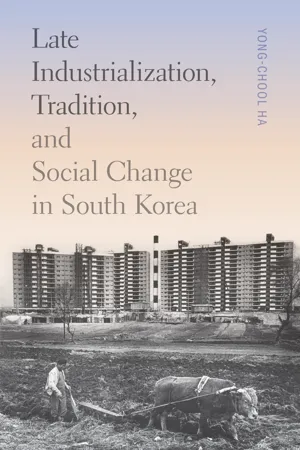
Late Industrialization, Tradition, and Social Change in South Korea
- 336 pages
- English
- ePUB (mobile friendly)
- Available on iOS & Android
Late Industrialization, Tradition, and Social Change in South Korea
About this book
Examines how primary social ties fueled economic growth South Korea's rapid industrialization occurred with the rise of powerful chaeb?l (family-owned business conglomerates) that controlled vast swaths of the nation's economy. Leader Park Chung Hee's sense of backwardness and urgency led him to rely on familial, school, and regional ties to expedite the economic transformation. Late Industrialization, Tradition, and Social Change in South Korea elucidates how a country can progress economically while relying on traditional social structures that usually fragment political and economic vitality. The book proposes a new framework for macro social change under late industrialization by analyzing the specific process of interactions between economic tasks and tradition through the state's mediation. Drawing on interviews with bureaucrats in the Ministry of Commerce and Industry as well as workers and others, Yong-Chool Ha demonstrates how the state propelled industrialization by using kinship networks to channel investments and capital into chaeb?l corporations. What Ha calls "neofamilism" was the central force behind South Korea's economic transformation as the state used preindustrial social patterns to facilitate industrialization. Ha's account of bureaucracy, democratization, and the middle class challenges assumptions about the universal outcomes of industrialization. Late Industrialization, Tradition, and Social Change in South Korea is also available in an open access edition, DOI 10.6069/9780295753249
Frequently asked questions
- Essential is ideal for learners and professionals who enjoy exploring a wide range of subjects. Access the Essential Library with 800,000+ trusted titles and best-sellers across business, personal growth, and the humanities. Includes unlimited reading time and Standard Read Aloud voice.
- Complete: Perfect for advanced learners and researchers needing full, unrestricted access. Unlock 1.4M+ books across hundreds of subjects, including academic and specialized titles. The Complete Plan also includes advanced features like Premium Read Aloud and Research Assistant.
Please note we cannot support devices running on iOS 13 and Android 7 or earlier. Learn more about using the app.
Information
Table of contents
- Cover
- Series Page
- Title Page
- Copyright
- Dedication
- Contents
- Preface and Acknowledgments
- Introduction
- 1. The Sociology of Late Industrialization
- 2. The Colonial Origins of Neofamilism
- 3. The State and Tradition
- 4. Hollowing Out Bureaucracy
- 5. Civil Society and Democratization
- 6. Daily Practice of Neofamilism
- 7. The 1997 Financial Crisis
- Conclusion
- Notes
- Bibliography
- Index