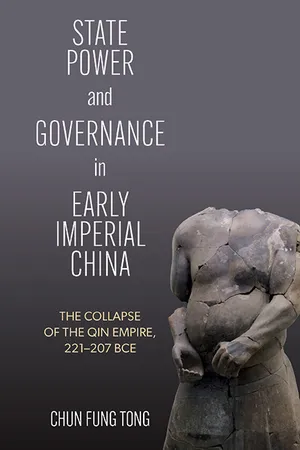
State Power and Governance in Early Imperial China
eBook - ePub

State Power and Governance in Early Imperial China

The Collapse of the Qin Empire, 221–207 BCE

  1. 208 pages
  2. English
  3. ePUB (mobile friendly)
  4. Available on iOS & Android
eBook - ePub

State Power and Governance in Early Imperial China

The Collapse of the Qin Empire, 221–207 BCE

About this book

Offers a new perspective on the first dynasty of imperial China and the reasons for its collapse.

State Power and Governance in Early Imperial China delves into the governance and capacity of the state by providing an empirical historical study of the collapse of China's Qin Empire. In contrast to the popular view that the Qin fell suddenly and dramatically, this book argues that the collapse was rooted in persistent structural problems of the empire, including the serious resource shortages experienced by local governments, inefficient communication between administrative units, and social tensions in the new territories. Rather than reducing Qin rulers to heartless villains who refused to adjust their policies and statecraft, this book focuses on the changes that the regime did make to meet these challenges. It reveals the various measures that Qin rulers devised to solve these problems, even if they were ultimately to no avail. The paradox of the Qin Empire seemed to be that, although the regime's policies and reforms could theoretically have strengthened the state's power and improved the governance of the empire, their ramifications simultaneously exacerbated the misfunction of local governments and triggered the military failures that eventually destroyed the empire.

Frequently asked questions

Yes, you can cancel anytime from the Subscription tab in your account settings on the Perlego website. Your subscription will stay active until the end of your current billing period. Learn how to cancel your subscription.
No, books cannot be downloaded as external files, such as PDFs, for use outside of Perlego. However, you can download books within the Perlego app for offline reading on mobile or tablet. Learn more here.
Perlego offers two plans: Essential and Complete
  • Essential is ideal for learners and professionals who enjoy exploring a wide range of subjects. Access the Essential Library with 800,000+ trusted titles and best-sellers across business, personal growth, and the humanities. Includes unlimited reading time and Standard Read Aloud voice.
  • Complete: Perfect for advanced learners and researchers needing full, unrestricted access. Unlock 1.4M+ books across hundreds of subjects, including academic and specialized titles. The Complete Plan also includes advanced features like Premium Read Aloud and Research Assistant.
Both plans are available with monthly, semester, or annual billing cycles.
We are an online textbook subscription service, where you can get access to an entire online library for less than the price of a single book per month. With over 1 million books across 1000+ topics, we’ve got you covered! Learn more here.
Look out for the read-aloud symbol on your next book to see if you can listen to it. The read-aloud tool reads text aloud for you, highlighting the text as it is being read. You can pause it, speed it up and slow it down. Learn more here.
Yes! You can use the Perlego app on both iOS or Android devices to read anytime, anywhere — even offline. Perfect for commutes or when you’re on the go.
Please note we cannot support devices running on iOS 13 and Android 7 or earlier. Learn more about using the app.
Yes, you can access State Power and Governance in Early Imperial China by Chun Fung Tong in PDF and/or ePUB format, as well as other popular books in History & Ancient History. We have over one million books available in our catalogue for you to explore.

Information

Table of contents

  1. Cover
  2. Title
  3. Copyright
  4. Contents
  5. List of Illustrations
  6. Acknowledgments
  7. Conventions
  8. Introduction
  9. Chapter 1 Toward a Theory of the Qin Collapse
  10. Chapter 2 State Ideology and Social Tensions in the Qin Empire
  11. Chapter 3 Territorial Expansion and Personnel Shortages in Local Governments
  12. Chapter 4 Inefficient Logistics of State Power and Communication Gaps in the New Territories
  13. Conclusion Gaps in State Power: The Structural Problem and the Fall of the Qin Empire
  14. Notes
  15. Bibliography
  16. Index
  17. Back Cover