When women have full socioeconomic citizenship as well as equitable and respectful partnerships with men, transformative justice can be sustained in postconflict societies
In Women's Work, Jennifer Moore presents a reimagined theory of peacebuilding and transformative justice based on the experiences and insights of women farmers and microentrepreneurs who lived through protracted civil conflicts, drawing on seven years of interviews with women activists across ten communities—five in the Acholi region of Northern Uganda and five in the Moyamba and Koinadugu Districts of Sierra Leone. Despite the important differences between the preconflict and conflict histories and demographics of the two countries, Moore finds commonalities in the practical, yet visionary, approaches to community life emerging from the core values, daily activities, and long-range goals shared by rural cooperative members in both regions.
Collective survival, communal healing, and conflict resolution define the rhythm of these women's daily lives as they go about building peace, piecemeal. They reject punitive retribution models and demand, instead, a peacebuilding model that advocates for advances in material well-being, the acknowledgment of state accountability for community suffering, and reconciliation and restoration of community networks. But most important, Moore amplifies these women's voices when they insist that legal equality for women and healthy partnerships between women and men are also essential components to enduring transformation of their societies.
Moore theorizes what peacebuilding look like if it were modeled on these women-led, matriarchically structured communities that proved not only to be effective at holding governments accountable but also to have the capacity to feed their people and revitalize their local economies. Women's Work shows that when women have full socioeconomic citizenship as well as equitable and respectful partnerships with men, transformative justice can be sustained through the arts of collective livelihood, violence-free conflict management, and celebration.
eBook - ePub
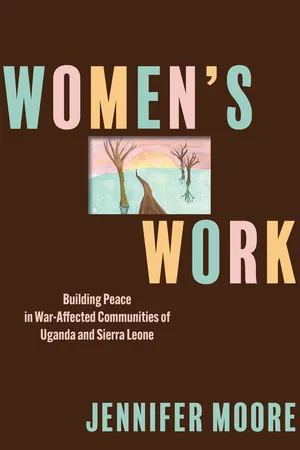
Women’s Work
Building Peace in War-Affected Communities of Uganda and Sierra Leone
- 352 pages
- English
- ePUB (mobile friendly)
- Available on iOS & Android
eBook - ePub
About this book
Information
Print ISBN
9781512827262
Subtopic
Peace & Global DevelopmentTable of contents
- Cover
- Series Page
- Title Page
- Copyright
- Dedication
- Contents
- Preface
- List of Abbreviations
- Introduction. Rural Women’s Perspectives on the Practice of Peace and the Meanings of Justice
- 1. Feminism, Human Rights, and Transformative Justice: From Patriarchy to Partnership, from Rights to Reparation
- 2. Historical Pathways: The Roots of Conflict and Peacebuilding in Uganda and Sierra Leone
- 3. Peace in the Home, Peace in the Nation: Conceptions of Justice Within Women’s Collectives in Northern Uganda
- 4. Women in Power with Men’s Support: Social Transformation Among the Peace Mothers of Sierra Leone
- Conclusion. Rural Women Peacebuilders: A Quiet Storm of Social Transformation
- Appendix 1. Women Peacebuilders’ Questionnaire
- Appendix 2. Talking with Members of Gwoko Ter Kwaro in Kitgum District, Northern Uganda
- Notes
- Index
- Acknowledgments
Trusted by 375,005 students
Access to over 1.5 million titles for a fair monthly price.
Study more efficiently using our study tools.
Frequently asked questions
Yes, you can cancel anytime from the Subscription tab in your account settings on the Perlego website. Your subscription will stay active until the end of your current billing period. Learn how to cancel your subscription
No, books cannot be downloaded as external files, such as PDFs, for use outside of Perlego. However, you can download books within the Perlego app for offline reading on mobile or tablet. Learn how to download books offline
Perlego offers two plans: Essential and Complete
- Essential is ideal for learners and professionals who enjoy exploring a wide range of subjects. Access the Essential Library with 800,000+ trusted titles and best-sellers across business, personal growth, and the humanities. Includes unlimited reading time and Standard Read Aloud voice.
- Complete: Perfect for advanced learners and researchers needing full, unrestricted access. Unlock 1.5M+ books across hundreds of subjects, including academic and specialized titles. The Complete Plan also includes advanced features like Premium Read Aloud and Research Assistant.
We are an online textbook subscription service, where you can get access to an entire online library for less than the price of a single book per month. With over 1.5 million books across 990+ topics, we’ve got you covered! Learn about our mission
Look out for the read-aloud symbol on your next book to see if you can listen to it. The read-aloud tool reads text aloud for you, highlighting the text as it is being read. You can pause it, speed it up and slow it down. Learn more about Read Aloud
Yes! You can use the Perlego app on both iOS and Android devices to read anytime, anywhere — even offline. Perfect for commutes or when you’re on the go.
Please note we cannot support devices running on iOS 13 and Android 7 or earlier. Learn more about using the app
Please note we cannot support devices running on iOS 13 and Android 7 or earlier. Learn more about using the app
Yes, you can access Women’s Work by Jennifer Moore in PDF and/or ePUB format. We have over 1.5 million books available in our catalogue for you to explore.