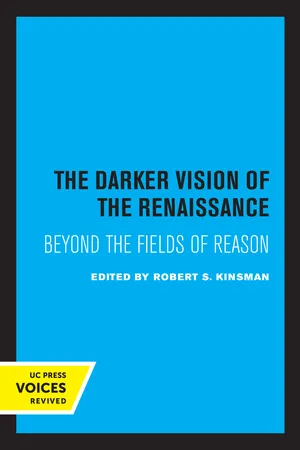
The Darker Vision of the Renaissance explores political, literary, social, religious, medical, and artistic events between 1300 and 1670 that led beyond the bounds of reason into the nonrational, irrational, and suprarational phenomena of the European Renaissance. Robert S. Kinsman's introduction examines Renaissance uses of ratio, "fancy" and "folly," melancholy, anxietas, and alienation. Lynn White Jr. presents the essential thesis of the collection in his view that the years 1300–1650 constituted one of the most psychically disturbed eras ever in European history. The "world-alienation" of the period is analyzed by Donald R. Howard, illustrated by two poems of the late fourteenth century: Gawain and the Green Knight and Toilus and Criseyde. The flourishing of hermetic, magical, cabalistic, and astrological practices in the Renaissance is described by John G. Burke. The gentleman and courtier's physical and psychological tensions resulting from literal exile or from psychic alienation from his lesser fellows are investigated by Lauro Martines. An analysis of the "structures" of Renaissance mysticism is provided by Kees W. Bolle. Gilbert Reaney's essay examines ratio as the basis for the "measured" music of the fourteenth century, against which the newer duple and triple rhythms that came into prominence in the later half of the century were assessed. An essay by Marc Bensimon concerns itself with Renaissance modes of perception—as illustrated in works of art, of literature, and of philosophic speculation—that seem shaped by primordial anxieties caused by the passing of time and the fear of death. The reflections of theological notions about the "dreadful hidden will of God" in such pieces as Marlowe's Dr. Faustus are given full background and perceptive treatment by Paul R. Sellin. Robert Kinsman concludes with his study "Folly, Melancholy, and Madness: Shifting Styles of Medical Analysis and Treatment, 1450–1675." This title is part of UC Press's Voices Revived program, which commemorates University of California Press's mission to seek out and cultivate the brightest minds and give them voice, reach, and impact. Drawing on a backlist dating to 1893, Voices Revived makes high-quality, peer-reviewed scholarship accessible once again using print-on-demand technology. This title was originally published in 1974.
Many titles in the Voices Revived program are also newly available as ebooks, offered at a discounted price to support wider access to scholarly work.
- 326 pages
- English
- ePUB (mobile friendly)
- Available on iOS & Android
eBook - ePub
About this book
Information
Publisher
University of California PressYear
1974Print ISBN
9780520304956
Edition
1eBook ISBN
9780520310032
Table of contents
- Cover
- Title
- Copyright
- CONTENTS
- INTRODUCTION
- I DEATH AND THE DEVIL
- II RENAISSANCE WORLD-ALIENATION
- III THE GENTLEMAN IN RENAISSANCE ITALY: STRAINS OF ISOLATION IN THE BODY POLITIC
- IV HERMETISM AS A RENAISSANCE WORLD VIEW
- V STRUCTURES OF RENAISSANCE MYSTICISM
- VI THE HIDDEN GOD: REFORMATION AWE IN RENAISSANCE ENGLISH LITERATURE
- VII THE IRRATIONAL AND LATE MEDIEVAL MUSIC
- VIII MODES OF PERCEPTION OF REALITY IN THE RENAISSANCE
- IX FOLLY, MELANCHOLY, AND MADNESS: A STUDY IN SHIFTING STYLES OF MEDICAL ANALYSIS AND TREATMENT, 1450-1675
Trusted by 375,005 students
Access to over 1.5 million titles for a fair monthly price.
Study more efficiently using our study tools.
Frequently asked questions
Yes, you can cancel anytime from the Subscription tab in your account settings on the Perlego website. Your subscription will stay active until the end of your current billing period. Learn how to cancel your subscription
No, books cannot be downloaded as external files, such as PDFs, for use outside of Perlego. However, you can download books within the Perlego app for offline reading on mobile or tablet. Learn how to download books offline
Perlego offers two plans: Essential and Complete
- Essential is ideal for learners and professionals who enjoy exploring a wide range of subjects. Access the Essential Library with 800,000+ trusted titles and best-sellers across business, personal growth, and the humanities. Includes unlimited reading time and Standard Read Aloud voice.
- Complete: Perfect for advanced learners and researchers needing full, unrestricted access. Unlock 1.5M+ books across hundreds of subjects, including academic and specialized titles. The Complete Plan also includes advanced features like Premium Read Aloud and Research Assistant.
We are an online textbook subscription service, where you can get access to an entire online library for less than the price of a single book per month. With over 1.5 million books across 990+ topics, we’ve got you covered! Learn about our mission
Look out for the read-aloud symbol on your next book to see if you can listen to it. The read-aloud tool reads text aloud for you, highlighting the text as it is being read. You can pause it, speed it up and slow it down. Learn more about Read Aloud
Yes! You can use the Perlego app on both iOS and Android devices to read anytime, anywhere — even offline. Perfect for commutes or when you’re on the go.
Please note we cannot support devices running on iOS 13 and Android 7 or earlier. Learn more about using the app
Please note we cannot support devices running on iOS 13 and Android 7 or earlier. Learn more about using the app
Yes, you can access The Darker Vision of the Renaissance by Robert S. Kinsman in PDF and/or ePUB format, as well as other popular books in Literature & Medieval & Early Modern Literary Criticism. We have over 1.5 million books available in our catalogue for you to explore.