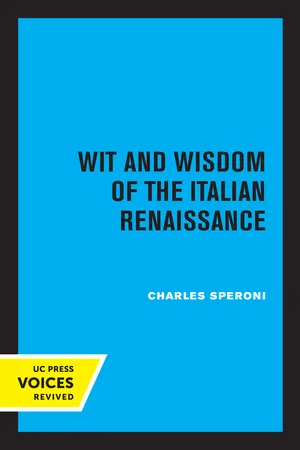
This is the first ample collection of facetiae, or witty tales, from the Italian Renaissance to be published in English. Witty and wise anecdotes had been known to the ancient Greeks and Romans in the form of apothegms, but not until the Renaissance did the true facetia acquire an independent life and popularity, and begin to spread rapidly throughout Italy and beyond the Alps. The publication of Poggio Bracciolini's Liberfacetiarum was largely responsible for this vogue: his collection met with tremendous success and resulted in the assembly of numerous other collection of facetiae. The facetia, which has some affinities with the longer, more carefully elaborated novella, is a brief narrative, varying in length from a few lines to two or three pages, whose main purpose it to entertain an excite laughter, and often concludes with a piece of pungent repartee. Both the facetia and the novella have often been censured for licentiousness, but most of them have a healthy moral, or at least a shrewd bit of psychology to impart. Above all, the facetia, like the novella, adds a new dimension to the overall, complex picture of the Renaissance. This title is part of UC Press's Voices Revived program, which commemorates University of California Press's mission to seek out and cultivate the brightest minds and give them voice, reach, and impact. Drawing on a backlist dating to 1893, Voices Revived makes high-quality, peer-reviewed scholarship accessible once again using print-on-demand technology. This title was originally published in 1964.
Many titles in the Voices Revived program are also newly available as ebooks, offered at a discounted price to support wider access to scholarly work.
- 328 pages
- English
- ePUB (mobile friendly)
- Available on iOS & Android
eBook - ePub
Wit and Wisdom of the Italian Renaissance
About this book
Information
Publisher
University of California PressYear
1964Print ISBN
9780520356849
Edition
1eBook ISBN
9780520310186
Table of contents
- Cover
- Title
- Copyright
- CONTENTS
- INTRODUCTION
- I. Poggio Bracciolini 1380-1459
- II. Ludovico Carbone 1435-1482
- III. Piovano Arlotto 1396-1484
- IV. Angelo Polivano 1454-1494
- V. Niccolò Angeli dal Bùcine
- VI. Giovanni fontano 1426-1503
- VII. Leonardo da Vinci
- VIII. Ludovico Domcnichi
- IX. Ludovico Guicciardini
- X. Two Wits:
- XI. Baldassare Castiglione 1478-1529
- Notes
- Bibliography
Trusted by 375,005 students
Access to over 1.5 million titles for a fair monthly price.
Study more efficiently using our study tools.
Frequently asked questions
Yes, you can cancel anytime from the Subscription tab in your account settings on the Perlego website. Your subscription will stay active until the end of your current billing period. Learn how to cancel your subscription
No, books cannot be downloaded as external files, such as PDFs, for use outside of Perlego. However, you can download books within the Perlego app for offline reading on mobile or tablet. Learn how to download books offline
Perlego offers two plans: Essential and Complete
- Essential is ideal for learners and professionals who enjoy exploring a wide range of subjects. Access the Essential Library with 800,000+ trusted titles and best-sellers across business, personal growth, and the humanities. Includes unlimited reading time and Standard Read Aloud voice.
- Complete: Perfect for advanced learners and researchers needing full, unrestricted access. Unlock 1.5M+ books across hundreds of subjects, including academic and specialized titles. The Complete Plan also includes advanced features like Premium Read Aloud and Research Assistant.
We are an online textbook subscription service, where you can get access to an entire online library for less than the price of a single book per month. With over 1.5 million books across 990+ topics, we’ve got you covered! Learn about our mission
Look out for the read-aloud symbol on your next book to see if you can listen to it. The read-aloud tool reads text aloud for you, highlighting the text as it is being read. You can pause it, speed it up and slow it down. Learn more about Read Aloud
Yes! You can use the Perlego app on both iOS and Android devices to read anytime, anywhere — even offline. Perfect for commutes or when you’re on the go.
Please note we cannot support devices running on iOS 13 and Android 7 or earlier. Learn more about using the app
Please note we cannot support devices running on iOS 13 and Android 7 or earlier. Learn more about using the app
Yes, you can access Wit and Wisdom of the Italian Renaissance by Charles Speroni in PDF and/or ePUB format, as well as other popular books in Literature & Medieval & Early Modern Literary Criticism. We have over 1.5 million books available in our catalogue for you to explore.