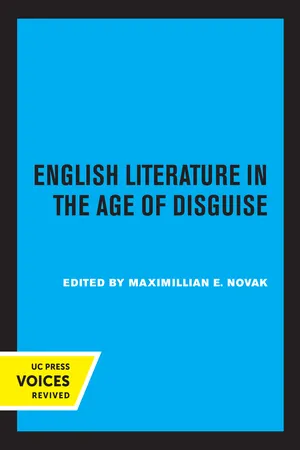
English Literature in the Age of Disguise explores the pervasive theme of disguise, deception, and masked identities in the works of writers from the Restoration through the eighteenth century. The concept of disguise was central to the social and literary fabric of the period, with figures like Fielding and Defoe lamenting the deception inherent in society. Fielding, for example, described the world as a vast masquerade, echoing a sentiment common among writers of the time, including Defoe, who critiqued the age as one of Plot and Deceit. Disguise and masks were more than just thematic elements; they were metaphors for the societal and personal facades that individuals maintained. In the literature of this period, comedies, such as Congreve's The Double Dealer, frequently centered around characters using masks and deceit for social or romantic advantage. Similarly, works like Defoe's Robinson Crusoe and Richardson's Clarissa employ different forms of disguise and role-playing, reflecting both the moral complexities and the personal struggles of characters. This book also delves into the role of irony and wit in literature during this time, with many authors using these tools to both entertain and critique society. Writers such as Pope and Swift masterfully employed irony to conceal their true messages, offering a layered critique of contemporary politics, religion, and morality. Irony, according to Lionel Gossman, was a form of disguise in itself, where the external narrative concealed deeper, often more subversive, meanings. Through an exploration of key works like Swift's satirical poetry and Pope's mock-epic verse, the book examines how the era's emphasis on disguise influenced literary style and the construction of meaning. Additionally, the essays in the collection provide new interpretations of well-known texts, suggesting that the use of disguise and role-playing was not just a narrative device but also a form of social commentary, revealing the moral and political undercurrents of the time. Through these analyses, the book offers a fresh perspective on the literary techniques of the Restoration and eighteenth century, showing how disguise, in both its social and literary manifestations, shaped the era's cultural and artistic landscape. This title is part of UC Press's Voices Revived program, which commemorates University of California Press's mission to seek out and cultivate the brightest minds and give them voice, reach, and impact. Drawing on a backlist dating to 1893, Voices Revived makes high-quality, peer-reviewed scholarship accessible once again using print-on-demand technology. This title was originally published in 1977.
Many titles in the Voices Revived program are also newly available as ebooks, offered at a discounted price to support wider access to scholarly work.
- 322 pages
- English
- ePUB (mobile friendly)
- Available on iOS & Android
eBook - ePub
English Literature in the Age of Disguise
About this book
Information
Publisher
University of California PressYear
1977Print ISBN
9780520359451
Edition
1eBook ISBN
9780520312937
Table of contents
- Cover
- Title
- Copyright
- CONTENTS
- INTRODUCTION
- I DEFOE: THE LITERATURE OF POLITICS AND THE POLITICS OF SOME FICTIONS
- II THE NIGHTMARES OF STREPHON: NYMPHS OF THE CITY IN THE POEMS
- III POPE’S MEANINGS AND THE STRATEGIES OF INTERRELATION
- IV FROM ACCIDIE TO NEUROSIS: THE CASTLE OF INDOLENCE REVISITED
- V CLARISSA'S RICHARDSON: AN ESSAY TO FIND THE READER
- VI POPE’S BOOKS: A BIOGRAPHICAL SURVEY WITH A FINDING LIST
- APPENDIX
- INDEX
Trusted by 375,005 students
Access to over 1.5 million titles for a fair monthly price.
Study more efficiently using our study tools.
Frequently asked questions
Yes, you can cancel anytime from the Subscription tab in your account settings on the Perlego website. Your subscription will stay active until the end of your current billing period. Learn how to cancel your subscription
No, books cannot be downloaded as external files, such as PDFs, for use outside of Perlego. However, you can download books within the Perlego app for offline reading on mobile or tablet. Learn how to download books offline
Perlego offers two plans: Essential and Complete
- Essential is ideal for learners and professionals who enjoy exploring a wide range of subjects. Access the Essential Library with 800,000+ trusted titles and best-sellers across business, personal growth, and the humanities. Includes unlimited reading time and Standard Read Aloud voice.
- Complete: Perfect for advanced learners and researchers needing full, unrestricted access. Unlock 1.5M+ books across hundreds of subjects, including academic and specialized titles. The Complete Plan also includes advanced features like Premium Read Aloud and Research Assistant.
We are an online textbook subscription service, where you can get access to an entire online library for less than the price of a single book per month. With over 1.5 million books across 990+ topics, we’ve got you covered! Learn about our mission
Look out for the read-aloud symbol on your next book to see if you can listen to it. The read-aloud tool reads text aloud for you, highlighting the text as it is being read. You can pause it, speed it up and slow it down. Learn more about Read Aloud
Yes! You can use the Perlego app on both iOS and Android devices to read anytime, anywhere — even offline. Perfect for commutes or when you’re on the go.
Please note we cannot support devices running on iOS 13 and Android 7 or earlier. Learn more about using the app
Please note we cannot support devices running on iOS 13 and Android 7 or earlier. Learn more about using the app
Yes, you can access English Literature in the Age of Disguise by Maximillian E. Novak in PDF and/or ePUB format, as well as other popular books in Literature & English Literary Criticism. We have over 1.5 million books available in our catalogue for you to explore.