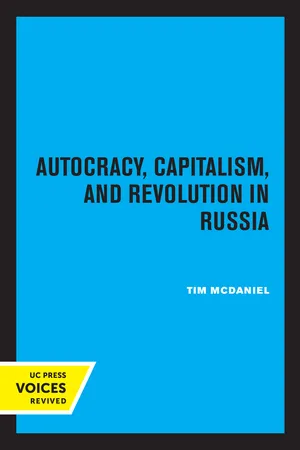
The introduction to Autocracy, Capitalism, and Revolution in Russia explores the unique social, economic, and political dynamics that shaped the 1917 Russian Revolution. Unlike other modern revolutions, such as the French or English cases, where industrialization played a secondary role, the Russian Revolution was heavily influenced by its emerging industrial proletariat. Concentrated in urban centers like Petrograd and Moscow, this working class became a pivotal revolutionary force despite its relatively small size. The revolution itself was multifaceted, encompassing a proletarian uprising against capitalism, a peasant revolt against landowners, soldiers' rebellions, and even elements of a bourgeois revolution against autocracy. The interplay of these forces created a complex revolutionary process, with labor militancy at its core. Severe repression under tsarist autocracy stifled formal worker organizations, but this repression also fueled sporadic bursts of radical action, making the Russian labor movement distinctly revolutionary. The book argues that the Russian revolution cannot be understood without considering the contradictions of autocratic capitalism, which hindered reform and radicalized the labor movement. It integrates structural and agency-based perspectives, showing how social movements both emerged from and shaped these contradictions. The inability of the tsarist regime to allow for moderate worker organizations or adapt to modern industrial capitalism undermined its legitimacy and set the stage for the Bolshevik victory. However, this outcome was not inevitable but one of several possible resolutions to the crises of the old regime. By analyzing the labor movement's development, its interactions with the state, and its role in the revolution, the study highlights the unique characteristics of Russia's revolutionary experience and its broader implications for understanding social and political change. This title is part of UC Press's Voices Revived program, which commemorates University of California Press's mission to seek out and cultivate the brightest minds and give them voice, reach, and impact. Drawing on a backlist dating to 1893, Voices Revived makes high-quality, peer-reviewed scholarship accessible once again using print-on-demand technology. This title was originally published in 1988.
Many titles in the Voices Revived program are also newly available as ebooks, offered at a discounted price to support wider access to scholarly work.
- 512 pages
- English
- ePUB (mobile friendly)
- Available on iOS & Android
eBook - ePub
Autocracy, Capitalism and Revolution in Russia
About this book
Information
Publisher
University of California PressYear
1988Print ISBN
9780520310667
Edition
1eBook ISBN
9780520314184
Table of contents
- Cover
- Title
- Copyright
- Contents
- Acknowledgments
- Notes on Dates and Transliteration
- CHAPTER 1 Introduction: The Proletarian Revolution in Russia
- PART I THEORETICAL AND COMPARATIVE PERSPECTIVES
- CHAPTER 2 Autocratic Capitalism as a Model of Industrialization
- CHAPTER 3 Theoretical Perspectives on the Russian Labor Movement
- PART II AUTOCRATIC CAPITALISM AND TSARIST LABOR POLICY
- CHAPTER 4 Government Labor Policy before 1905
- CHAPTER 5 Labor Policy in 1905-1907
- CHAPTER 6 Labor Policy at a Dead End
- PART III STRUCTURE AND BASIC TRAITS OF THE RUSSIAN LABOR MOVEMENT
- CHAPTER 7 Mass Workers
- CHAPTER 8 Conscious Workers
- CHAPTER 9 The Revolutionary Intelligentsia
- CHAPTER 10 Labor and Organization
- CHAPTER 11 Solidarity
- CHAPTER 12 Radicalism
- PART IV PERSPECTIVES ON THE URBAN REVOLUTION IN 1917
- CHAPTER 13 Radicalism in the Class Struggle
- CHAPTER 14 The Workers and the State in 1917
- CHAPTER 15 Workers and Social Democracy in 1917
- Conclusion
- Notes
- Bibliography
- Index
Trusted by 375,005 students
Access to over 1.5 million titles for a fair monthly price.
Study more efficiently using our study tools.
Frequently asked questions
Yes, you can cancel anytime from the Subscription tab in your account settings on the Perlego website. Your subscription will stay active until the end of your current billing period. Learn how to cancel your subscription
No, books cannot be downloaded as external files, such as PDFs, for use outside of Perlego. However, you can download books within the Perlego app for offline reading on mobile or tablet. Learn how to download books offline
Perlego offers two plans: Essential and Complete
- Essential is ideal for learners and professionals who enjoy exploring a wide range of subjects. Access the Essential Library with 800,000+ trusted titles and best-sellers across business, personal growth, and the humanities. Includes unlimited reading time and Standard Read Aloud voice.
- Complete: Perfect for advanced learners and researchers needing full, unrestricted access. Unlock 1.5M+ books across hundreds of subjects, including academic and specialized titles. The Complete Plan also includes advanced features like Premium Read Aloud and Research Assistant.
We are an online textbook subscription service, where you can get access to an entire online library for less than the price of a single book per month. With over 1.5 million books across 990+ topics, we’ve got you covered! Learn about our mission
Look out for the read-aloud symbol on your next book to see if you can listen to it. The read-aloud tool reads text aloud for you, highlighting the text as it is being read. You can pause it, speed it up and slow it down. Learn more about Read Aloud
Yes! You can use the Perlego app on both iOS and Android devices to read anytime, anywhere — even offline. Perfect for commutes or when you’re on the go.
Please note we cannot support devices running on iOS 13 and Android 7 or earlier. Learn more about using the app
Please note we cannot support devices running on iOS 13 and Android 7 or earlier. Learn more about using the app
Yes, you can access Autocracy, Capitalism and Revolution in Russia by Tim McDaniel in PDF and/or ePUB format, as well as other popular books in History & Eastern European History. We have over 1.5 million books available in our catalogue for you to explore.