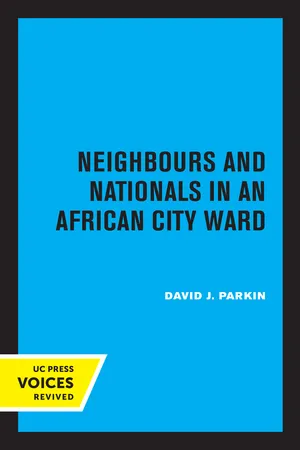
This study analyses the way in which tribal ties are maintained in the development of a tribally mixed, middle class community in Kampala, Uganda. Political independence in the early nineteen sixties in much of Africa created expectations of increased development, education and living standards. There was hope that ethnic tensions arising from false colonial boundaries might be transcended by newly emerging socio-economic status-groups. However, the new national boundaries suddenly made aliens of peoples who had migrated and settled in towns distant from their home countries. The interplay of nationality, ethnicity and socio-economic status or class was given a new theatre. Hope was dramatically tempered by nationalist and ethnic conflicts which cut across ethnically mixed, small status groups of neighbours and friends. In Kampala, Uganda, this rapidly unfolding drama resulted in the expulsion of two Kenyan ethnic groups and polarised peoples from northern and southern Uganda. The essentialisation of ethnic and national identity imposed by colonialism was thus taken on in this new situation by the people themselves, with the result that they became 'cultural' starting-points of social and political judgement.
This title is part of UC Press's Voices Revived program, which commemorates University of California Press's mission to seek out and cultivate the brightest minds and give them voice, reach, and impact. Drawing on a backlist dating to 1893, Voices Revived makes high-quality, peer-reviewed scholarship accessible once again using print-on-demand technology. This title was originally published in 1969.
Many titles in the Voices Revived program are also newly available as ebooks, offered at a discounted price to support wider access to scholarly work.
- 250 pages
- English
- ePUB (mobile friendly)
- Available on iOS & Android
eBook - ePub
Neighbours and Nationals in an African City Ward
About this book
Information
Publisher
University of California PressYear
1969Print ISBN
9780520360846
Edition
1eBook ISBN
9780520314382
Table of contents
- Cover
- Title
- Copyright
- CONTENTS 1
- INTRODUCTORY
- CHAPTER I SOCIAL OUTLINE OF KAMPALA
- CHAPTER II INDEPENDENCE AND POLITICAL CHANGES
- CHAPTER III NEIGHBOURHOOD, LOCALITY, AND THE STATUS SYSTEM
- CHAPTER IV COMMUNAL UNITY AND POLITICS
- CHAPTER V THE TRIBAL SYSTEM AND FAMILY LIFE
- CHAPTER VI SANCTIONS AND IDEOLOGY
- CHAPTER VII CHOICE AMONG KIN
- CHAPTER VIII LUO UNION AND OTHER ETHNIC ASSOCIATIONS
- CONCLUSIONS
- APPENDIX I ADDITIONAL DETAILS ON THE MAIN TRIBES REPRESENTED IN KAMPALA-MENGO
- APPENDIX II (to Chapter VIII) LUO UNION GENERAL ELECTION OF OFFICERS, OCTOBER 1963
- APPENDIX III TABLE Vll(a). NAGURU ESTATE RELIGION (1962)
- TABLE Vll(b). NAKAWAESTATE RELIGION (1962)
- REFERENCES
- INDEX
Trusted by 375,005 students
Access to over 1.5 million titles for a fair monthly price.
Study more efficiently using our study tools.
Frequently asked questions
Yes, you can cancel anytime from the Subscription tab in your account settings on the Perlego website. Your subscription will stay active until the end of your current billing period. Learn how to cancel your subscription
No, books cannot be downloaded as external files, such as PDFs, for use outside of Perlego. However, you can download books within the Perlego app for offline reading on mobile or tablet. Learn how to download books offline
Perlego offers two plans: Essential and Complete
- Essential is ideal for learners and professionals who enjoy exploring a wide range of subjects. Access the Essential Library with 800,000+ trusted titles and best-sellers across business, personal growth, and the humanities. Includes unlimited reading time and Standard Read Aloud voice.
- Complete: Perfect for advanced learners and researchers needing full, unrestricted access. Unlock 1.5M+ books across hundreds of subjects, including academic and specialized titles. The Complete Plan also includes advanced features like Premium Read Aloud and Research Assistant.
We are an online textbook subscription service, where you can get access to an entire online library for less than the price of a single book per month. With over 1.5 million books across 990+ topics, we’ve got you covered! Learn about our mission
Look out for the read-aloud symbol on your next book to see if you can listen to it. The read-aloud tool reads text aloud for you, highlighting the text as it is being read. You can pause it, speed it up and slow it down. Learn more about Read Aloud
Yes! You can use the Perlego app on both iOS and Android devices to read anytime, anywhere — even offline. Perfect for commutes or when you’re on the go.
Please note we cannot support devices running on iOS 13 and Android 7 or earlier. Learn more about using the app
Please note we cannot support devices running on iOS 13 and Android 7 or earlier. Learn more about using the app
Yes, you can access Neighbours and Nationals in an African City Ward by David Parkin in PDF and/or ePUB format, as well as other popular books in Social Sciences & Urban Sociology. We have over 1.5 million books available in our catalogue for you to explore.