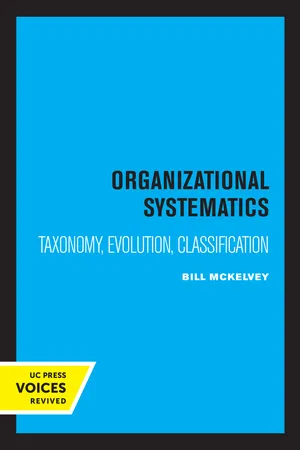
Organizational Systematics: Taxonomy, Evolution, Classification delves into the complex and underexplored domain of organizational differences, offering a groundbreaking framework for understanding, classifying, and theorizing about the diverse forms of organizational populations. The author positions organizational systematics as an essential yet overlooked discipline, drawing compelling parallels with biological taxonomy to build a systematic approach for organizational science. The book emphasizes the critical role of systematics in establishing a structured foundation for empirical and theoretical advancements, likening its importance to that of classification systems in biology, which have historically underpinned progress in the natural sciences. The text serves as both a theoretical treatise and a practical guide for researchers interested in the evolutionary and ecological dynamics of organizations. Through a synthesis of insights from biology and organizational studies, the book introduces concepts such as the organizational "species," evolutionary branching, and population ecology. It calls for a paradigm shift in organizational science, advocating for a population perspective rooted in natural selection theory. By integrating evolutionary theory with empirical classification methods, the book aims to inspire debate and foster new research methodologies that can address the challenges of diversity and variation in organizational forms. This innovative work is a must-read for scholars and practitioners seeking to advance the study of organizations as dynamic, adaptive systems within complex environments. This title is part of UC Press's Voices Revived program, which commemorates University of California Press's mission to seek out and cultivate the brightest minds and give them voice, reach, and impact. Drawing on a backlist dating to 1893, Voices Revived makes high-quality, peer-reviewed scholarship accessible once again using print-on-demand technology. This title was originally published in 1982.
Many titles in the Voices Revived program are also newly available as ebooks, offered at a discounted price to support wider access to scholarly work.
- 528 pages
- English
- ePUB (mobile friendly)
- Available on iOS & Android
eBook - ePub
About this book
Information
Publisher
University of California PressYear
1982Print ISBN
9780520314689
Edition
1eBook ISBN
9780520314696
Table of contents
- Cover
- Title
- Copyright
- CONTENTS 1
- ACKNOWLEDGMENTS
- 1 INTRODUCTION
- Why Study Systematics?
- The Biological Analogy
- To What End?
- 2 SYSTEMATICS
- 2.1 SYSTEMATICS AND FUNCTIONAL SCIENCE
- 2.2 SPECIAL AND GENERAL CLASSIFICATIONS
- 2.2.1 Special Classifications
- 2.2.2 General Classifications
- 2.3 THE IMPORTANCE OF SYSTEMATICS
- 2.3.1 Systematics and Functional Investigation
- 2.3.2 Systematics and Diversity
- 2.3.3 Systematics and Information Retrieval
- 2.3.4 Systematics and Scientific Curiosity
- 2.4 BASIC TERMS
- 2.5 TASKS FOR THE ORGANIZATIONAL SYSTEMATIST
- 2.5.1 Discovering Processes Underlying Speciation: Taxonomy
- 2.5.2 Tracing out the Origin and Evolution of Organizations: PHYLETICS
- 2.5.3 Classification
- 2.5.4 Personal Preference
- 2.6 SYSTEMATICS AS A PROFESSION
- 2.7 SUMMARY
- 3 TOWARD A THEORY OF ORGANIZATIONAL CLASS FICATION
- 3.1 THEORIES OF CLASSIFICATION
- 3.1.1 Principles of Enquiry
- 3.1.2 Essentialism, Typology
- 3.1.3 Nominalism
- 3.1.4 Empiricism, Numerical Phenetics, Numerical Taxonomy
- 3.1.5 Phyletics, Evolutionism, Cladism
- 3.1.6 Are Additional Theories of Classification Possible?
- 3.2 ORGANIZATIONAL CLASSIFICATION: PHYLETIC AND PHENETIC METHODS
- 3.2.1 The Trend in Biology
- 3.2.2 A Combined Phyletic-Phenetic Approach for Organizational Science
- 3.2.3 Arguments Supporting a Combined Phyletic- Phenetic Approach
- Mutual Benefit
- Better Science
- 3.2.4 Implications of the Combined Approach
- Implications of the Evolutionist Approach
- Implications of the Numerical Phenetic Approach
- 3.3 SUMMARY
- 4 ORGANIZATIONS AND SYSTEMATICS
- 4.1 ASPIRATIONS OF THEORISTS
- 4.1.1 Searching for Universal Principles
- 4.1.2 Searching for Academic Respectability
- 4.2 CAUSES OF ORGANIZATIONAL VARIATION
- 4.2.1 Autogenic Models
- The Rational Model
- The Natural System Model
- The Market Process Model
- 4.2.2 A Synthesized Autogenic Model
- 4.2.3 Systematics Slowed by Autogenic Models
- 4.2.4 Allogenic Models
- Warriner
- Hannan and Freeman
- Aldrich
- 4.3 TOWARD A SYNTHESIS OF AUTOGENIC AND ALLOGENIC MODELS
- 4.3.1 Environment, Organizational Variation, and Form
- 4.3.2 Environments and Niches
- 4.3.3 An Asymptotic Model of Organizational Variation
- 4.4 SUMMARY
- 5 THE PROTOSYSTEM
- 5.1 ENVIRONMENTAL VARIATION
- 5.1.1 A Concept of Organizational Environments
- 5.1.2 Variation
- 5.1.3 The Evolution of Environments
- 5.2 ENVIRONMENTAL IMPACT ON ORGANIZATIONS
- 5.2.1 Specialization
- 5.2.2 Impact via Alpha Sources
- 5.2.3 Impact via Sigma Sources
- 5.3 EVIDENCE OF A PROTOSYSTEM
- 5.3.1 Observations Underlying Typologies
- 5.3.2 Empirical Evidence
- 5.4 SUMMARY
- 6 PREREQUISITES TO AN ORGANIZATIONAL SPECIES CONCEPT
- 6.1 PREREQUISITES TO A SPECIES CONCEPT
- 6.1.1 Attributes of an Ideal Classification
- 6.1.2 The Species Concept in Biology
- Elements of the Biological Species Concept
- The Biological Speciation Process
- 6.1.3 The Unique Objectivity of the Species Category
- 6.1.4 Difficulties with the Biological Species Concept
- 6.1.5 Essential Elements of an Evolutionary Species Concept
- 6.2 A REVIEW OF EXISTING ORGANIZATIONAL CLASSIFICATIONS
- 6.2.1 Inattention to Isolating Processes
- 6.2.2 Lack of Stability
- 6.2.3 Lack of Ecological Sensitivity and Explanation of Change
- 6.2.4 Lack of Polythetic Groupings and Real Organizations
- 6.2.5 Lack of A Species Concept Altogether
- 6.3 SUMMARY
- 7 AN ORGANIZATIONAL SPECIES CONCEPT
- 7.1 A DEFINITION OF SPECIES
- 7.1.1 The Concept of Primary Task/Dominant Competence General Definition
- Dominant Competence and Unit Operations
- 7.1.2 The Workplace-Management Task
- Measurement of Effectiveness
- Coordination of Interdependencies
- Mitigation of Environmental Forces
- 7.1.3 The Dominant Competence Species Concept
- 7.2 EVALUATION OF THE DOMINANT COMP TENCE SPECIES CONCEPT
- 7.2.1 Strengths In Terms of Cross-Validation with Systems Concepts
- In Terms of the Essential Criteria
- In Terms of Empirical Validation
- In Terms of Scientific Relevance
- In Terms of Practical Usefulness
- 7.1.3 Difficulties
- Lack of Operationality
- Insufficient Information
- Evolutionary Intermediacy
- Rapid Evolutionary Pace
- 7.1.4 Strengths and Difficulties in Perspective
- 7.3 DEFINITIONAL NOTES
- 7.3.1 Technological Interdependence and Organizational Entitivity
- 7.3.2 Organizational Form
- 7.3.3 Dominant Competence Operationally Defined
- 7.4 ORGANIZATIONAL PROPINQUITY AND N MERICAL PHENETICS
- 7.5 SUMMARY
- 8 AN EVOLUTIONARY PE SPECTIVE
- 8.1 DEFINITION
- 8.2 THE SOCIAL SCIENCE EXPERIENCE
- 8.3 BIOLOGICAL NATURAL SELECTION THEORY AND RECENT CHALLENGES
- 8.4 ORGANISMS VERSUS ORGANIZATIONS: EVOLUTIONARY COMPARISONS
- 8.5 THE GENETICS OF ORGANIZATIONAL FORM
- 8.6 BASIC ELEMENTS OF AN EVOLUTIONARY THEORY OF ORGANIZATIONAL FORMS 8.6.1 Postulates
- 8.6.2 Basic Principles of Organizational Evolution
- 8.7 SUMMARY
- 9 ORGANIZATIONAL EVOLUTION AND THE HIGHER CATEGORIES
- 9.1 THE FORMATION OF ORGANIZATIONAL LINEAGES
- 9.1.1 How New Compools Form
- Illustrative Dendrograms
- Cladogenesis
- Anagenesis
- 9.1.2 Evidence of Cladogenesis
- 9.1.3 Evidence of Anagenesis
- 9.2 BASIC ASSUMPTIONS OF HIGHER CLASSIFICATION
- 9.3 SOME MISCONCEPTIONS
- 9.4 SOME OPERATIONAL PRINCIPLES OF ORGANIZATIONAL PHYLETICS
- 9.4.1 Patristic Groupings
- 9.4.2 Higher Taxa
- 9.4.3 Ecological Significance
- 9.4.4 Number of Species Considered
- 9.4.5 Nomenclatural Preliminaries
- 9.4.6 Miscellaneous Additional Operational Principles
- 9.5 SUMMARY
- 10 THE EVOLUTION OF ORGANIZATIONAL FORM IN ANCIENT MESOPOTAMIA
- 10.1 MODELING AND HISTORICAL ANALYSIS 10.1.1 Evolutionary Theory and a Model: The Family Tree
- 10.1.2 Induction, Falsifiability, and History
- 10.1.3 Historical Analysis
- 10.1.4 Limitations
- 10.2 ENVIRONMENTAL EVENTS IN ANCIENT MESOPOTAMIA
- Upper Paleolithic Age
- Mesolithic Period
- Neolithic Revolution
- Chalcolithic Period
- Protoliterate Period
- Urban Revolution
- The Flood
- Early Dynastic Period
- Akkadian Empire
- Ur Ill-Isin Dynasties
- Age of Hammurapi
- 10.3 THE HUNTERS FORM
- 10.4 The TEMPLES FORM
- 10.5 THE PRODUCERS FORM
- 10.6 THE PALACES FORM
- 10.7 THE COMMERCIALS FORM
- 10.8 SUMMARY
- 11 TAXONOMIC CASES AND CHARACTERS
- 11.1 OPERATIONAL TAXONOMIC UNITS
- 11.2 POPULATION SELECTION
- 11.2.1 Starting Without a Species Concept
- 11.2.2 Starting With a Species Concept
- 11.2.3 Kinds of Populations to Begin With
- 11.3 SAMPLING OTUs
- 11.3.1 Sampling Populations
- 11.3.2 The Exemplar Method
- 11.4 TAXONOMIC CHARACTERS
- 11.4.1 Definition of Taxonomic Characters
- 11.4.2 Homologous Characters in Organizations
- 11.4.3 Kinds of Characters
- 11.4.4 Selection and Weighting of Characters
- Character Selection
- Character Weighting
- 11.4.5 Inadmissible Characters
- 11.5 SUMMARY
- 12 NUMERICAL TAXONOMIC METHODS
- 12.1 CODING AND SCALING DATA
- 12.1.1 Coding
- 12.1.2 Size Reduction
- 12.1.3 Scaling
- 12.2 RESEMBLANCE COEFFICIENTS
- 12.2.1 Numerical Taxonomic Resemblance
- 12.2.2 Kinds of Resemblance Coefficients
- Matching Coefficients
- Distance Coefficients
- Correlation Coefficients
- The Resemblance Coefficient in Perspective
- 12.3 STRUCTURAL ANALYSIS
- 12.3.1 Joining Methods Nearest Neighbor Method
- Group Average Method
- 12.3.2 Sorting Methods Factor Analysis
- 12.3.3 Rank Considerations
- 12.4 METHODS OF VISUAL REPRESENTATION
- 12.4.1 Dendrograms
- 12.4.2 Multidimensional Plots
- 12.5 EVALUATION OF RESULTS
- 12.5.1 Phyletic Validity
- 12.5.2 Cophenetic Optimality
- 12.5.3 Significance of Clusters
- 12.6 IDENTIFICATION
- 12.7 PRESENTATION OF RESULTS (SUMMARY)
- 13 THE POPULATION PERSPECTIVE
- 13.1 ORGANIZATIONAL POPULATIONS
- 13.2 EXPLANATORY BUT NONPREDICTIVE SCIENCE
- 13.3 MAJOR IMPLICATIONS
- GLOSSARY
- BIBLIOGRAPHY
- INDEX
Trusted by 375,005 students
Access to over 1.5 million titles for a fair monthly price.
Study more efficiently using our study tools.
Frequently asked questions
Yes, you can cancel anytime from the Subscription tab in your account settings on the Perlego website. Your subscription will stay active until the end of your current billing period. Learn how to cancel your subscription
No, books cannot be downloaded as external files, such as PDFs, for use outside of Perlego. However, you can download books within the Perlego app for offline reading on mobile or tablet. Learn how to download books offline
Perlego offers two plans: Essential and Complete
- Essential is ideal for learners and professionals who enjoy exploring a wide range of subjects. Access the Essential Library with 800,000+ trusted titles and best-sellers across business, personal growth, and the humanities. Includes unlimited reading time and Standard Read Aloud voice.
- Complete: Perfect for advanced learners and researchers needing full, unrestricted access. Unlock 1.5M+ books across hundreds of subjects, including academic and specialized titles. The Complete Plan also includes advanced features like Premium Read Aloud and Research Assistant.
We are an online textbook subscription service, where you can get access to an entire online library for less than the price of a single book per month. With over 1.5 million books across 990+ topics, we’ve got you covered! Learn about our mission
Look out for the read-aloud symbol on your next book to see if you can listen to it. The read-aloud tool reads text aloud for you, highlighting the text as it is being read. You can pause it, speed it up and slow it down. Learn more about Read Aloud
Yes! You can use the Perlego app on both iOS and Android devices to read anytime, anywhere — even offline. Perfect for commutes or when you’re on the go.
Please note we cannot support devices running on iOS 13 and Android 7 or earlier. Learn more about using the app
Please note we cannot support devices running on iOS 13 and Android 7 or earlier. Learn more about using the app
Yes, you can access Organizational Systematics by Bill McKelvey in PDF and/or ePUB format, as well as other popular books in Business & Management. We have over 1.5 million books available in our catalogue for you to explore.