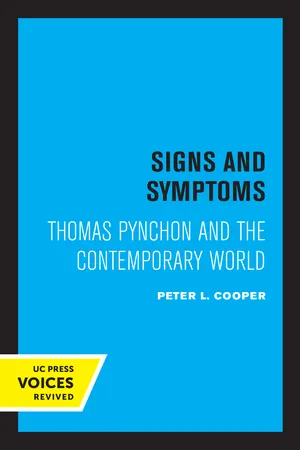
Signs and Symptoms: Thomas Pynchon and the Contemporary World by Peter L. Cooper situates Pynchon's achievement within the philosophical, literary, and scientific currents of modern thought, emphasizing his place among American counterrealists. While earlier novelists grounded their work in the traditions of realism and naturalism—offering psychologically rounded characters, coherent narration, and cause-and-effect logic—Pynchon and his contemporaries, including Heller, Vonnegut, Barth, Burroughs, and Nabokov, resist such conventions. Their fiction portrays diminished, often cartoonish characters adrift in grotesque and absurd worlds shaped by entropy, conspiratorial forces, or unfathomable chance. These counterrealists deliberately frustrate narrative expectations, undermining traditional concepts of identity, causality, and meaning to reflect a twentieth-century reality that itself feels fragmented, unstable, and menacing. For Pynchon in particular, paranoia, conspiracy, and epistemological uncertainty become structural motifs, dramatizing the tension between too little structure—cosmic drift toward entropy—and too much structure—bureaucratic control and technological domination. Cooper argues that although Pynchon mocks humanity's compulsion to impose order through patterns and interpretive systems, he also acknowledges their necessity. His fiction stages this paradox through unreliable narrators, labyrinthine plots, proliferating symbols, and scientific metaphors that highlight the limits of perception and the inevitability of projection. In works such as *The Crying of Lot 49* and *Gravity's Rainbow*, characters struggle to interpret evidence, never knowing whether they uncover hidden systems or simply overlay their own delusions upon reality. This epistemological anxiety, shared across counterrealist fiction, links Pynchon to Borges's infinite regress of invented realities and Barth's metafictional games, yet Pynchon maintains a more urgent political and historical focus. By tracing the interplay of paranoia, grotesque absurdity, and entropic decline in Pynchon's oeuvre, Cooper illuminates the novelist's distinctive position at the crossroads of modern fiction, where satire, science, and philosophy converge to expose the precariousness of knowledge, identity, and control in the contemporary world. This title is part of UC Press's Voices Revived program, which commemorates University of California Press's mission to seek out and cultivate the brightest minds and give them voice, reach, and impact. Drawing on a backlist dating to 1893, Voices Revived makes high-quality, peer-reviewed scholarship accessible once again using print-on-demand technology. This title was originally published in 1983.
Many titles in the Voices Revived program are also newly available as ebooks, offered at a discounted price to support wider access to scholarly work.
- 248 pages
- English
- ePUB (mobile friendly)
- Available on iOS & Android
eBook - ePub
About this book
Information
Publisher
University of California PressYear
1983Print ISBN
9780520314726
Edition
1eBook ISBN
9780520314733
Table of contents
- Cover
- Title
- Copyright
- Table of Contents
- Preface
- Abbreviations
- 1 Pynchon’s Literary Context The Counterrealists
- 2 Pynchon’s Jeremiad A Control That Is Out Of Control
- 3 Pynchon’s Solutions The Moment and Its Possibilities
- 4 Pynchon’s Cosmos Symbols of Randomness and Fright
- 5 Pynchon’s Epistemology An Eye That Reflects and An Eye That Receives
- 6 Metaphor, Model Building, and Paranoia A Thrust at Truth and a Lie
- 7 Pynchon’s Fictional Techniques Assertion Through Structure
- Selected Bibliography
- Index
Trusted by 375,005 students
Access to over 1.5 million titles for a fair monthly price.
Study more efficiently using our study tools.
Frequently asked questions
Yes, you can cancel anytime from the Subscription tab in your account settings on the Perlego website. Your subscription will stay active until the end of your current billing period. Learn how to cancel your subscription
No, books cannot be downloaded as external files, such as PDFs, for use outside of Perlego. However, you can download books within the Perlego app for offline reading on mobile or tablet. Learn how to download books offline
Perlego offers two plans: Essential and Complete
- Essential is ideal for learners and professionals who enjoy exploring a wide range of subjects. Access the Essential Library with 800,000+ trusted titles and best-sellers across business, personal growth, and the humanities. Includes unlimited reading time and Standard Read Aloud voice.
- Complete: Perfect for advanced learners and researchers needing full, unrestricted access. Unlock 1.5M+ books across hundreds of subjects, including academic and specialized titles. The Complete Plan also includes advanced features like Premium Read Aloud and Research Assistant.
We are an online textbook subscription service, where you can get access to an entire online library for less than the price of a single book per month. With over 1.5 million books across 990+ topics, we’ve got you covered! Learn about our mission
Look out for the read-aloud symbol on your next book to see if you can listen to it. The read-aloud tool reads text aloud for you, highlighting the text as it is being read. You can pause it, speed it up and slow it down. Learn more about Read Aloud
Yes! You can use the Perlego app on both iOS and Android devices to read anytime, anywhere — even offline. Perfect for commutes or when you’re on the go.
Please note we cannot support devices running on iOS 13 and Android 7 or earlier. Learn more about using the app
Please note we cannot support devices running on iOS 13 and Android 7 or earlier. Learn more about using the app
Yes, you can access Signs and Symptoms by Peter L. Cooper in PDF and/or ePUB format, as well as other popular books in Literature & North American Literary Criticism. We have over 1.5 million books available in our catalogue for you to explore.