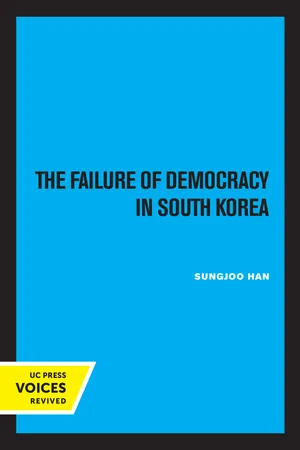
The Failure of Democracy in South Korea explores the political instability and collapse of South Korea's Second Republic following a military coup in 1961. This book analyzes the root causes of the failure of democratic governance in a nation undergoing rapid social and political changes. The study examines various perspectives on why the government led by Prime Minister Chang Myôn faltered, including critiques of his leadership, the flawed constitutional structure, and the larger social and ideological divisions within South Korean society. The author suggests that the inability of South Korea to sustain democratic institutions was influenced by acute ideological polarization, with significant divides between anti-Syngman Rhee revolutionaries and pro-Rhee conservatives, as well as between radical and conservative factions within the country. These divisions made political cooperation and stability nearly impossible, leading to the ultimate collapse of the democratic experiment. The book draws on various theories of political development and democracy, suggesting that a combination of factors—including the centralization of political power, a lack of pluralistic social structures, and the absence of a democratic political culture—contributed to the failure. The study also highlights the challenges faced by developing nations, where political decay can occur when ideological conflict, especially between political elites, prevents effective governance. By focusing on South Korea's specific historical and social context, the book provides a detailed sectoral analysis, examining the roles of key political groups like the military, students, and business leaders. The insights offered in this work are not only pertinent to understanding South Korea's political history but also offer valuable lessons for other nations struggling with the challenges of implementing stable democracy in the face of deep political and social divisions. This title is part of UC Press's Voices Revived program, which commemorates University of California Press's mission to seek out and cultivate the brightest minds and give them voice, reach, and impact. Drawing on a backlist dating to 1893, Voices Revived makes high-quality, peer-reviewed scholarship accessible once again using print-on-demand technology. This title was originally published in 1974.
Many titles in the Voices Revived program are also newly available as ebooks, offered at a discounted price to support wider access to scholarly work.
- 254 pages
- English
- ePUB (mobile friendly)
- Available on iOS & Android
eBook - ePub
The Failure of Democracy in South Korea
About this book
Information
Publisher
University of California PressYear
1974Print ISBN
9780520361096
Edition
1eBook ISBN
9780520314900
Table of contents
- Cover
- Title
- Copyright
- CONTENTS
- PREFACE
- I INTRODUCTION
- II THE LEGACY OF THE FIRST REPUBLIC
- III PARTY POLITICIANS AND MILITARY OFFICERS
- IV THE INTERIM GOVERNMENT OF HÖ CHÖNG AND THE FALL OF THE LIBERAL PARTY
- V THE POLITICS OF THE REFORMISTS203
- VI PARTY POLITICS IN THE SECOND REPUBLIC
- VII CAUGHT IN THE MIDDLE:The Chang My on Government Between the “Revolutionary” and “Anti-Revolutionary” Forces
- VIII LEFTIST AGITATION AND RIGHTIST REACTION
- IX CONCLUSIONS:The Collapse of the Chang Myon Government
- BIBLIOGRAPHY
- INDEX
Trusted by 375,005 students
Access to over 1.5 million titles for a fair monthly price.
Study more efficiently using our study tools.
Frequently asked questions
Yes, you can cancel anytime from the Subscription tab in your account settings on the Perlego website. Your subscription will stay active until the end of your current billing period. Learn how to cancel your subscription
No, books cannot be downloaded as external files, such as PDFs, for use outside of Perlego. However, you can download books within the Perlego app for offline reading on mobile or tablet. Learn how to download books offline
Perlego offers two plans: Essential and Complete
- Essential is ideal for learners and professionals who enjoy exploring a wide range of subjects. Access the Essential Library with 800,000+ trusted titles and best-sellers across business, personal growth, and the humanities. Includes unlimited reading time and Standard Read Aloud voice.
- Complete: Perfect for advanced learners and researchers needing full, unrestricted access. Unlock 1.5M+ books across hundreds of subjects, including academic and specialized titles. The Complete Plan also includes advanced features like Premium Read Aloud and Research Assistant.
We are an online textbook subscription service, where you can get access to an entire online library for less than the price of a single book per month. With over 1.5 million books across 990+ topics, we’ve got you covered! Learn about our mission
Look out for the read-aloud symbol on your next book to see if you can listen to it. The read-aloud tool reads text aloud for you, highlighting the text as it is being read. You can pause it, speed it up and slow it down. Learn more about Read Aloud
Yes! You can use the Perlego app on both iOS and Android devices to read anytime, anywhere — even offline. Perfect for commutes or when you’re on the go.
Please note we cannot support devices running on iOS 13 and Android 7 or earlier. Learn more about using the app
Please note we cannot support devices running on iOS 13 and Android 7 or earlier. Learn more about using the app
Yes, you can access The Failure of Democracy in South Korea by Sungjoo Han in PDF and/or ePUB format, as well as other popular books in Politics & International Relations & Asian Politics. We have over 1.5 million books available in our catalogue for you to explore.