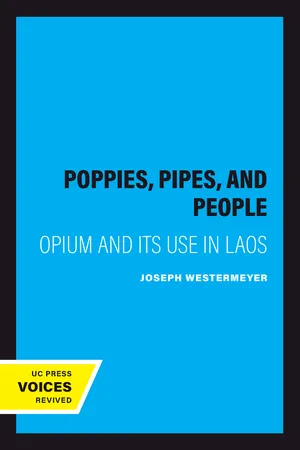
Opium production and use connote international intrigues, illicit wealth, and social degeneracy to industrialized societies. The experiences and attitudes of those growing and using opiumin poppy-producing areas are not always so dramatic or so negative. For a total of three years between 1965 and 1975, Joseph Westermeyer practiced medicine and studied the function of opiumin Laos, where it is a cash crop, and from 1975 to 1982 he spent an additional six months studying opium addiction in other parts of Asia. His work gives a clear picture of the very different ways opium and its use are regarded in a developing agricultural society. Opium is a mainstay of the highland economy in Laos. Ease of Transport gives the poppy great advantage over other cash crops, although growers readily abandon its cultivation for work or animal husbandry that offers a higher profit. Opium can sometimes be used without addiction as a recreational intoxicant or folk medicine, but addiction is always a possibility, especially among the growers of the poppy themselves. Opium consumption can initially enhance productivity, but its long-term use is generally debilitating, and the biomedical, psychological, and familial problems commonly associated with drug addiction also occur in Laos. Westermeyer describes heroin as well as opium addiction, includes a chapter on Caucasian addicts, and evaluates indigenous and medical treatments for addiction. He shows how, lacking the cross-cultural perspective offered here, attempts by the United States to restrict opium flow have had little regard for the effect of narcotics policy on other countries, and actually opens the way for heroin use in Laos. Westermeyer's careful documentation is supplemented by individual vignettes that give a sense of the complex and often unpredictable reality of drug use. HIs analysis will change many stereotypic notions of opiate use in Asia, as it takes into account the myriad views and needs of people living under vastly different circumstances.
Many titles in the Voices Revived program are also newly available as ebooks, offered at a discounted price to support wider access to scholarly work.
- English
- ePUB (mobile friendly)
- Available on iOS & Android
eBook - ePub
About this book
Information
Table of contents
- Cover
- Title
- Copyright
- Contents
- Introduction
- The Country and Its People
- III Agroeconomics of Poppy and Opium
- IV Using Opium
- V Natural Courses of Addiction
- VII Subgroups Among Addicts
- VIII
- IX
- XI
- XII
- XIII
- XIV
- XV Opium Reconsidered
- Appendix
- Glossary
- References
- Index
Trusted by 375,005 students
Access to over 1.5 million titles for a fair monthly price.
Study more efficiently using our study tools.
Frequently asked questions
Yes, you can cancel anytime from the Subscription tab in your account settings on the Perlego website. Your subscription will stay active until the end of your current billing period. Learn how to cancel your subscription
No, books cannot be downloaded as external files, such as PDFs, for use outside of Perlego. However, you can download books within the Perlego app for offline reading on mobile or tablet. Learn how to download books offline
Perlego offers two plans: Essential and Complete
- Essential is ideal for learners and professionals who enjoy exploring a wide range of subjects. Access the Essential Library with 800,000+ trusted titles and best-sellers across business, personal growth, and the humanities. Includes unlimited reading time and Standard Read Aloud voice.
- Complete: Perfect for advanced learners and researchers needing full, unrestricted access. Unlock 1.5M+ books across hundreds of subjects, including academic and specialized titles. The Complete Plan also includes advanced features like Premium Read Aloud and Research Assistant.
We are an online textbook subscription service, where you can get access to an entire online library for less than the price of a single book per month. With over 1.5 million books across 990+ topics, we’ve got you covered! Learn about our mission
Look out for the read-aloud symbol on your next book to see if you can listen to it. The read-aloud tool reads text aloud for you, highlighting the text as it is being read. You can pause it, speed it up and slow it down. Learn more about Read Aloud
Yes! You can use the Perlego app on both iOS and Android devices to read anytime, anywhere — even offline. Perfect for commutes or when you’re on the go.
Please note we cannot support devices running on iOS 13 and Android 7 or earlier. Learn more about using the app
Please note we cannot support devices running on iOS 13 and Android 7 or earlier. Learn more about using the app
Yes, you can access Poppies, Pipes, and People by Joseph Westermeyer in PDF and/or ePUB format, as well as other popular books in Social Sciences & Cultural & Social Anthropology. We have over 1.5 million books available in our catalogue for you to explore.