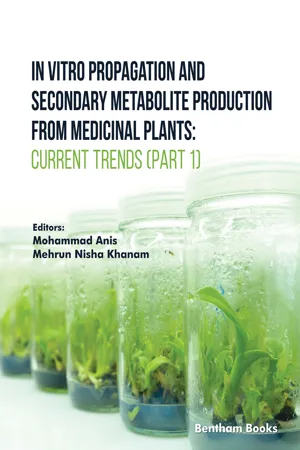
This book is a comprehensive review of secondary metabolite production from plant tissue culture. The editors have compiled 12 meticulously organized chapters that provide the relevant theoretical and practical frameworks in this subject using empirical research findings. The goal of the book is to explain the rationale behind in vitro production of secondary metabolites from some important medicinal plants. Biotechnological strategies like metabolic engineering and the biosynthesis, transport and modulation of important secondary metabolites are explained along with research studies on specific plants. In addition to the benefits of secondary metabolites, the book also aims to highlight the commercial value of medicinal plants for pharmaceutical and healthcare ventures. Topics covered in this part include: 1. Elicitation Strategies and Metabolic Engineering to boost metabolite production with case studies in metabolic engineering with examples of Scaevola Taccada and Catharanthus Roseus. 2. Stress response investigation and the role of glandular trichomes as bio-cell factories 3. Plant growth regulators and rapid regeneration techniques using swift plantlets regeneration and phytochemical characterization 4. Nutraceuticals, antimicrobials, and genomic applications of in vitro cultures with an example of Hassawi rice and its genomics 5. Sustainable approaches for saving endangered medicinal plants The book caters to a wide readership. It primarily prepares graduate students, researchers, biotechnologists, giving them a grasp of the key methodologies in the secondary metabolite production. It is a secondary reference for support executives, industry professionals, and policymakers at corporate and government levels to understand the importance of plant tissue culture and maximizing its impact in the herbal industry. Readership Graduate students and researchers in plant biotechnology courses; industry professionals and policymakers in the herbal industry.
eBook - ePub
In Vitro Propagation and Secondary Metabolite Production from Medicinal Plants: Current Trends (Part 1)
- English
- ePUB (mobile friendly)
- Available on iOS & Android
eBook - ePub
In Vitro Propagation and Secondary Metabolite Production from Medicinal Plants: Current Trends (Part 1)
About this book
Information
Table of contents
- Welcome
- Table of Content
- Title
- BENTHAM SCIENCE PUBLISHERS LTD.
- FOREWORD
- PREFACE
- List of Contributors
- Secondary Metabolite Production through Elicitation: Biotic, Abiotic, MeJA, PGRs and Stress Signaling in Improving Compounds in Select Medicinal Plants
- In Vitro Multiplication and Metabolite Variations through GC-MS of a Medicinal Plant Scaevola Taccada (Gaertn.) Roxb.
- Metabolic Engineering & Synthetic Biology of Monoterpenoid Indole Alkaloids Pathway in Catharanthus Roseus
- Impact of Abiotic Stresses on In Vitro Production of Secondary Metabolites
- Glandular Trichomes: Bio-cell Factories of Plant Secondary Metabolites
- Role of Plant Growth Regulators for Augmenting Secondary Metabolites Production in Medicinal Plants
- Hassawi Rice (Oryza Sativa L.) Nutraceutical Properties, In Vitro Culture and Genomics
- In Vitro Rapid Regeneration of Plantlets from Shoot Tip Explants of Allamanda Cathartica L. and Characterization of Phytochemicals in Regenerants
- Production of Secondary Metabolites from Endangered and Commercially Important Medicinal Plants Through Cell and Tissue Culture Technology
- Antimicrobial Efficacy of In Vitro Cultures and their Applications
- The Contemporary Facts Towards In Vitro Production of the Plant-derived Medicinal Metabolites
- Harnessing the Potential of Plant Tissue Culture Techniques for the Herbal Industry
Trusted by 375,005 students
Access to over 1.5 million titles for a fair monthly price.
Study more efficiently using our study tools.
Frequently asked questions
Yes, you can cancel anytime from the Subscription tab in your account settings on the Perlego website. Your subscription will stay active until the end of your current billing period. Learn how to cancel your subscription
No, books cannot be downloaded as external files, such as PDFs, for use outside of Perlego. However, you can download books within the Perlego app for offline reading on mobile or tablet. Learn how to download books offline
Perlego offers two plans: Essential and Complete
- Essential is ideal for learners and professionals who enjoy exploring a wide range of subjects. Access the Essential Library with 800,000+ trusted titles and best-sellers across business, personal growth, and the humanities. Includes unlimited reading time and Standard Read Aloud voice.
- Complete: Perfect for advanced learners and researchers needing full, unrestricted access. Unlock 1.5M+ books across hundreds of subjects, including academic and specialized titles. The Complete Plan also includes advanced features like Premium Read Aloud and Research Assistant.
We are an online textbook subscription service, where you can get access to an entire online library for less than the price of a single book per month. With over 1.5 million books across 990+ topics, we’ve got you covered! Learn about our mission
Look out for the read-aloud symbol on your next book to see if you can listen to it. The read-aloud tool reads text aloud for you, highlighting the text as it is being read. You can pause it, speed it up and slow it down. Learn more about Read Aloud
Yes! You can use the Perlego app on both iOS and Android devices to read anytime, anywhere — even offline. Perfect for commutes or when you’re on the go.
Please note we cannot support devices running on iOS 13 and Android 7 or earlier. Learn more about using the app
Please note we cannot support devices running on iOS 13 and Android 7 or earlier. Learn more about using the app
Yes, you can access In Vitro Propagation and Secondary Metabolite Production from Medicinal Plants: Current Trends (Part 1) by Mohammad Anis, Mehrun Nisha Khanam, Mohammad Anis,Mehrun Nisha Khanam in PDF and/or ePUB format, as well as other popular books in Computer Science & Cloud Computing. We have over 1.5 million books available in our catalogue for you to explore.