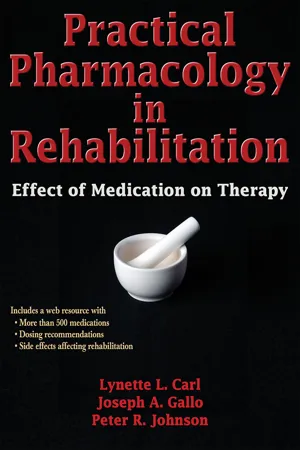
Practical Pharmacology in Rehabilitation
eBook - ePub

Practical Pharmacology in Rehabilitation

Effect of Medication on Therapy

  1. 640 pages
  2. English
  3. ePUB (mobile friendly)
  4. Available on iOS & Android
eBook - ePub

Practical Pharmacology in Rehabilitation

Effect of Medication on Therapy

About this book

Practical Pharmacology in Rehabilitation: Effect of Medication on Therapy serves as a textbook for students and a reference book for practicing rehabilitation professionals. Rather than discussing pharmacology as it relates to only a limited segment of rehabilitation professions, this text takes an interdisciplinary approach to the effects of medications on rehabilitation patients and assists rehabilitation professionals in designing patient-specific therapy plans based on coexisting disease states.

Practical Pharmacology in Rehabilitation explains the necessary pharmacology and then focuses on the relationship between medications and the rehabilitation process. It offers a proactive approach to educating the patient and caregiver, monitoring the patient for side effects, and modifying therapy plans to provide the most effective and safe therapy for each patient. Written by a clinical pharmacist, a speech-language pathologist, and a physical therapist and athletic trainer, this unique guide helps readers in these ways:

• Optimize rehabilitation sessions with appropriately timed and dosed administration of medication.

• Understand the effects of medication on cognition and learning necessary for accomplishing the tasks of rehabilitation.

• Identify medication-associated issues affecting the rehabilitation progress, such as dysphagia and problems with muscle function.

• Work with patients, caregivers, staff, and physicians to determine appropriate interventions regarding medication use in patients.

Practical Pharmacology in Rehabilitation begins by presenting foundational concepts necessary for understanding clinical disease states and the impact of medications used for treatment on rehabilitation. Chapters that follow are grouped by categories of clinical disease covering psychiatric and cognitive disorders, neurologic and movement disorders, chronic pain syndromes and substance abuse disorders, immune system disorders, and common chronic diseases such as diabetes, cardiac disease, thyroid and parathyroid disease, respiratory diseases, gastrointestinal diseases, and dysphagia.

Each chapter begins with a definition of the condition or special population that it focuses on. Chapters are organized to provide an overview of the pathophysiology, pharmacology, mechanism of action, dosing and monitoring for effects, drug and food interactions, side effects and effects on rehabilitation, and the role of various rehabilitation specialists for each disease state. Summaries conclude each chapter to reinforce the important concepts covered. A glossary is included, and terms are boldfaced in the text to denote their inclusion. A medication index, an index of important terms, and an appendix with information on administering medications using iontophoresis and phonophoresis are also included.

With Practical Pharmacology in Rehabilitation, students in rehabilitation and related health care fields can gain essential knowledge to prevent adverse occurrences and medical complications and work with their patients, caregivers, pharmacists, and physicians to optimize rehabilitation and the return to daily living. For rehabilitation professionals, this essential reference provides an integrated understanding of medication use with nonpharmacologic therapies in rehabilitation patients.

Trusted by 375,005 students

Access to over 1.5 million titles for a fair monthly price.

Study more efficiently using our study tools.

Information

Year
2013
Print ISBN
9780736096041
eBook ISBN
9781492581895
Edition
1
Subtopic
Pharmacology

Table of contents

  1. Cover Page
  2. Practical Pharmacology in Rehabilitation
  3. Copyright Page
  4. Dedication
  5. Contents
  6. Preface
  7. Acknowledgments
  8. Reviewers and Contributors
  9. Part I: Foundations
  10. Chapter 1: Introduction to Medication Monitoring by the Rehabilitation Therapist
  11. Chapter 2: Medication’s Effects on the Nervous System, Muscle Function, and Cognition
  12. Chapter 3: Nutrition in the Rehabilitation Patient
  13. Part II: Medications Used to Treat Psychiatric and Cognitive Disorders
  14. Chapter 4: Medications Used to Treat Depression and Bipolar Disorder
  15. Chapter 5: Medications Used to Treat Psychosis and Schizophrenia
  16. Chapter 6: Medications Used to Treat Delirium, Dementia, and Alzheimer’s Disease
  17. Chapter 7: Medications Used to Treat Anxiety, Anxiety Disorders, and Insomnia
  18. Part III: Medications Used to Treat Neurologic and Movement Disorders
  19. Chapter 8: Medications Used to Treat Seizure Disorders
  20. Chapter 9: Medications Used to Treat Spasticity and Muscle Spasm
  21. Chapter 10: Medications Used to Treat Parkinson’s Disease
  22. Chapter 11: Medications Used to Treat Amyotrophic Lateral Sclerosis, Multiple Sclerosis, and Myasthenia Gravis
  23. Chapter 12: Medications Used to Treat Other Movement Disorders
  24. Part IV: Medications Used to Treat Pain and Substance-Use Disorders
  25. Chapter 13: Medications Used to Treat Pain
  26. Chapter 14: Medications Used to Treat Chronic Pain Syndromes
  27. Chapter 15: Medications Used to Treat Substance-Use Disorders
  28. Part V: Medications Used to Treat Disorders of the Immune System
  29. Chapter 16: Medications Used to Treat Infections
  30. Chapter 17: Medications Used to Treat Osteoarthritis, Gout, and Rheumatoid Arthritis
  31. Chapter 18: Medications Used to Treat Cancer
  32. Part VI: Medications Used to Treat Chronic Disease
  33. Chapter 19: Medications Used to Treat Hypertension, Congestive Heart Failure, and Cardiac Arrhythmias
  34. Chapter 20: Medications Used to Treat Peripheral Artery Disease, Stroke, and Coronary Heart Disease
  35. Chapter 21: Medications Used to Treat Diabetes
  36. Chapter 22: Medications Used to Treat Respiratory Disease
  37. Chapter 23: Medications Used to Treat Thyroid Disease, Parathyroid Disease, and Osteoporosis
  38. Chapter 24 : Medications Used to Treat Gastrointestinal Disorders
  39. Appendix: Medications Delivered by Iontophoresis and Phonophoresis
  40. Glossary
  41. References
  42. About the Authors
  43. Back Page Ad

Frequently asked questions

Yes, you can cancel anytime from the Subscription tab in your account settings on the Perlego website. Your subscription will stay active until the end of your current billing period. Learn how to cancel your subscription
No, books cannot be downloaded as external files, such as PDFs, for use outside of Perlego. However, you can download books within the Perlego app for offline reading on mobile or tablet. Learn how to download books offline
Perlego offers two plans: Essential and Complete
  • Essential is ideal for learners and professionals who enjoy exploring a wide range of subjects. Access the Essential Library with 800,000+ trusted titles and best-sellers across business, personal growth, and the humanities. Includes unlimited reading time and Standard Read Aloud voice.
  • Complete: Perfect for advanced learners and researchers needing full, unrestricted access. Unlock 1.5M+ books across hundreds of subjects, including academic and specialized titles. The Complete Plan also includes advanced features like Premium Read Aloud and Research Assistant.
Both plans are available with monthly, semester, or annual billing cycles.
We are an online textbook subscription service, where you can get access to an entire online library for less than the price of a single book per month. With over 1.5 million books across 990+ topics, we’ve got you covered! Learn about our mission
Look out for the read-aloud symbol on your next book to see if you can listen to it. The read-aloud tool reads text aloud for you, highlighting the text as it is being read. You can pause it, speed it up and slow it down. Learn more about Read Aloud
Yes! You can use the Perlego app on both iOS and Android devices to read anytime, anywhere — even offline. Perfect for commutes or when you’re on the go.
Please note we cannot support devices running on iOS 13 and Android 7 or earlier. Learn more about using the app
Yes, you can access Practical Pharmacology in Rehabilitation by Lynette Carl,Joseph A. Gallo,Peter R. Johnson in PDF and/or ePUB format, as well as other popular books in Medicine & Pharmacology. We have over 1.5 million books available in our catalogue for you to explore.