- 272 pages
- English
- PDF
- Available on iOS & Android
About this book
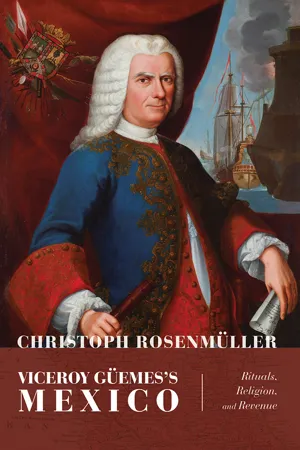
Viceroy Güemes's Mexico: Rituals, Religion, and Revenue examines the career of Juan Francisco Güemes y Horcasitas, viceroy of New Spain from 1746 to 1755. It provides the best account yet of how the colonial reform process most commonly known as the Bourbon Reforms did not commence with the arrival of José de Gálvez, the visitador general to New Spain appointed in 1765. Rather, Güemes, ennobled as the conde de Revillagigedo in 1749, pushed through substantial reforms in the late 1740s and early 1750s, most notably the secularization of the doctrinas (turning parishes administering to Natives over to diocesan priests) and the state takeover of the administration of the alcabala tax in Mexico City. Both measures served to strengthen royal authority and increase fiscal revenues, the twin goals historians have long identified as central to the Bourbon reform project. Güemes also managed to implement these reforms without stirring up the storm of protest that attended the Gálvez visita. The book thus recasts how historians view eighteenth-century colonial reform in New Spain and the Spanish empire generally.Christoph Rosenmüller's study of Güemes is the first in English-language scholarship that draws on significant research in a family archive. Using these rarely consulted sources allows for a deeper understanding of daily life and politics. Whereas most scholars have relied on the official communications in the great archives to emphasize tightly choreographed rituals, for instance, Rosenmüller's work shows that much interaction in the viceregal palace was rather informal—a fact that scholars have overlooked. The sources throw light on meeting and greeting people, ongoing squabbles over hierarchy and ceremony, walks on the Alameda square, the role of the vicereine and their children, and working hours in the offices. Such insights are drawn from a rare family archive harboring a trove of personal communications. The resulting book paints a vivid portrait of a society undergoing change earlier than many historians have believed.
Frequently asked questions
- Essential is ideal for learners and professionals who enjoy exploring a wide range of subjects. Access the Essential Library with 800,000+ trusted titles and best-sellers across business, personal growth, and the humanities. Includes unlimited reading time and Standard Read Aloud voice.
- Complete: Perfect for advanced learners and researchers needing full, unrestricted access. Unlock 1.4M+ books across hundreds of subjects, including academic and specialized titles. The Complete Plan also includes advanced features like Premium Read Aloud and Research Assistant.
Please note we cannot support devices running on iOS 13 and Android 7 or earlier. Learn more about using the app.
Information
Table of contents
- Cover
- Half title
- Title
- Copyright
- Contents
- List of Illustrations
- List of Tables
- Acknowledgments
- A Note on Terms
- Introduction
- Chapter 1. The Education of a Bourbon Viceroy
- Chapter 2. A Passage to Mexico
- Chapter 3. From Viceregal Rituals to Informality: The Court in Mexico City
- Chapter 4. “The Indians and Castes . . . Long for Change”: Wrestling the Rural Priories from the Religious Orders
- Chapter 5. Friends, Foes, and “Specters Spreading at Court”: How Güemes Seized the Mexico City Alcabala Tax in 1753-1754
- Chapter 6. One Kingdom to Rule the Other?: New Spain versus New Galicia
- Chapter 7. Güemes’s Endgame: Helping the King and Helping Oneself
- Conclusion: Bourbon Brawn and Brain
- Measures and Weights
- Dramatis Personae
- Glossary
- Notes
- Bibliography
- Index