- 367 pages
- English
- ePUB (mobile friendly)
- Available on iOS & Android
About this book
"
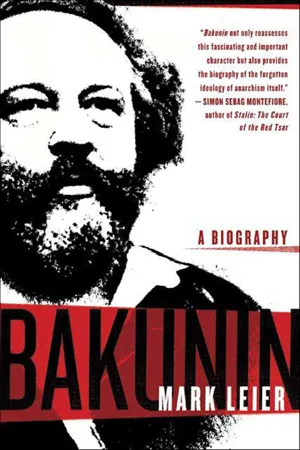
Bakunin not only reassesses this fascinating and important character but also provides the biography of the forgotten ideology of anarchism itself."—Simon Sebag Montefiore, author of
Stalin: The Court of the Red Tsar
The passion for destruction is a creative passion," wrote the anarchist Mikhail Bakunin in 1842. Since then, the popular image of anarchism has been one of violence and terror. But this picture is wildly misleading, and the media has done more to obscure anarchism than to explain it. Focusing on the street fighting and confrontations with police, mainstream commentators are unable to understand what anarchism is or why a philosophy with roots in the nineteenth century has resurfaced with such power at the dawn of the new millennium. To understand anarchism, it is necessary to go beyond the caricature presented by the media. In this new biography of Mikhail Bakunin, Mark Leier traces the life and ideas of anarchism's first major thinker, and in the process revealing the origins of the movement.
There was little in Bakunin's background to suggest that he would grow up to be anything other than a loyal subject of the Russian Empire. Instead, he became one the most notorious radicals of the nineteenth century, devoting his life to the destruction of the tsar and feudalism, capitalism, the state, even God. In the process, he became a historical actor and political thinker whose ideas continue to influence world events.
Bakunin is of keen interest these days, though the attention paid to his image continues to obscure the man and his ideas. Using archival sources and the most recent scholarship, Leier corrects many of the popular misconceptions about Bakunin and his ideas, offering a fresh interpretation of Bakunin's life and thoughts of use to those interested in understanding anarchism and social change. Arguing for the relevance and importance of anarchism to our present world, Leier sheds light on the nineteenth century, as well as on today's headlines, as he examines a political philosophy that has inspired mass movements and contemporary social critics.
Mark Leier shows that the "passion for destruction" is a call to build a new world free of oppression, not a cult of violence. He argues that anarchism is a philosophy of morality and solidarity, based not on wishful thinking or naïve beliefs about the goodness of humanity but on a practical, radical critique of wealth and power. By studying Bakunin, we can learn a great deal about our own time and begin to recover a world of possibility and promise. It is often said that we are all anarchists at heart. This book explains why.
Tools to learn more effectively

Saving Books

Keyword Search

Annotating Text

Listen to it instead
Information
Table of contents
- Cover
- Title
- Copyright
- Dedication
- Contents
- Introduction
- 1 Werewolves, Nobles, and the Idyll of Priamukhino
- 2 War, Slavery, and Service
- 3 Rules, Rebellion, and Romance
- 4 Shooting Blanks
- 5 The Main Illness of Our Generation
- 6 Contradiction Is the Source of Movement
- 7 The Passion for Destruction Is a Creative Passion
- 8 Gay Paris
- 9 Barricades Piled Up Like Mountains
- 10 Without Organization, We Will Never Gain Victory
- 11 Liberty Without Socialism Is Injustice; Socialism Without Liberty Is Slavery
- 12 The Revolutionary Is a Doomed Man
- 13 Hermaphrodite Man Versus Carbuncle Boy in the First International
- 14 The Only Liberty Deserving of the Name
- 15 We Detest All Power
- Conclusion
- Bibliographic Guide
- Notes
- Index
Frequently asked questions
- Essential is ideal for learners and professionals who enjoy exploring a wide range of subjects. Access the Essential Library with 800,000+ trusted titles and best-sellers across business, personal growth, and the humanities. Includes unlimited reading time and Standard Read Aloud voice.
- Complete: Perfect for advanced learners and researchers needing full, unrestricted access. Unlock 1.4M+ books across hundreds of subjects, including academic and specialized titles. The Complete Plan also includes advanced features like Premium Read Aloud and Research Assistant.
Please note we cannot support devices running on iOS 13 and Android 7 or earlier. Learn more about using the app