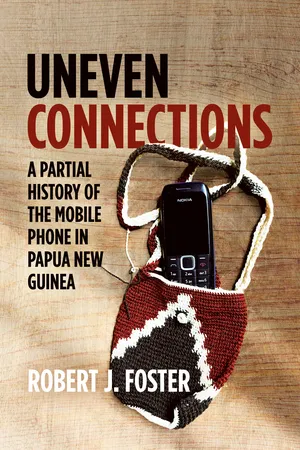
Uneven Connections
eBook - PDF

Uneven Connections

A Partial History of the Mobile Phone in Papua New Guinea

  1. 238 pages
  2. English
  3. PDF
  4. Available on iOS & Android
eBook - PDF

Uneven Connections

A Partial History of the Mobile Phone in Papua New Guinea

About this book

In the first years of the 21st century, economic liberalisation began to transform telecommunications services throughout the Pacific Islands. Government regulators, corporate executives and everyday consumers hopefully imagined that opening mobile phone markets to competition would result in greater access, lower costs and accelerated development.

Uneven Connections examines the ways in which liberalisation took hold in Papua New Guinea (PNG) when a unit of the Caribbean-based mobile network operator Digicel Group Ltd. seized the opportunity to compete with the state-sponsored incumbent. The book highlights how mobile phones entered the lives of urban and rural Papua New Guineans after Digicel's arrival in 2007. In so doing, it describes a moral economy in which companies, consumers and state agents continually negotiate who owes what to whom. In what ways have these various actors invented and negotiated new forms of both freedom and constraint?

Uneven Connections advances understanding of how a so-called digital revolution in PNG unfolded, resulting in outcomes that often confounded the expectations of policy makers and ordinary citizens alike. It assesses the extent to which some of the promises of this revolution have been redeemed and identifies the challenges faced by companies, consumers and state agents in establishing and experiencing novel forms of uneven connectivity. The book provides a short and selective history of mobile phones in PNG, ending with the sale of Digicel's Pacific operations to the Australian company Telstra in 2022.

Frequently asked questions

Yes, you can cancel anytime from the Subscription tab in your account settings on the Perlego website. Your subscription will stay active until the end of your current billing period. Learn how to cancel your subscription.
No, books cannot be downloaded as external files, such as PDFs, for use outside of Perlego. However, you can download books within the Perlego app for offline reading on mobile or tablet. Learn more here.
Perlego offers two plans: Essential and Complete
  • Essential is ideal for learners and professionals who enjoy exploring a wide range of subjects. Access the Essential Library with 800,000+ trusted titles and best-sellers across business, personal growth, and the humanities. Includes unlimited reading time and Standard Read Aloud voice.
  • Complete: Perfect for advanced learners and researchers needing full, unrestricted access. Unlock 1.4M+ books across hundreds of subjects, including academic and specialized titles. The Complete Plan also includes advanced features like Premium Read Aloud and Research Assistant.
Both plans are available with monthly, semester, or annual billing cycles.
We are an online textbook subscription service, where you can get access to an entire online library for less than the price of a single book per month. With over 1 million books across 1000+ topics, we’ve got you covered! Learn more here.
Look out for the read-aloud symbol on your next book to see if you can listen to it. The read-aloud tool reads text aloud for you, highlighting the text as it is being read. You can pause it, speed it up and slow it down. Learn more here.
Yes! You can use the Perlego app on both iOS or Android devices to read anytime, anywhere — even offline. Perfect for commutes or when you’re on the go.
Please note we cannot support devices running on iOS 13 and Android 7 or earlier. Learn more about using the app.
Yes, you can access Uneven Connections by Robert. J Foster in PDF and/or ePUB format, as well as other popular books in Social Sciences & Anthropology. We have over one million books available in our catalogue for you to explore.

Information

Publisher
ANU Press
Year
2024
Print ISBN
9781760466251
eBook ISBN
9781760466268

Table of contents

  1. List of Illustrations
  2. Acknowledgements
  3. Introduction: The Moral Economy of Mobile Phones in Papua New Guinea
  4. Part I. After Liberalisation: An Evolving Mobile Market
  5. Part II. Consumer Uptake: Freedom and Constraint
  6. Part III. Delimiting Mobility: Regulation and Responsibility
  7. Conclusion: Infrastructural Citizenship and Uneven Connections
  8. References