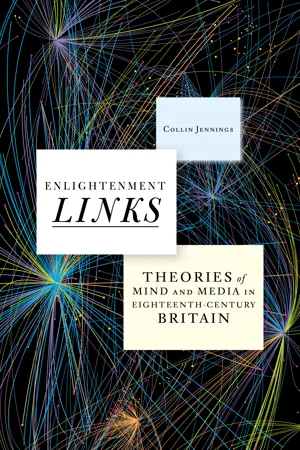
Enlightenment Links
eBook - PDF

Enlightenment Links

Theories of Mind and Media in Eighteenth-Century Britain

  1. 282 pages
  2. English
  3. PDF
  4. Available on iOS & Android
eBook - PDF

Enlightenment Links

Theories of Mind and Media in Eighteenth-Century Britain

About this book

In this ambitious work, Collin Jennings applies computational methods to eighteenth-century fiction, history, and poetry to reveal the nonlinear courses of reading they produce. Hallmark genres of the British Enlightenment, such as the novel and the stadial history, are typically viewed as narratives of linear progress, emerging from Britain's imperial growth and scientific advancement. Jennings foregrounds Enlightenment links: the paratextual devices, including cross-references, footnotes, and epigraphs, that make words work differently by pointing the reader to places inside and outside the text. Writers and printers combined text and paratext to produce nonlinear paths of reading and polysemous forms of reference that resist simple, causal structures of experience or theories of mind. Alexander Pope, Adam Smith, Ann Radcliffe, and other writers developed genres that operate diagrammatically, with different points of entry and varied relationships between the language and format of books.

  Revealing the eighteenth-century genealogy of the digital hyperlinks of today, Enlightenment Links argues that emergent print genres combined language and links to bring forward the associative, circular, and multi-sequential ways in which literature makes language work.

Frequently asked questions

Yes, you can cancel anytime from the Subscription tab in your account settings on the Perlego website. Your subscription will stay active until the end of your current billing period. Learn how to cancel your subscription.
No, books cannot be downloaded as external files, such as PDFs, for use outside of Perlego. However, you can download books within the Perlego app for offline reading on mobile or tablet. Learn more here.
Perlego offers two plans: Essential and Complete
  • Essential is ideal for learners and professionals who enjoy exploring a wide range of subjects. Access the Essential Library with 800,000+ trusted titles and best-sellers across business, personal growth, and the humanities. Includes unlimited reading time and Standard Read Aloud voice.
  • Complete: Perfect for advanced learners and researchers needing full, unrestricted access. Unlock 1.4M+ books across hundreds of subjects, including academic and specialized titles. The Complete Plan also includes advanced features like Premium Read Aloud and Research Assistant.
Both plans are available with monthly, semester, or annual billing cycles.
We are an online textbook subscription service, where you can get access to an entire online library for less than the price of a single book per month. With over 1 million books across 1000+ topics, we’ve got you covered! Learn more here.
Look out for the read-aloud symbol on your next book to see if you can listen to it. The read-aloud tool reads text aloud for you, highlighting the text as it is being read. You can pause it, speed it up and slow it down. Learn more here.
Yes! You can use the Perlego app on both iOS or Android devices to read anytime, anywhere — even offline. Perfect for commutes or when you’re on the go.
Please note we cannot support devices running on iOS 13 and Android 7 or earlier. Learn more about using the app.
Yes, you can access Enlightenment Links by Collin Jennings in PDF and/or ePUB format, as well as other popular books in Literature & Historical & Comparative Linguistics. We have over one million books available in our catalogue for you to explore.

Table of contents

  1. Cover
  2. Title Page
  3. Copyright
  4. Dedication
  5. Contents
  6. Acknowledgments
  7. Introduction: What’s in a Link?
  8. 1. Cross-References: Shapes of Knowledge in Chambers’s Cyclopaedia
  9. 2. Footnotes: The Poetics of Progress
  10. 3. Indexes: Techniques of Abstraction in the Scottish Philosophical History
  11. 4. Epigraphs: Paratextual Spaces in Novels of the 1790s
  12. Conclusion: The Future of Links
  13. Appendix: Data and Methods
  14. Notes
  15. Bibliography
  16. Index
  17. Back Cover