How Turkish poetry became the preferred mode for communicating, debating, and shaping political and social experience in the early Ottoman Empire
Occasions for Poetry is a history of how Turkish poetry became the preferred mode for communicating, debating, and shaping political and social experience in the early Ottoman Empire. After the conquest of Constantinople in 1453, Ottoman elites at the imperial court turned to poetry to craft distinctive modes of expression in order to articulate their own place within the Ottoman sultanate.
Placing Ottoman court poetry in its social and historical context, Oscar Aguirre-Mandujano argues that poetry functioned as a political act. Aguirre-Mandujano examines the occasions that compelled the Ottomans to compose poetry, to present it to their superiors, to share it with their peers, and to spend considerable efforts and time to make poetry often and to make it well. He explores how scholars and bureaucrats interacted with each other through poetic imagery, revealing how literary language affected bureaucratic practice. Poetry was not only an artistic activity, but also a means to advance or save one's own political or bureaucratic career.
For the Ottoman elite, poetry was more than a creative activity or a flattering description of Ottoman power and expansion; it was a vehicle to shape and mold their social reality. The language and genres created and used by these early modern Ottomans would define both a literary tradition and the shape of imperial politics and power for almost six centuries, until the end of the empire in the twentieth century.
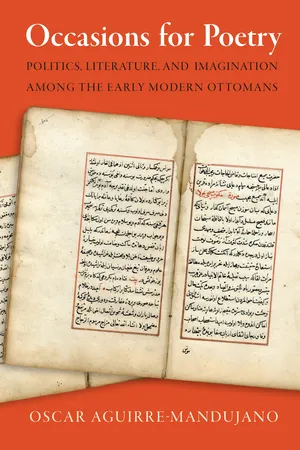
eBook - ePub
Occasions for Poetry
Politics, Literature, and Imagination Among the Early Modern Ottomans
- 280 pages
- English
- ePUB (mobile friendly)
- Available on iOS & Android
eBook - ePub
Occasions for Poetry
Politics, Literature, and Imagination Among the Early Modern Ottomans
About this book
Information
Subtopic
Middle Eastern HistoryIndex
HistoryTable of contents
- Cover
- Title Page
- Copyright
- Dedication
- Contents
- Transliteration, Names, and Diacritics
- Introduction. Poetry in the Lands of Rūm
- Chapter 1. Another Age of Splendor, 1451–1512
- Chapter 2. Toward an Ottoman Poetics: History, Language, and Politics
- Chapter 3. All the Shaykh’s Poets: Poetry and the Making of Charisma
- Chapter 4. Inhabiting Constantinople After the Ottoman Conquest
- Chapter 5. Loss and Separation: Poetry in Exile, Failure, and Death
- Chapter 6. Imperial Diction: Communication, Language, and Choice in Ottoman Political Imagination
- Epilogue
- Notes
- Selected Bibliography
- Index
- Acknowledgments
Trusted by 375,005 students
Access to over 1.5 million titles for a fair monthly price.
Study more efficiently using our study tools.
Frequently asked questions
Yes, you can cancel anytime from the Subscription tab in your account settings on the Perlego website. Your subscription will stay active until the end of your current billing period. Learn how to cancel your subscription
No, books cannot be downloaded as external files, such as PDFs, for use outside of Perlego. However, you can download books within the Perlego app for offline reading on mobile or tablet. Learn how to download books offline
Perlego offers two plans: Essential and Complete
- Essential is ideal for learners and professionals who enjoy exploring a wide range of subjects. Access the Essential Library with 800,000+ trusted titles and best-sellers across business, personal growth, and the humanities. Includes unlimited reading time and Standard Read Aloud voice.
- Complete: Perfect for advanced learners and researchers needing full, unrestricted access. Unlock 1.5M+ books across hundreds of subjects, including academic and specialized titles. The Complete Plan also includes advanced features like Premium Read Aloud and Research Assistant.
We are an online textbook subscription service, where you can get access to an entire online library for less than the price of a single book per month. With over 1.5 million books across 990+ topics, we’ve got you covered! Learn about our mission
Look out for the read-aloud symbol on your next book to see if you can listen to it. The read-aloud tool reads text aloud for you, highlighting the text as it is being read. You can pause it, speed it up and slow it down. Learn more about Read Aloud
Yes! You can use the Perlego app on both iOS and Android devices to read anytime, anywhere — even offline. Perfect for commutes or when you’re on the go.
Please note we cannot support devices running on iOS 13 and Android 7 or earlier. Learn more about using the app
Please note we cannot support devices running on iOS 13 and Android 7 or earlier. Learn more about using the app
Yes, you can access Occasions for Poetry by Oscar Aguirre-Mandujano in PDF and/or ePUB format, as well as other popular books in History & Middle Eastern History. We have over 1.5 million books available in our catalogue for you to explore.