- 320 pages
- English
- ePUB (mobile friendly)
- Available on iOS & Android
About this book
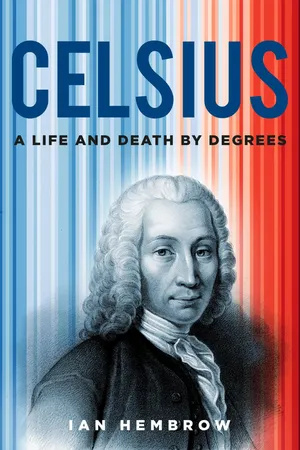
The Swedish astronomer Anders Celsius (1701–44) was arguably the world's first true Earth scientist. In Celsius: A Life and Death by Degrees, Ian Hembrow reveals what his extraordinary, but tragically short, life and career can teach us about our today and humanity's tomorrow.
Our modern understanding of many of the Earth's most awe-inspiring phenomena owes much to a modest and quietly spoken, eighteenth-century Swedish astronomer, who died of tuberculosis aged just 42. From the Northern Lights, air pressure and magnetism to the shape of the planet, sea levels and early studies of climate change, Celsius unravelled some of the greatest mysteries of his time.
Best known for inventing the 100-point ' centi-grade ' scale, Celsius' name also now frames humanity's future in the international targets to limit average global temperature increases to no more than 1.5 degrees above pre-industrial levels. As our world faces this life-or-death struggle, there's much we can learn from Celsius – if we will listen.
Frequently asked questions
- Essential is ideal for learners and professionals who enjoy exploring a wide range of subjects. Access the Essential Library with 800,000+ trusted titles and best-sellers across business, personal growth, and the humanities. Includes unlimited reading time and Standard Read Aloud voice.
- Complete: Perfect for advanced learners and researchers needing full, unrestricted access. Unlock 1.4M+ books across hundreds of subjects, including academic and specialized titles. The Complete Plan also includes advanced features like Premium Read Aloud and Research Assistant.
Please note we cannot support devices running on iOS 13 and Android 7 or earlier. Learn more about using the app.
Information
Table of contents
- Cover
- Title
- Copyright
- Contents
- Foreword
- Prologue
- Charts and Maps
- Anders Celsius’ Timeline
- Part I: Fire
- Part II: Light and Air
- Part III: Land
- Part IV: Sea and Space
- Part V: Temperature and Climate
- Part VI: Time
- Epilogue
- Bibliography
- Acknowledgements
- Notes
- Picture Section