"BRICS: Architects of a New Global Order" is an in-depth and holistic examination of the emerging economic block comprised of Brazil, Russia, India, China and South Africa, which together are redefining power dynamics and influencing the structure of global governance in the 21st century. This book explores in detail the genesis of the BRICS bloc, analyzing the shared motivations, aspirations, and challenges that led these diverse but ambitious countries to unite in a joint effort to reform the world economic and political order. Through an engaging narrative, the book outlines the BRICS economic growth trajectory, highlighting how each member state has navigated the path from development to emergency on the global stage. Particular attention is paid to the economic strategies adopted, the successes achieved and the challenges encountered on their journey towards integration and global economic influence. In addition to economic aspects, "BRICS: Architects of a New Global Order" immerses itself in the complex geopolitical dynamics and sustainable development policies undertaken by the BRICS. The book reviews their bilateral and multilateral relationships, both domestic and with the rest of the world, and discusses their impact on multilateralism, global governance, and international issues such as climate change, security and human rights. Criticism and controversy are not overlooked; the text provides a balanced analysis of the main challenges the BRICS face, including internal cohesion, governance, environmental practices and the social impact of their rapid growth. Through this critical assessment, the book aims to offer a nuanced understanding of the complexities that characterize this economic block and its aspirations for global leadership. In conclusion, the book reflects on the future role of BRICS in the world, proposing reflections on the potential trajectories that these countries could follow in reforming existing global structures and in promoting fairer and more inclusive global development. Enriched with in-depth data, expert analysis and a wide range of perspectives, "BRICS: Architects of a New Global Order" is an indispensable resource for anyone interested in understanding the forces that are shaping our world and the crucial role that BRICS play in this dynamic process.
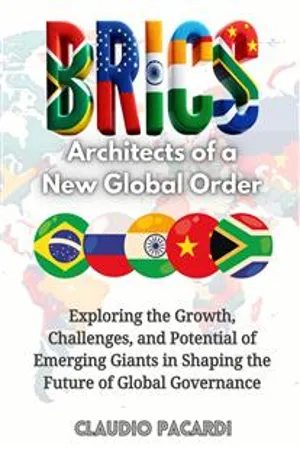
eBook - ePub
BRICS: Architects of a New Global Order
Exploring the Growth, Challenges, and Potential of Emerging Giants in Shaping the Future of Global Governance
- English
- ePUB (mobile friendly)
- Available on iOS & Android
eBook - ePub
BRICS: Architects of a New Global Order
Exploring the Growth, Challenges, and Potential of Emerging Giants in Shaping the Future of Global Governance
About this book
Information
Table of contents
- 1. Introduction to the BRICS: history, formation of the bloc and common objectives.
- 2. Comparative Economic Analysis: comparison of the BRICS economies with those of the G7 nations.
- 3. Economic Development Policies: description of the economic development strategies adopted by each BRICS country.
- 4. Role in Global Governance: BRICS impact on international financial and political institutions
- 5. International Trade and Investment: analysis of trade and investment relations between the BRICS and with the rest of the world.
- 6. Innovation and Technology: focus on how the BRICS are driving innovation in key sectors such as technology, renewable energy and space.
- 7. Environmental Challenges and Sustainability: exploration of environmental policies and initiatives for sustainable development in BRICS countries.
- 8. Population and Social Dynamics: Demography, Urbanization, and Social Issues in the BRICS.
- 9. Culture and Soft Power: BRICS cultural influence at a global level.
- 10. Defense and Security: analysis of defense policies and initiatives for regional and global security.
- 11. Education and Research: state of higher education and scientific research.
- 12. Infrastructure and Urban Development: significant infrastructure and urban development projects.
- 13. Energy and Natural Resources: management of natural resources and energy policies
- 14. Agriculture and Food Security: strategies for sustainable agriculture and food security.
- 15. Domestic Policy and Challenges: discussion on domestic political challenges and reforms in each country.
- 16. Health and Wellbeing: state of health systems and welfare initiatives in the BRICS.
- 17. Future of the BRICS: future prospects and potential scenarios for the development of the bloc.
- 18. Bilateral and Multilateral Relations: examination of key relationships between BRICS members and with other nations.
- 19. Criticism and Controversies: analysis of the main criticisms and controversies concerning the BRICS.
- 20. Conclusions and Final Reflections: summary of key points and reflections on the future role of the BRICS in the world.
Trusted by 375,005 students
Access to over 1.5 million titles for a fair monthly price.
Study more efficiently using our study tools.
Frequently asked questions
Yes, you can cancel anytime from the Subscription tab in your account settings on the Perlego website. Your subscription will stay active until the end of your current billing period. Learn how to cancel your subscription
No, books cannot be downloaded as external files, such as PDFs, for use outside of Perlego. However, you can download books within the Perlego app for offline reading on mobile or tablet. Learn how to download books offline
Perlego offers two plans: Essential and Complete
- Essential is ideal for learners and professionals who enjoy exploring a wide range of subjects. Access the Essential Library with 800,000+ trusted titles and best-sellers across business, personal growth, and the humanities. Includes unlimited reading time and Standard Read Aloud voice.
- Complete: Perfect for advanced learners and researchers needing full, unrestricted access. Unlock 1.5M+ books across hundreds of subjects, including academic and specialized titles. The Complete Plan also includes advanced features like Premium Read Aloud and Research Assistant.
We are an online textbook subscription service, where you can get access to an entire online library for less than the price of a single book per month. With over 1.5 million books across 990+ topics, we’ve got you covered! Learn about our mission
Look out for the read-aloud symbol on your next book to see if you can listen to it. The read-aloud tool reads text aloud for you, highlighting the text as it is being read. You can pause it, speed it up and slow it down. Learn more about Read Aloud
Yes! You can use the Perlego app on both iOS and Android devices to read anytime, anywhere — even offline. Perfect for commutes or when you’re on the go.
Please note we cannot support devices running on iOS 13 and Android 7 or earlier. Learn more about using the app
Please note we cannot support devices running on iOS 13 and Android 7 or earlier. Learn more about using the app
Yes, you can access BRICS: Architects of a New Global Order by Claudio Pacardi in PDF and/or ePUB format, as well as other popular books in Politics & International Relations & Civics & Citizenship. We have over 1.5 million books available in our catalogue for you to explore.