Distills ten volumes, four dictionaries, and 1,800 years of knowledge into an authoritative introduction to the Ben cao gang mu.
The Ben cao gang mu was the world’s most comprehensive encyclopedia of natural history and medicine when it was published in China in 1593. In fifty-two chapters, the physician Li Shizhen recorded two millennia of medical observations, interpreting the wide-ranging uses of plants, animals, minerals, and artificial substances and including countless verbatim quotations along with his own evaluations.
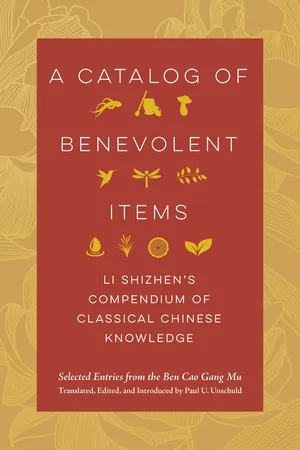
Edited and translated by Paul U. Unschuld, A Catalog of Benevolent Items provides thoughtfully curated selections from the Ben cao gang mu, organized by theme. This anthology offers little-known details of China’s historical knowledge of nature; traditional Chinese medicine and its theoretical foundations; social and cultural facets of ancient Chinese civilization not documented elsewhere; and the information management of a sixteenth-century Chinese scholar.
eBook - ePub
A Catalog of Benevolent Items
Li Shizhen's Compendium of Classical Chinese Knowledge
- 403 pages
- English
- ePUB (mobile friendly)
- Available on iOS & Android
eBook - ePub
About this book
Information
Table of contents
- Title
- Copyright
- Subvention
- Series Page
- Contents
- Preface
- Prolegomena
- 1. Division of items: 16 sections
- 2. Widespread culture, local customs, personal interventions
- 3. Visions of associations: From magic correlations observed in equal appearances and functions to systematized correspondences of the yin and yang and Five Phases doctrines
- 4. Cosmic structures: Numbers, time, and cardinal directions
- 5. Demons and spirits, shamans and exorcism
- 6. Involvement of Buddhists and Daoists
- 7. The human body: Its organs and paths of entrance
- 8. Standing up to nature: Cosmetics, body enhancement, anti-aging
- 9. Social and natural conditioning: Gender and sex
- 10. The significance of reproduction: Fertility and pregnancy, abortion and birth
- 11. Case records: Assessment and justification of therapeutic strategies
- 12. Neglected heritage: Tool-supported therapy
- 13. Sources of therapeutic expertise: Beggar and sovereign, chance encounters and dreams
- 14. Dealing with poison
- 15. Raw materials found in nature and objects produced from them
- 16. Explanation of names
- 17. “Further research is required”: Controversy and judgment
- 18. Sample text and plant monograph: Chai hu, sickle-leaved hare’s ear
- Notes
- Appendix
- Glossary
Trusted by 375,005 students
Access to over 1.5 million titles for a fair monthly price.
Study more efficiently using our study tools.
Frequently asked questions
Yes, you can cancel anytime from the Subscription tab in your account settings on the Perlego website. Your subscription will stay active until the end of your current billing period. Learn how to cancel your subscription
No, books cannot be downloaded as external files, such as PDFs, for use outside of Perlego. However, you can download books within the Perlego app for offline reading on mobile or tablet. Learn how to download books offline
We are an online textbook subscription service, where you can get access to an entire online library for less than the price of a single book per month. With over 1.5 million books across 990+ topics, we’ve got you covered! Learn about our mission
Look out for the read-aloud symbol on your next book to see if you can listen to it. The read-aloud tool reads text aloud for you, highlighting the text as it is being read. You can pause it, speed it up and slow it down. Learn more about Read Aloud
Yes! You can use the Perlego app on both iOS and Android devices to read anytime, anywhere — even offline. Perfect for commutes or when you’re on the go.
Please note we cannot support devices running on iOS 13 and Android 7 or earlier. Learn more about using the app
Please note we cannot support devices running on iOS 13 and Android 7 or earlier. Learn more about using the app
Yes, you can access A Catalog of Benevolent Items by Li Shizhen in PDF and/or ePUB format, as well as other popular books in Medicine & Chinese History. We have over 1.5 million books available in our catalogue for you to explore.