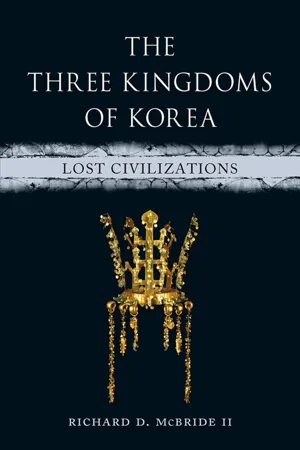
Korea's Three Kingdoms period is a genuine 'lost civilization', during which ancient realms vied for supremacy during the first millennium CE. Nobles from this period's feuding states adopted and adapted Buddhism and Confucianism through interactions with early medieval Chinese dynasties. In the mid-seventh century, with the assistance of the mighty Chinese Tang empire, the aristocratic Silla state ultimately unified the Three Kingdoms by conquering the militaristic northern kingdom of Kogury? and the culturally sophisticated state of Paekche.
Weaving together legends of founding kings, tales of wars and political intrigue and narratives of fascinating individuals – including flower boys, wise monks, loyal scholars and virtuous women – this exploration sheds new light on a foundational period that continues to shape Korean identity today.
- 256 pages
- English
- ePUB (mobile friendly)
- Available on iOS & Android
eBook - ePub
About this book
Information
Table of contents
- Front Cover
- Half Title
- Title Page
- Copyright
- CONTENTS
- CHRONOLOGY
- INTRODUCTION
- 1 LEGENDS AND ORIGINS OF KOREA’S THREE KINGDOMS
- 2 KOGURYŎ AND PAEKCHE
- 3 KAYA AND EARLY SILLA
- 4 RELIGION AND CULTURE IN THE EARLY THREE KINGDOMS
- 5 GREATER SILLA AND PARHAE
- 6 THE FLOURISHING OF BUDDHISM AND CONFUCIANISM IN GREATER SILLA
- 7 THE GOOD, THE BAD AND THE UGLY IN THE LATER THREE KINGDOMS
- EPILOGUE
- REFERENCES
- BIBLIOGRAPHY
- PHOTO ACKNOWLEDGEMENTS
- INDEX
Trusted by 375,005 students
Access to over 1.5 million titles for a fair monthly price.
Study more efficiently using our study tools.
Frequently asked questions
Yes, you can cancel anytime from the Subscription tab in your account settings on the Perlego website. Your subscription will stay active until the end of your current billing period. Learn how to cancel your subscription
No, books cannot be downloaded as external files, such as PDFs, for use outside of Perlego. However, you can download books within the Perlego app for offline reading on mobile or tablet. Learn how to download books offline
We are an online textbook subscription service, where you can get access to an entire online library for less than the price of a single book per month. With over 1.5 million books across 990+ topics, we’ve got you covered! Learn about our mission
Look out for the read-aloud symbol on your next book to see if you can listen to it. The read-aloud tool reads text aloud for you, highlighting the text as it is being read. You can pause it, speed it up and slow it down. Learn more about Read Aloud
Yes! You can use the Perlego app on both iOS and Android devices to read anytime, anywhere — even offline. Perfect for commutes or when you’re on the go.
Please note we cannot support devices running on iOS 13 and Android 7 or earlier. Learn more about using the app
Please note we cannot support devices running on iOS 13 and Android 7 or earlier. Learn more about using the app
Yes, you can access The Three Kingdoms of Korea by Richard D. McBride II in PDF and/or ePUB format, as well as other popular books in History & Ancient History. We have over 1.5 million books available in our catalogue for you to explore.