eBook - PDF
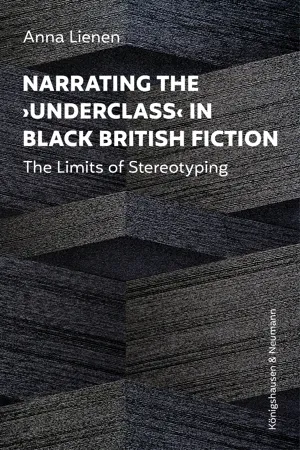
Narrating the ›Underclass‹ in Black British Fiction
The Limits of Stereotyping
- 287 pages
- English
- PDF
- Available on iOS & Android
eBook - PDF
About this book
When one is poor and black, it is hard »to come into representation«
(Hall, New Ethnicities 164). Those on the margins of society are usually
talked and written about rather than given a voice of their own.
Young black men in particular are stereotyped as criminal and violent,
as dangerous threats to society. In this context the term ›underclass‹
comes up time and again in public discourse. It is a very controversial
label which masquerades as a scientific descriptor but actually fulfils
the ideological function of stigmatising the poor and justifying their
criminalisation and marginalisation.
Black British novels dealing with the ›underclass‹, such as Alex
Wheatle's East of Acre Lane (2001) and The Dirty South (2008) as well
as Courttia Newland's The Scholar (1997), put those living on the periphery
of British society at the centre of their narratives – as focalisers
or first-person narrators. Their stories provide a place where stereotypes
about ›black youth‹ are scrutinised and challenged.
Within the field of black British fiction, black ›underclass‹ subjectivities
seem to be somewhat overlooked in literary representations; and
they only appear on the margins of academic research. This study aims
at improving this situation by providing a comprehensive analysis of
the representational strategies employed by the selected black British
novels as well as discussing the conditions under which black British
authors and their work are perceived and marketed by the publishing
industry. The analysis draws attention to the way in which structural
racism, classism and sexism impact protagonists and authors alike.
Information
Table of contents
- Frontmatter
- Introduction
- Part I: Theoretical Framework
- Part II: Pervasive Stereotypes and their Limiting Effects on Identity Constructions
- Part III: Spatial and Narrative Strategies of Representing Limitations
- Part IV: Producing, Regulating and Consuming Stereotypes
Trusted by 375,005 students
Access to over 1.5 million titles for a fair monthly price.
Study more efficiently using our study tools.
Frequently asked questions
Yes, you can cancel anytime from the Subscription tab in your account settings on the Perlego website. Your subscription will stay active until the end of your current billing period. Learn how to cancel your subscription
No, books cannot be downloaded as external files, such as PDFs, for use outside of Perlego. However, you can download books within the Perlego app for offline reading on mobile or tablet. Learn how to download books offline
Perlego offers two plans: Essential and Complete
- Essential is ideal for learners and professionals who enjoy exploring a wide range of subjects. Access the Essential Library with 800,000+ trusted titles and best-sellers across business, personal growth, and the humanities. Includes unlimited reading time and Standard Read Aloud voice.
- Complete: Perfect for advanced learners and researchers needing full, unrestricted access. Unlock 1.5M+ books across hundreds of subjects, including academic and specialized titles. The Complete Plan also includes advanced features like Premium Read Aloud and Research Assistant.
We are an online textbook subscription service, where you can get access to an entire online library for less than the price of a single book per month. With over 1.5 million books across 990+ topics, we’ve got you covered! Learn about our mission
Look out for the read-aloud symbol on your next book to see if you can listen to it. The read-aloud tool reads text aloud for you, highlighting the text as it is being read. You can pause it, speed it up and slow it down. Learn more about Read Aloud
Yes! You can use the Perlego app on both iOS and Android devices to read anytime, anywhere — even offline. Perfect for commutes or when you’re on the go.
Please note we cannot support devices running on iOS 13 and Android 7 or earlier. Learn more about using the app
Please note we cannot support devices running on iOS 13 and Android 7 or earlier. Learn more about using the app
Yes, you can access Narrating the ›Underclass‹ in Black British Fiction by Anna Lienen in PDF and/or ePUB format, as well as other popular books in Languages & Linguistics & Linguistics. We have over 1.5 million books available in our catalogue for you to explore.