The turn of the twenty-first century saw the rise of a brand of fiction that centres the experience and perspective of the perpetrator, thereby humanizing this character and granting it the capability to evoke our empathy. The vast scholarship published on this phenomenon, however, fails to consider Israeli writing, and with it some of the most complex characterizations of Holocaust perpetrators, imagined from the unparalleled position of a nation that was shaped from its very birth by the legacy of Holocaust victimhood and survival.
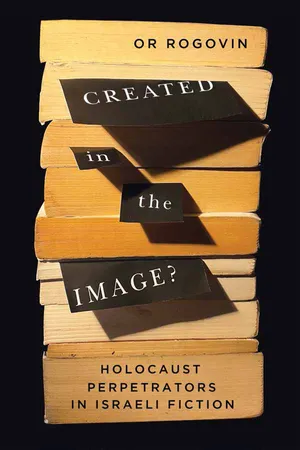
In Created in the Image? Or Rogovin situates Israeli literary responses to the Holocaust in the canon of perpetrator fiction for the first time. Since the state's establishment in 1948, perpetrator characterization in Israeli fiction has demonstrated a remarkable development that corresponds to changing circumstances, from the Eichmann trial to the First Intifada. While early examples depicted perpetrators stereotypically and minimally - as seen in Ka-Tzetnik's demonic and bestial Nazis in Salamandra and in the amorphous persecutor figures in Aharon Appelfeld's stories - since the mid-1980s these characters have been created in the human image, as nuanced and multidimensional individuals. The turning point came with Herr Neigel, the sensitive and self-contradictory commandant in David Grossman's See Under: Love (1986), followed by likewise multifaceted and humanized perpetrators in fiction by A.B. Yehoshua, Savyon Liebrecht, and Amir Gutfreund.
Anchored in theoretical and comparative perspectives, Created in the Image? presents a groundbreaking analysis of the poetic mechanisms, moral implications, and historical contexts of this paradigm shift in the Israeli literary response to the Shoah.
- 288 pages
- English
- ePUB (mobile friendly)
- Available on iOS & Android
eBook - ePub
About this book
Information
Table of contents
- Cover Page
- Title Page
- Copyright
- Contents
- Acknowledgments
- Introduction
- Chapter 1: Holocaust Perpetrators from Fact to Fiction: Characterization and Its Moral Implications
- Part 1 | The Simple Mode of Perpetrator Characterization
- Part 2 | The Complex Mode of Perpetrator Characterization
- Notes
- Bibliography
- Index
Trusted by 375,005 students
Access to over 1.5 million titles for a fair monthly price.
Study more efficiently using our study tools.
Frequently asked questions
Yes, you can cancel anytime from the Subscription tab in your account settings on the Perlego website. Your subscription will stay active until the end of your current billing period. Learn how to cancel your subscription
No, books cannot be downloaded as external files, such as PDFs, for use outside of Perlego. However, you can download books within the Perlego app for offline reading on mobile or tablet. Learn how to download books offline
Perlego offers two plans: Essential and Complete
- Essential is ideal for learners and professionals who enjoy exploring a wide range of subjects. Access the Essential Library with 800,000+ trusted titles and best-sellers across business, personal growth, and the humanities. Includes unlimited reading time and Standard Read Aloud voice.
- Complete: Perfect for advanced learners and researchers needing full, unrestricted access. Unlock 1.5M+ books across hundreds of subjects, including academic and specialized titles. The Complete Plan also includes advanced features like Premium Read Aloud and Research Assistant.
We are an online textbook subscription service, where you can get access to an entire online library for less than the price of a single book per month. With over 1.5 million books across 990+ topics, we’ve got you covered! Learn about our mission
Look out for the read-aloud symbol on your next book to see if you can listen to it. The read-aloud tool reads text aloud for you, highlighting the text as it is being read. You can pause it, speed it up and slow it down. Learn more about Read Aloud
Yes! You can use the Perlego app on both iOS and Android devices to read anytime, anywhere — even offline. Perfect for commutes or when you’re on the go.
Please note we cannot support devices running on iOS 13 and Android 7 or earlier. Learn more about using the app
Please note we cannot support devices running on iOS 13 and Android 7 or earlier. Learn more about using the app
Yes, you can access Created in the Image? by Or Rogovin in PDF and/or ePUB format, as well as other popular books in Literature & Jewish Literary Criticism. We have over 1.5 million books available in our catalogue for you to explore.