Lake Ontario has profoundly influenced the historical evolution of North America. For centuries it has enabled and enriched the societies that crowded its edges, from fertile agricultural landscapes to energy production systems to sprawling cities.
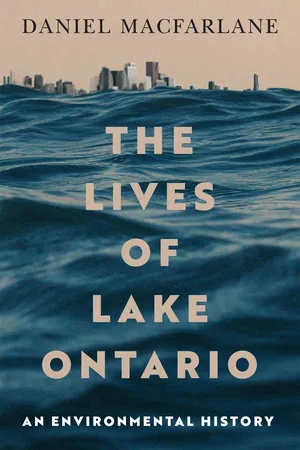
In The Lives of Lake Ontario Daniel Macfarlane details the lake’s relationship with the Indigenous nations, settler cultures, and modern countries that have occupied its shores. He examines the myriad ways Canada and the United States have used and abused this resource: through dams and canals, drinking water and sewage, trash and pollution, fish and foreign species, industry and manufacturing, urbanization and infrastructure, population growth and biodiversity loss. Serving as both bridge and buffer between the two countries, Lake Ontario came to host Canada’s largest megalopolis. Yet its transborder exploitation exacted a tremendous ecological cost, leading people to abandon the lake. Innovative regulations in the later twentieth century, such as the Great Lakes Water Quality Agreements, have partially improved Lake Ontario’s health.
Despite signs that communities are re-engaging with Lake Ontario, it remains the most degraded of the Great Lakes, with new and old problems alike exacerbated by climate change. The Lives of Lake Ontario demonstrates that this lake is both remarkably resilient and uniquely vulnerable.
- 280 pages
- English
- ePUB (mobile friendly)
- Available on iOS & Android
eBook - ePub
About this book
Information
Print ISBN
9780228026549
9780228022237
Subtopic
North American HistoryTable of contents
- Cover Page
- Title Page
- Copyright
- Contents
- Figures
- Acknowledgments
- Introduction
- 1 Glaciers and Empires
- 2 Settlers and Ecologies
- 3 Canals and Ships
- 4 Cities and Growth
- 5 Energy and Megaprojects
- 6 Fisheries and Invasives
- 7 Pollution and Protection
- 8 Levels and Regulation
- Conclusion: Listen to the Lake
- Notes
- Bibliography
- Index
Trusted by 375,005 students
Access to over 1.5 million titles for a fair monthly price.
Study more efficiently using our study tools.
Frequently asked questions
Yes, you can cancel anytime from the Subscription tab in your account settings on the Perlego website. Your subscription will stay active until the end of your current billing period. Learn how to cancel your subscription
No, books cannot be downloaded as external files, such as PDFs, for use outside of Perlego. However, you can download books within the Perlego app for offline reading on mobile or tablet. Learn how to download books offline
Perlego offers two plans: Essential and Complete
- Essential is ideal for learners and professionals who enjoy exploring a wide range of subjects. Access the Essential Library with 800,000+ trusted titles and best-sellers across business, personal growth, and the humanities. Includes unlimited reading time and Standard Read Aloud voice.
- Complete: Perfect for advanced learners and researchers needing full, unrestricted access. Unlock 1.5M+ books across hundreds of subjects, including academic and specialized titles. The Complete Plan also includes advanced features like Premium Read Aloud and Research Assistant.
We are an online textbook subscription service, where you can get access to an entire online library for less than the price of a single book per month. With over 1.5 million books across 990+ topics, we’ve got you covered! Learn about our mission
Look out for the read-aloud symbol on your next book to see if you can listen to it. The read-aloud tool reads text aloud for you, highlighting the text as it is being read. You can pause it, speed it up and slow it down. Learn more about Read Aloud
Yes! You can use the Perlego app on both iOS and Android devices to read anytime, anywhere — even offline. Perfect for commutes or when you’re on the go.
Please note we cannot support devices running on iOS 13 and Android 7 or earlier. Learn more about using the app
Please note we cannot support devices running on iOS 13 and Android 7 or earlier. Learn more about using the app
Yes, you can access The Lives of Lake Ontario by Daniel Macfarlane in PDF and/or ePUB format. We have over 1.5 million books available in our catalogue for you to explore.