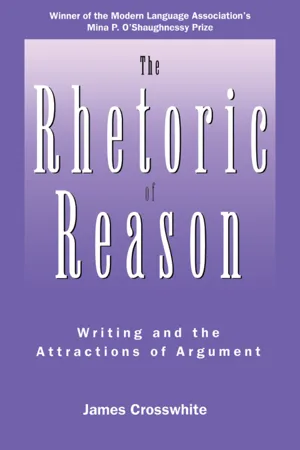
Responding to skeptics within higher education and critics without, James Crosswhite argues powerfully that the core of a college education should be learning to write a reasoned argument. A trained philosopher and director of a university-wide composition program, Crosswhite challenges his readers—teachers of writing and communication, philosophers, critical theorists, and educational administrators—to reestablish the traditional role of rhetoric in education.
To those who have lost faith in the abilities of people to reach reasoned mutual agreements, and to others who have attacked the right-or-wrong model of formal logic, this book offers the reminder that the rhetorical tradition has always viewed argumentation as a dialogue, a response to changing situations, an exchange of persuading, listening, and understanding. Crosswhite's aim is to give new purpose to writing instruction and to students' writing, to reinvest both with the deep ethical interests of the rhetorical tradition. In laying out the elements of argumentation, for example, he shows that claiming, questioning, and giving reasons are not simple elements of formal logic, but communicative acts with complicated ethical features. Students must learn not only how to construct an argument, but the purposes, responsibilities, and consequences of engaging in one.
Crosswhite supports his aims through a rhetorical reconstruction of reason, offering new interpretations of Plato and Aristotle and of the concepts of reflection and dialogue from early modernity through Hegel to Gadamer. And, in his conclusion, he ties these theoretical and historical underpinnings to current problems of higher education, the definition of the liberal arts, and, especially, the teaching of written communication.
To those who have lost faith in the abilities of people to reach reasoned mutual agreements, and to others who have attacked the right-or-wrong model of formal logic, this book offers the reminder that the rhetorical tradition has always viewed argumentation as a dialogue, a response to changing situations, an exchange of persuading, listening, and understanding. Crosswhite's aim is to give new purpose to writing instruction and to students' writing, to reinvest both with the deep ethical interests of the rhetorical tradition. In laying out the elements of argumentation, for example, he shows that claiming, questioning, and giving reasons are not simple elements of formal logic, but communicative acts with complicated ethical features. Students must learn not only how to construct an argument, but the purposes, responsibilities, and consequences of engaging in one.
Crosswhite supports his aims through a rhetorical reconstruction of reason, offering new interpretations of Plato and Aristotle and of the concepts of reflection and dialogue from early modernity through Hegel to Gadamer. And, in his conclusion, he ties these theoretical and historical underpinnings to current problems of higher education, the definition of the liberal arts, and, especially, the teaching of written communication.