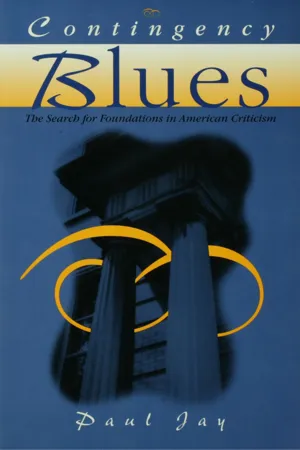
From Emerson to Rorty, American criticism has grappled in one way or another with the problem of modernity—specifically, how to determine critical and cultural standards in a world where every position seems the product of an interpretation. Part intellectual history, part cultural critique, this provocative book is an effort to shake American thought out of the grip of the nineteenth century—and out of its contingency blues.
Paul Jay focuses his analysis on two strands of American criticism. The first, which includes Richard Poirier and Giles Gunn, has attempted to revive what Jay insists is an anachronistic pragmatism derived from Emerson, James, and Dewey. The second, represented most forcefully by Richard Rorty, tends to reduce American criticism to a metadiscourse about the contingent grounds of knowledge. In chapters on Emerson, Whitman, Santayana, Van Wyck Brooks, Dewey, and Kenneth Burke, Jay examines the historical roots of these two positions, which he argues are marked by recurrent attempts to reconcile transcendentalism and pragmatism. A forceful rejection of both kinds of revisionism, Contingency Blues locates an alternative in the work of the "border studies" critics, those who give our interest in contingency a new, more concrete form by taking a more historical, cultural, and anthropological approach to the invention of literature, subjectivity, community, and culture in a pan-American context.
- 236 pages
- English
- PDF
- Available on iOS & Android
eBook - PDF
About this book
Information
Publisher
University of Wisconsin PressYear
1997Print ISBN
9780299154141
9780299154103
eBook ISBN
9780299154134
Table of contents
- Contents
- Acknowledgments
- Introduction
- 1. Modernity and Nature in Emerson
- 2. Emerson, Whitman, and the Problem of Culture
- 3. George Santayana and Van Wyck Brooks: Pragmatism and the Genteel Tradition
- 4. John Dewey: Pragmatism, Modernism, and Aesthetic Criticsm
- 5. Kenneth Burke: Modernism and the Motives of Rhetoric
- Conclusion Rhetoric, Neopragmatism, Border Studies - Beyond the Contingency Blues
- Notes
- Works Cited
- Index
Trusted by 375,005 students
Access to over 1.5 million titles for a fair monthly price.
Study more efficiently using our study tools.
Frequently asked questions
Yes, you can cancel anytime from the Subscription tab in your account settings on the Perlego website. Your subscription will stay active until the end of your current billing period. Learn how to cancel your subscription
No, books cannot be downloaded as external files, such as PDFs, for use outside of Perlego. However, you can download books within the Perlego app for offline reading on mobile or tablet. Learn how to download books offline
Perlego offers two plans: Essential and Complete
- Essential is ideal for learners and professionals who enjoy exploring a wide range of subjects. Access the Essential Library with 800,000+ trusted titles and best-sellers across business, personal growth, and the humanities. Includes unlimited reading time and Standard Read Aloud voice.
- Complete: Perfect for advanced learners and researchers needing full, unrestricted access. Unlock 1.5M+ books across hundreds of subjects, including academic and specialized titles. The Complete Plan also includes advanced features like Premium Read Aloud and Research Assistant.
We are an online textbook subscription service, where you can get access to an entire online library for less than the price of a single book per month. With over 1.5 million books across 990+ topics, we’ve got you covered! Learn about our mission
Look out for the read-aloud symbol on your next book to see if you can listen to it. The read-aloud tool reads text aloud for you, highlighting the text as it is being read. You can pause it, speed it up and slow it down. Learn more about Read Aloud
Yes! You can use the Perlego app on both iOS and Android devices to read anytime, anywhere — even offline. Perfect for commutes or when you’re on the go.
Please note we cannot support devices running on iOS 13 and Android 7 or earlier. Learn more about using the app
Please note we cannot support devices running on iOS 13 and Android 7 or earlier. Learn more about using the app
Yes, you can access Contingency Blues by Paul Jay in PDF and/or ePUB format, as well as other popular books in Literature & Literary Criticism. We have over 1.5 million books available in our catalogue for you to explore.