eBook - ePub
The Catalan Crisis
Between Spanish Liberal Democracy and State (dis) Unity
- 288 pages
- English
- ePUB (mobile friendly)
- Available on iOS & Android
eBook - ePub
About this book
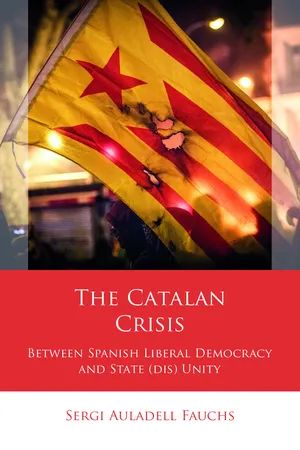
This study is unique for its anti-essentialist approach to the recent political crisis between Catalonia and Spain. Through a blending of post-Marxist and Lacanian discourse-analysis, it tackles the ontological foundations of the post-1978 status quo between Catalonia and Spain, its partial dissolution during the 2010s, and the attempt made by a significant share of the Catalan population and political leadership to achieve an alternative politico-territorial status. With a radical critique of how the universalism of state unity (and its alternatives) work as organising principles for our political experience of the world, the text analyses the political manifestos, court decisions, and parliamentary speeches of Catalan and Spanish politics of the period. It then proceeds to argue that the Catalan crisis should be understood as the by-product of the mainstream nationalising discourse, whereby Spain has become a liberal democracy after General Franco's dictatorship.
Information
Table of contents
- Cover
- Title Page
- Copyright Page
- Series Editors’ Foreword
- Preface
- 1 Introduction
- 2 The Essentialist Pitfalls of the Literature
- 3 A Psychoanalytical and Post-Marxist Approach to Social Institution and Change
- 4 On Monadic Unity: The Point de capiton of the Status Quo (and the Seeds of its Dissolution)
- 5 The Rule of Law and the Symptoms of Consensual Democracy
- 6 Sourcing Absence and Alienation to Name Collective Emancipation
- 7 The Sublimation of Choice into an Emancipatory Horizon: A Procés to Exert the Dret a decidir
- 8 Conclusion
- Notes
- Bibliography
Trusted by 375,005 students
Access to over 1.5 million titles for a fair monthly price.
Study more efficiently using our study tools.
Frequently asked questions
Yes, you can cancel anytime from the Subscription tab in your account settings on the Perlego website. Your subscription will stay active until the end of your current billing period. Learn how to cancel your subscription
No, books cannot be downloaded as external files, such as PDFs, for use outside of Perlego. However, you can download books within the Perlego app for offline reading on mobile or tablet. Learn how to download books offline
Perlego offers two plans: Essential and Complete
- Essential is ideal for learners and professionals who enjoy exploring a wide range of subjects. Access the Essential Library with 800,000+ trusted titles and best-sellers across business, personal growth, and the humanities. Includes unlimited reading time and Standard Read Aloud voice.
- Complete: Perfect for advanced learners and researchers needing full, unrestricted access. Unlock 1.5M+ books across hundreds of subjects, including academic and specialized titles. The Complete Plan also includes advanced features like Premium Read Aloud and Research Assistant.
We are an online textbook subscription service, where you can get access to an entire online library for less than the price of a single book per month. With over 1.5 million books across 990+ topics, we’ve got you covered! Learn about our mission
Look out for the read-aloud symbol on your next book to see if you can listen to it. The read-aloud tool reads text aloud for you, highlighting the text as it is being read. You can pause it, speed it up and slow it down. Learn more about Read Aloud
Yes! You can use the Perlego app on both iOS and Android devices to read anytime, anywhere — even offline. Perfect for commutes or when you’re on the go.
Please note we cannot support devices running on iOS 13 and Android 7 or earlier. Learn more about using the app
Please note we cannot support devices running on iOS 13 and Android 7 or earlier. Learn more about using the app
Yes, you can access The Catalan Crisis by Sergi Auladell Fauchs in PDF and/or ePUB format, as well as other popular books in Politics & International Relations & European Politics. We have over 1.5 million books available in our catalogue for you to explore.