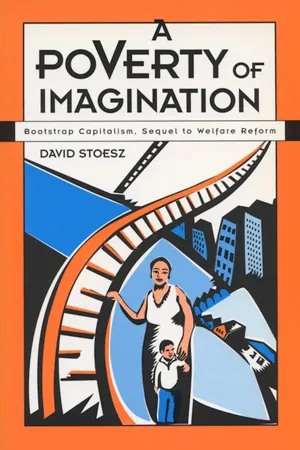
Welfare reform was supposed to end welfare as we know it. And it has. The welfare poor have been largely transformed into the working poor, but their poverty persists. This hard-hitting book takes a close look at where we've gone wrong—and where we might go next if we truly want to improve the lot of America's underclass.
Tracing the roots of recent reforms to the early days of the war on poverty, A Poverty of Imagination describes a social welfare system grown increasingly inept, corrupt, and susceptible to conservative redesign. Investigating the causes of the ongoing failure of welfare assistance, Stoesz focuses on the economic barriers that impede movement out of poverty into the American mainstream. He explores such issues as the heterogeneity of welfare families, generational welfare, inadequate benefits, the negative effects of time limits on welfare recipients, a fringe banking industry that exploits low-income families, the limited capacity of low-wage markets, and the unavailability of credit.
Stoesz suggests that a form of "bootstrap capitalism" would allow individuals and families to participate more fully in American society and achieve upward economic mobility and stability. This proposal, emphasizing wage supplements, asset building, and community capitalism, sets the stage for the next act in poverty policy in the United States. With its valuable insights on the American welfare system and its positive agenda for change, this book makes a significant intervention in our ongoing struggle to come to terms with widespread poverty in the wealthiest nation on earth.
- 226 pages
- English
- PDF
- Available on iOS & Android
eBook - PDF
About this book
Information
Publisher
University of Wisconsin PressYear
2000Print ISBN
9780299169541
9780299169503
eBook ISBN
9780299169534
Table of contents
- Contents
- Illustrations
- Preface
- 1. The End of Welfare
- 2. The Old Maternalism
- 3. The New Paternalism
- 4. Welfare Behaviorism
- 5. The Dynamics of Welfare and Work
- 6. Bootstrap Capitalism
- Notes
- Index
Trusted by 375,005 students
Access to over 1.5 million titles for a fair monthly price.
Study more efficiently using our study tools.
Frequently asked questions
Yes, you can cancel anytime from the Subscription tab in your account settings on the Perlego website. Your subscription will stay active until the end of your current billing period. Learn how to cancel your subscription
No, books cannot be downloaded as external files, such as PDFs, for use outside of Perlego. However, you can download books within the Perlego app for offline reading on mobile or tablet. Learn how to download books offline
Perlego offers two plans: Essential and Complete
- Essential is ideal for learners and professionals who enjoy exploring a wide range of subjects. Access the Essential Library with 800,000+ trusted titles and best-sellers across business, personal growth, and the humanities. Includes unlimited reading time and Standard Read Aloud voice.
- Complete: Perfect for advanced learners and researchers needing full, unrestricted access. Unlock 1.5M+ books across hundreds of subjects, including academic and specialized titles. The Complete Plan also includes advanced features like Premium Read Aloud and Research Assistant.
We are an online textbook subscription service, where you can get access to an entire online library for less than the price of a single book per month. With over 1.5 million books across 990+ topics, we’ve got you covered! Learn about our mission
Look out for the read-aloud symbol on your next book to see if you can listen to it. The read-aloud tool reads text aloud for you, highlighting the text as it is being read. You can pause it, speed it up and slow it down. Learn more about Read Aloud
Yes! You can use the Perlego app on both iOS and Android devices to read anytime, anywhere — even offline. Perfect for commutes or when you’re on the go.
Please note we cannot support devices running on iOS 13 and Android 7 or earlier. Learn more about using the app
Please note we cannot support devices running on iOS 13 and Android 7 or earlier. Learn more about using the app
Yes, you can access A Poverty of Imagination by David Stoesz in PDF and/or ePUB format, as well as other popular books in Social Sciences & Social Work. We have over 1.5 million books available in our catalogue for you to explore.