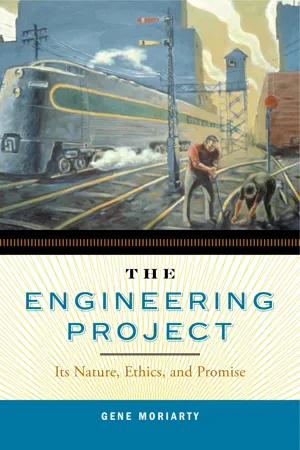
The Engineering Project
eBook - PDF

The Engineering Project

Its Nature, Ethics, and Promise

  1. English
  2. PDF
  3. Available on iOS & Android
eBook - PDF

The Engineering Project

Its Nature, Ethics, and Promise

About this book

We all live our daily lives surrounded by the products of technology that make what we do simpler, faster, and more efficient. These are benefits we often just take for granted. But at the same time, as these products disburden us of unwanted tasks that consumed much time and effort in earlier eras, many of them also leave us more disengaged from our natural and even human surroundings. It is the task of what Gene Moriarty calls focal engineering to create products that will achieve a balance between disburdenment and engagement: "How much disburdenment will be appropriate while still permitting an engagement that enriches one's life, elevates the spirit, and calls forth a good life in a convivial society?"

One of his examples of a focally engineered structure is the Golden Gate Bridge, which "draws people to it, enlivens and elevates the human spirit, and resonates with the world of its congenial setting. Humans, bridge, and world are in tune." These values of engagement, enlivenment, and resonance are key to the normative approach Moriarty brings to the profession of engineering, which traditionally has focused mainly on technical measures of evaluation such as efficiency, productivity, objectivity, and precision. These measures, while important, look at the engineered product in a local and limited sense. But "from a broader perspective, what is locally benign may present serious moral problems," undermining "social justice, environmental sustainability, and health and safety of affected parties." It is this broader perspective that is championed by focal engineering, the subject of Part III of the book, which Moriarty contrasts with "modern" engineering in Part I and "pre-modern" engineering in Part II.

Frequently asked questions

Yes, you can cancel anytime from the Subscription tab in your account settings on the Perlego website. Your subscription will stay active until the end of your current billing period. Learn how to cancel your subscription.
No, books cannot be downloaded as external files, such as PDFs, for use outside of Perlego. However, you can download books within the Perlego app for offline reading on mobile or tablet. Learn more here.
Perlego offers two plans: Essential and Complete
  • Essential is ideal for learners and professionals who enjoy exploring a wide range of subjects. Access the Essential Library with 800,000+ trusted titles and best-sellers across business, personal growth, and the humanities. Includes unlimited reading time and Standard Read Aloud voice.
  • Complete: Perfect for advanced learners and researchers needing full, unrestricted access. Unlock 1.4M+ books across hundreds of subjects, including academic and specialized titles. The Complete Plan also includes advanced features like Premium Read Aloud and Research Assistant.
Both plans are available with monthly, semester, or annual billing cycles.
We are an online textbook subscription service, where you can get access to an entire online library for less than the price of a single book per month. With over 1 million books across 1000+ topics, we’ve got you covered! Learn more here.
Look out for the read-aloud symbol on your next book to see if you can listen to it. The read-aloud tool reads text aloud for you, highlighting the text as it is being read. You can pause it, speed it up and slow it down. Learn more here.
Yes! You can use the Perlego app on both iOS or Android devices to read anytime, anywhere — even offline. Perfect for commutes or when you’re on the go.
Please note we cannot support devices running on iOS 13 and Android 7 or earlier. Learn more about using the app.
Yes, you can access The Engineering Project by Gene Moriarty in PDF and/or ePUB format, as well as other popular books in Philosophy & Ethics & Moral Philosophy. We have over one million books available in our catalogue for you to explore.

Table of contents

  1. Cover
  2. Copyright
  3. Contents
  4. Preface and Acknowledgments
  5. Introduction
  6. 1. Process
  7. 2. Process Ethics
  8. 3. Colonization
  9. 4. Person
  10. 5. Virtue Ethics
  11. 6. Contextualization
  12. 7. Product
  13. 8. Material Ethics
  14. 9. Balance
  15. Index
  16. Back Cover