Limiting Resources
eBook - PDF

Limiting Resources

Market-Led Reform and the Transformation of Public Goods

  1. English
  2. PDF
  3. Available on iOS & Android
eBook - PDF

Limiting Resources

Market-Led Reform and the Transformation of Public Goods

About this book

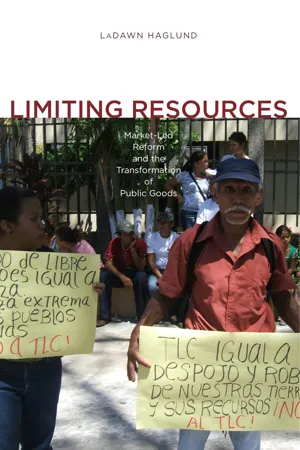
The provision of public goods such as education, electricity, health, sanitation, and water used to be regarded as primarily the responsibility of governments, but in the 1980s privatization of such services spread and reliance on market mechanisms instead of governments became common in many parts of the world, including developing countries. The record of the past twenty-five years of market-led development, however, has not been encouraging. Not only has it failed to improve public services significantly, but it has also undermined democratic institutions and processes, reproduced authoritarian relations of power, and suppressed alternatives made possible by an increasing global acceptance of the importance of economic and social rights. In Limiting Resources, LaDawn Haglund seeks an understanding of public goods that can better serve the needs of people in developing countries today.

Haglund critiques the narrow conception of public goods used in economics, which tends to limit the range of resources considered "public," and proposes an expanded conception drawing from multiple disciplines that incorporates issues of justice, inclusion, and sustainability. She then uses case studies of electricity and water provision in Central America to illuminate the conditions for success and the causes of failure in constructing adequate mechanisms for the supply of public goods. She follows with an analysis of political conflicts over privatization that reveals how neoliberal policies have made effective state action difficult. The book concludes with suggestions for ways in which this reformulated conception of public goods can be applied to promote justice, sustainability, and economic and social rights in developing countries.

Frequently asked questions

Yes, you can cancel anytime from the Subscription tab in your account settings on the Perlego website. Your subscription will stay active until the end of your current billing period. Learn how to cancel your subscription.
At the moment all of our mobile-responsive ePub books are available to download via the app. Most of our PDFs are also available to download and we're working on making the final remaining ones downloadable now. Learn more here.
Perlego offers two plans: Essential and Complete
  • Essential is ideal for learners and professionals who enjoy exploring a wide range of subjects. Access the Essential Library with 800,000+ trusted titles and best-sellers across business, personal growth, and the humanities. Includes unlimited reading time and Standard Read Aloud voice.
  • Complete: Perfect for advanced learners and researchers needing full, unrestricted access. Unlock 1.4M+ books across hundreds of subjects, including academic and specialized titles. The Complete Plan also includes advanced features like Premium Read Aloud and Research Assistant.
Both plans are available with monthly, semester, or annual billing cycles.
We are an online textbook subscription service, where you can get access to an entire online library for less than the price of a single book per month. With over 1 million books across 1000+ topics, we’ve got you covered! Learn more here.
Look out for the read-aloud symbol on your next book to see if you can listen to it. The read-aloud tool reads text aloud for you, highlighting the text as it is being read. You can pause it, speed it up and slow it down. Learn more here.
Yes! You can use the Perlego app on both iOS or Android devices to read anytime, anywhere — even offline. Perfect for commutes or when you’re on the go.
Please note we cannot support devices running on iOS 13 and Android 7 or earlier. Learn more about using the app.
Yes, you can access Limiting Resources by LaDawn Haglund in PDF and/or ePUB format, as well as other popular books in Economics & Latin American & Caribbean History. We have over one million books available in our catalogue for you to explore.

Table of contents

  1. Front Cover
  2. Title Page
  3. Copyright
  4. Contents
  5. Figures and Tables
  6. Preface
  7. Acknowledgments
  8. Acronyms
  9. Introduction: Public Utility Reform: Problems and Perspectives
  10. 1. Theorizing Public Goods: The Role of Organizing Principles
  11. 2. ‘‘For the People’’: Constructing the ‘‘Public’’ of Public Goods
  12. 3. ‘‘Over Our Dead Bodies’’: The Emergence of Privatization Policies
  13. 4. The Institutionalization of Market-Led Public Goods Provision
  14. 5. Power, Resistance, and Neoliberalism as Instituted Process
  15. Conclusion: Market Transformation of Public Goods
  16. Appendix: Methodological Notes
  17. References
  18. Index
  19. Back Cover