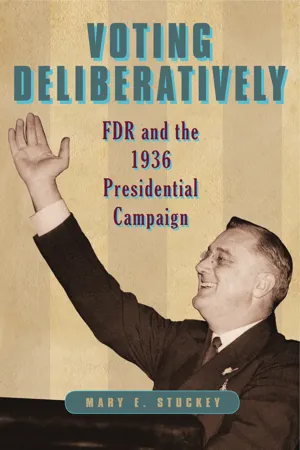
The 1932 election of Franklin Delano Roosevelt seemed to hold the promise of Democratic domination for years to come. However, leading up to the 1936 election, persistent economic problems, a controversial domestic agenda, and the perception of a weak foreign policy were chipping away at public support. The president faced unrelenting criticism from both the Left and the Right, and it seemed unlikely that he would cruise to the same clear victory he enjoyed in 1932. But 1936 was yet another landslide win for FDR, which makes it easy to forget just how contested the campaign was. In Voting Deliberatively, Mary Stuckey examines little-discussed components of FDR's 1936 campaign that aided his victory. She reveals four elements of this reelection campaign that have not received adequate attention: the creation of public opinion, the attention paid to local organizations, the focus on specific kinds of interests, and the public rhetoric that tied it all together. Previous studies of the 1936 presidential election discuss elements such as FDR's vulnerability before the campaign and the weakness of Republican candidate Alf Landon. But these histories pay little attention to the quantity and quality of information Roosevelt acquired, the importance of organizations such as the Good Neighbor League and the Committee of One, the mobilization of the vote, and the ways in which these organizational strategies fused with Roosevelt's rhetorical strategies. Stuckey shows how these facets combined in one of the largest victories in Electoral College history and provided a template for future victory.
- 166 pages
- English
- PDF
- Available on iOS & Android
eBook - PDF
About this book
Information
Table of contents
- COVER Front
- Series Page
- Copyright Page
- Table of Contents
- Acknowledgments
- Introduction: Roosevelt and the 1936 Election
- Notes to Introduction
- Chapter 1: Creating Public Opinion, Muting the Public’s Voice
- Notes to Chapter 1
- Chapter 2: Empowering the Public, Privileging the Candidate
- Notes to CHapter 2
- Chapter 3: Mobilizing the Vote, Containing the Public
- Notes to Chapter 3
- Chapter 4: Speaking for the Public, Empowering the Presidency
- Notes to Chapter 4
- Conclusion: The Mass Public and the Presidency
- Notes to Conclusion
- Notes
- Bibliography
- Index
- COVER Back
Trusted by 375,005 students
Access to over 1.5 million titles for a fair monthly price.
Study more efficiently using our study tools.
Frequently asked questions
Yes, you can cancel anytime from the Subscription tab in your account settings on the Perlego website. Your subscription will stay active until the end of your current billing period. Learn how to cancel your subscription
No, books cannot be downloaded as external files, such as PDFs, for use outside of Perlego. However, you can download books within the Perlego app for offline reading on mobile or tablet. Learn how to download books offline
Perlego offers two plans: Essential and Complete
- Essential is ideal for learners and professionals who enjoy exploring a wide range of subjects. Access the Essential Library with 800,000+ trusted titles and best-sellers across business, personal growth, and the humanities. Includes unlimited reading time and Standard Read Aloud voice.
- Complete: Perfect for advanced learners and researchers needing full, unrestricted access. Unlock 1.5M+ books across hundreds of subjects, including academic and specialized titles. The Complete Plan also includes advanced features like Premium Read Aloud and Research Assistant.
We are an online textbook subscription service, where you can get access to an entire online library for less than the price of a single book per month. With over 1.5 million books across 990+ topics, we’ve got you covered! Learn about our mission
Look out for the read-aloud symbol on your next book to see if you can listen to it. The read-aloud tool reads text aloud for you, highlighting the text as it is being read. You can pause it, speed it up and slow it down. Learn more about Read Aloud
Yes! You can use the Perlego app on both iOS and Android devices to read anytime, anywhere — even offline. Perfect for commutes or when you’re on the go.
Please note we cannot support devices running on iOS 13 and Android 7 or earlier. Learn more about using the app
Please note we cannot support devices running on iOS 13 and Android 7 or earlier. Learn more about using the app
Yes, you can access Voting Deliberatively by Mary E. Stuckey in PDF and/or ePUB format, as well as other popular books in Languages & Linguistics & North American History. We have over 1.5 million books available in our catalogue for you to explore.