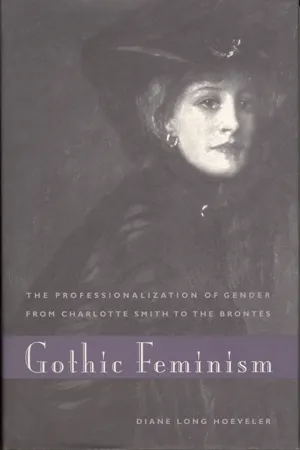
Gothic Feminism
eBook - PDF

Gothic Feminism

The Professionalization of Gender from Charlotte Smith to the Brontës

  1. English
  2. PDF
  3. Available on iOS & Android
eBook - PDF

Gothic Feminism

The Professionalization of Gender from Charlotte Smith to the Brontës

About this book

As British women writers in the late eighteenth and early nineteenth centuries sought to define how they experienced their era's social and economic upheaval, they helped popularize a new style of bourgeois female sensibility. Building on her earlier work in Romantic Androgyny, Diane Long Hoeveler now examines the Gothic novels of Charlotte Smith, Ann Radcliffe, Jane Austen, Charlotte Dacre Byrne, Mary Shelley, and the Brontës to show how these writers helped define femininity for women of the British middle class.

Hoeveler argues that a female-created literary ideology, now known as "victim feminism," arose as the Gothic novel helped create a new social role of professional victim for women adjusting to the new bourgeois order. These novels were thinly disguised efforts at propagandizing a new form of conduct for women, teaching that "professional femininity"—a cultivated pose of wise passiveness and controlled emotions—best prepared them for social survival. She examines how representations of both men and women in these novels moved from the purely psychosexual into social and political representations, and how these writers constructed a series of ideologies that would allow their female characters—and readers—fictitious mastery over an oppressive social and political system.

Gothic Feminism takes a neo-feminist approach to these women's writings, treating them not as sacred texts but as thesis-driven works that attempted to instruct women in a series of strategic poses. It offers both a new understanding of the genre and a wholly new interpretation of feminism as a literary ideology.

Frequently asked questions

Yes, you can cancel anytime from the Subscription tab in your account settings on the Perlego website. Your subscription will stay active until the end of your current billing period. Learn how to cancel your subscription.
No, books cannot be downloaded as external files, such as PDFs, for use outside of Perlego. However, you can download books within the Perlego app for offline reading on mobile or tablet. Learn more here.
Perlego offers two plans: Essential and Complete
  • Essential is ideal for learners and professionals who enjoy exploring a wide range of subjects. Access the Essential Library with 800,000+ trusted titles and best-sellers across business, personal growth, and the humanities. Includes unlimited reading time and Standard Read Aloud voice.
  • Complete: Perfect for advanced learners and researchers needing full, unrestricted access. Unlock 1.4M+ books across hundreds of subjects, including academic and specialized titles. The Complete Plan also includes advanced features like Premium Read Aloud and Research Assistant.
Both plans are available with monthly, semester, or annual billing cycles.
We are an online textbook subscription service, where you can get access to an entire online library for less than the price of a single book per month. With over 1 million books across 1000+ topics, we’ve got you covered! Learn more here.
Look out for the read-aloud symbol on your next book to see if you can listen to it. The read-aloud tool reads text aloud for you, highlighting the text as it is being read. You can pause it, speed it up and slow it down. Learn more here.
Yes! You can use the Perlego app on both iOS or Android devices to read anytime, anywhere — even offline. Perfect for commutes or when you’re on the go.
Please note we cannot support devices running on iOS 13 and Android 7 or earlier. Learn more about using the app.
Yes, you can access Gothic Feminism by Diane Long Hoeveler in PDF and/or ePUB format, as well as other popular books in Literature & 19th Century History. We have over one million books available in our catalogue for you to explore.

Table of contents

  1. Cover
  2. Title
  3. Copyright
  4. Dedication
  5. Contents
  6. Abbreviations
  7. Preface
  8. Introduction: Gothic Feminism and the Professionalization of “Femininity”
  9. One: Gendering the Civilizing Process: The Case of Charlotte Smith’s Emmeline, the Orphan of the Castle
  10. Two: Gendering Victimization: Radcliffe’s Early Gothics
  11. Three: Gendering Vindication: Radcliffe’s Major Gothics
  12. Four: Hyperbolic Femininity: Jane Austen, “Rosa Matilda,” and Mary Shelley
  13. Five: The Triumph of the Civilizing Process: The Brontës and Romantic Feminism
  14. Afterword
  15. Index