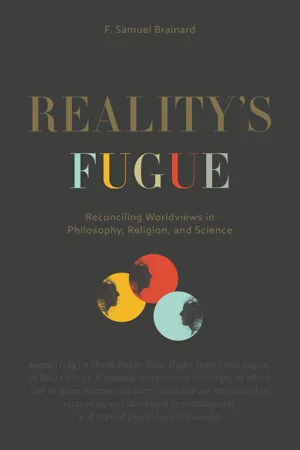
Reality’s Fugue
eBook - PDF

Reality’s Fugue

Reconciling Worldviews in Philosophy, Religion, and Science

  1. English
  2. PDF
  3. Available on iOS & Android
eBook - PDF

Reality’s Fugue

Reconciling Worldviews in Philosophy, Religion, and Science

About this book

Science, religion, philosophy: these three categories of thought have organized humankind's search for meaning from time immemorial. Reality's Fugue presents a compelling case that these ways of understanding, often seen as competing, are part of a larger puzzle that cannot be rendered by one account of reality alone.

This book begins with an overview of the concept of reality and the philosophical difficulties associated with attempts to account for it through any single worldview. By clarifying the differences among first-person, third-person, and dualist understandings of reality, F. Samuel Brainard repurposes the three predominant ways of making sense of those differences: exclusionist (only one worldview can be right), inclusivist (viewing other worldviews through the lens of one in order to incorporate them all, and thus distorting them), and pluralist or relativist (holding that there are no universals, and truth is relative). His alternative mode of understanding uses Douglas Hofstadter's metaphor of a musical fugue that allows different "voices" and "melodies" of worldviews to coexist in counterpoint and conversation, while each remains distinct, with none privileged above the others. Approaching reality in this way, Brainard argues, opens up the possibility for a multivoiced perspective that can overcome the skeptical challenges that metaphysical positions face.

Engagingly argued by a lifelong scholar of philosophy and global religions, this edifying and accessible exploration of the nature of reality addresses deeply meaningful questions about belief, reconciliation, and being.

Frequently asked questions

Yes, you can cancel anytime from the Subscription tab in your account settings on the Perlego website. Your subscription will stay active until the end of your current billing period. Learn how to cancel your subscription.
No, books cannot be downloaded as external files, such as PDFs, for use outside of Perlego. However, you can download books within the Perlego app for offline reading on mobile or tablet. Learn more here.
Perlego offers two plans: Essential and Complete
  • Essential is ideal for learners and professionals who enjoy exploring a wide range of subjects. Access the Essential Library with 800,000+ trusted titles and best-sellers across business, personal growth, and the humanities. Includes unlimited reading time and Standard Read Aloud voice.
  • Complete: Perfect for advanced learners and researchers needing full, unrestricted access. Unlock 1.4M+ books across hundreds of subjects, including academic and specialized titles. The Complete Plan also includes advanced features like Premium Read Aloud and Research Assistant.
Both plans are available with monthly, semester, or annual billing cycles.
We are an online textbook subscription service, where you can get access to an entire online library for less than the price of a single book per month. With over 1 million books across 1000+ topics, we’ve got you covered! Learn more here.
Look out for the read-aloud symbol on your next book to see if you can listen to it. The read-aloud tool reads text aloud for you, highlighting the text as it is being read. You can pause it, speed it up and slow it down. Learn more here.
Yes! You can use the Perlego app on both iOS or Android devices to read anytime, anywhere — even offline. Perfect for commutes or when you’re on the go.
Please note we cannot support devices running on iOS 13 and Android 7 or earlier. Learn more about using the app.
Yes, you can access Reality’s Fugue by F. Samuel Brainard in PDF and/or ePUB format, as well as other popular books in Theology & Religion & Epistemology in Philosophy. We have over one million books available in our catalogue for you to explore.

Table of contents

  1. COVER front
  2. Copyright Page
  3. Table of Contents
  4. Preface
  5. Introduction
  6. Chapter 1: The Predicament
  7. Notes on Chapter 1
  8. Chapter 2: Two Views of Reality
  9. Notes on Chapter 2
  10. Chapter 3: Universals and Particulars
  11. Notes on Chapter 3
  12. Chapter 4: Hinduism and the Third-Person View
  13. Notes on Chapter 4
  14. Chapter 5: Awareness and Its Objects
  15. Notes on Chapter 5
  16. Chapter 6: Buddhism and the First-Person View
  17. Notes on Chapter 6
  18. Chapter 7: The Dualism of Everyday Reality
  19. Notes on Chapter 7
  20. Chapter 8: Western Theism and the Dualist View
  21. Notes on Chapter 8
  22. Chapter 9: Awareness’s Two Roles
  23. Notes on Chapter 9
  24. Chapter 10: Artifacts of Awareness
  25. Notes on Chapter 10
  26. Chapter 11: Physical Reality
  27. Notes to Chapter 11
  28. Chapter 12: Religions Revisited
  29. Notes to Chapter 12
  30. Postscript 1: Scale as a Dimension of Reality
  31. Notes to Postscript 1
  32. Postscript 2: Definition for Truth
  33. Notes to Postscript 2
  34. Acknowledgments
  35. Terms Defined in This Book
  36. Glossary of Hindu and Buddhist Terms
  37. Notes
  38. Bibliography
  39. Index