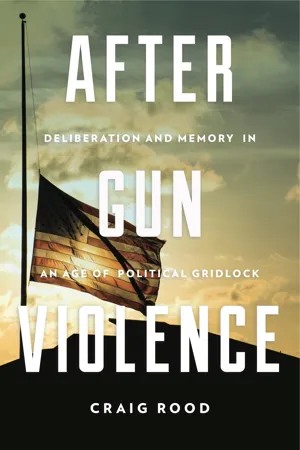
After Gun Violence
eBook - PDF

After Gun Violence

Deliberation and Memory in an Age of Political Gridlock

  1. English
  2. PDF
  3. Available on iOS & Android
eBook - PDF

After Gun Violence

Deliberation and Memory in an Age of Political Gridlock

About this book

Mass shootings have become the "new normal" in American life. The same can be said for the public debate that follows a shooting: blame is cast, political postures are assumed, but no meaningful policy changes are enacted. In After Gun Violence, Craig Rood argues that this cycle is the result of a communication problem. Without advocating for specific policies, Rood examines how Americans talk about gun violence and suggests how we might discuss the issues more productively and move beyond our current, tragic impasse.

Exploring the ways advocacy groups, community leaders, politicians, and everyday citizens talk about gun violence, Rood reveals how the gun debate is about far more than just guns. He details the role of public memory in shaping the discourse, showing how memories of the victims of gun violence, the Second Amendment, and race relations influence how gun policy is discussed. In doing so, Rood argues that forgetting and misremembering this history leads interest groups and public officials to entrenched positions and political failure and drives the public further apart.

Timely and innovative, After Gun Violence advances our understanding of public discourse in an age of gridlock by illustrating how public deliberation and public memory shape and misshape one another. It is a search to understand why public discourse fails and how we can do better.

Frequently asked questions

Yes, you can cancel anytime from the Subscription tab in your account settings on the Perlego website. Your subscription will stay active until the end of your current billing period. Learn how to cancel your subscription.
At the moment all of our mobile-responsive ePub books are available to download via the app. Most of our PDFs are also available to download and we're working on making the final remaining ones downloadable now. Learn more here.
Perlego offers two plans: Essential and Complete
  • Essential is ideal for learners and professionals who enjoy exploring a wide range of subjects. Access the Essential Library with 800,000+ trusted titles and best-sellers across business, personal growth, and the humanities. Includes unlimited reading time and Standard Read Aloud voice.
  • Complete: Perfect for advanced learners and researchers needing full, unrestricted access. Unlock 1.4M+ books across hundreds of subjects, including academic and specialized titles. The Complete Plan also includes advanced features like Premium Read Aloud and Research Assistant.
Both plans are available with monthly, semester, or annual billing cycles.
We are an online textbook subscription service, where you can get access to an entire online library for less than the price of a single book per month. With over 1 million books across 1000+ topics, we’ve got you covered! Learn more here.
Look out for the read-aloud symbol on your next book to see if you can listen to it. The read-aloud tool reads text aloud for you, highlighting the text as it is being read. You can pause it, speed it up and slow it down. Learn more here.
Yes! You can use the Perlego app on both iOS or Android devices to read anytime, anywhere — even offline. Perfect for commutes or when you’re on the go.
Please note we cannot support devices running on iOS 13 and Android 7 or earlier. Learn more about using the app.
Yes, you can access After Gun Violence by Craig Rood in PDF and/or ePUB format, as well as other popular books in Languages & Linguistics & North American History. We have over one million books available in our catalogue for you to explore.

Table of contents

  1. Cover Page
  2. Title Page
  3. Copyright Page
  4. Contents
  5. Acknowledgments
  6. Introduction: Deliberating Gun Violence
  7. 1. Deliberation and Memory
  8. 2. The Weight of the Past: Memory and the Second Amendment
  9. 3. The Fleeting Past: Memory and Our Obligations to the Dead
  10. 4. The Implicit Past: Memory and Racism
  11. 5. Conclusions for Moving Beyond Gridlock
  12. Epilogue
  13. Notes
  14. Bibliography
  15. Index