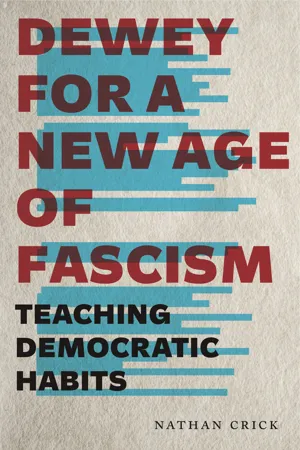
Dewey for a New Age of Fascism
eBook - PDF

Dewey for a New Age of Fascism

Teaching Democratic Habits

  1. English
  2. PDF
  3. Available on iOS & Android
eBook - PDF

Dewey for a New Age of Fascism

Teaching Democratic Habits

About this book

During the rise of fascism in the early twentieth century, American philosopher and educational reformer John Dewey argued that the greatest threat to democracy was not a political regime or even an aggressive foreign power but rather a set of dispositions or attitudes. Though not fascist in and of themselves, these habits of thought—rugged individualism and ideological nationalism—lay the foundation for fascism. In this study, Nathan Crick uses Dewey's social thought and philosophy of education to provide insight into and resources for transforming our present-day politics.

Through a close reading of Dewey's political writings and educational theory, Crick elaborates Dewey's vision of democratic social life and the education required for its foundation. He shows that for Dewey, communication is essential to cultivating sympathy, intelligence, and creativity—habits of thought that form the core of democratic culture. Crick then lays out a broad curriculum of logic, aesthetics, and rhetoric for inculcating these habits in the classroom, arguing that if we are to meet the challenge of fascism, we must teach these new arts as if our civilization depends on it—because in our new age of politics, it does.

Comprehensive and pragmatic, this book presents an experimental model of education that can be applied across the humanities curriculum. It will be of interest to teachers of writing, composition, and rhetoric as well as scholars and students of communication studies, pedagogy, and political theory.

Frequently asked questions

Yes, you can cancel anytime from the Subscription tab in your account settings on the Perlego website. Your subscription will stay active until the end of your current billing period. Learn how to cancel your subscription.
No, books cannot be downloaded as external files, such as PDFs, for use outside of Perlego. However, you can download books within the Perlego app for offline reading on mobile or tablet. Learn more here.
Perlego offers two plans: Essential and Complete
  • Essential is ideal for learners and professionals who enjoy exploring a wide range of subjects. Access the Essential Library with 800,000+ trusted titles and best-sellers across business, personal growth, and the humanities. Includes unlimited reading time and Standard Read Aloud voice.
  • Complete: Perfect for advanced learners and researchers needing full, unrestricted access. Unlock 1.4M+ books across hundreds of subjects, including academic and specialized titles. The Complete Plan also includes advanced features like Premium Read Aloud and Research Assistant.
Both plans are available with monthly, semester, or annual billing cycles.
We are an online textbook subscription service, where you can get access to an entire online library for less than the price of a single book per month. With over 1 million books across 1000+ topics, we’ve got you covered! Learn more here.
Look out for the read-aloud symbol on your next book to see if you can listen to it. The read-aloud tool reads text aloud for you, highlighting the text as it is being read. You can pause it, speed it up and slow it down. Learn more here.
Yes! You can use the Perlego app on both iOS or Android devices to read anytime, anywhere — even offline. Perfect for commutes or when you’re on the go.
Please note we cannot support devices running on iOS 13 and Android 7 or earlier. Learn more about using the app.
Yes, you can access Dewey for a New Age of Fascism by Nathan Crick in PDF and/or ePUB format, as well as other popular books in Languages & Linguistics & Education Theory & Practice. We have over one million books available in our catalogue for you to explore.

Table of contents

  1. Cover Page
  2. Title Page
  3. Copyright Page
  4. Contents
  5. Acknowledgments
  6. Introduction
  7. Part 1: The Challenge of Fascist Antihumanism
  8. Part 2: The Politics of Democratic Humanism
  9. Part 3: The Pedagogy of Democratic Humanism
  10. Conclusion: Teaching Democratic Humanism
  11. Notes
  12. Bibliography
  13. Index
  14. Other Books in the Series