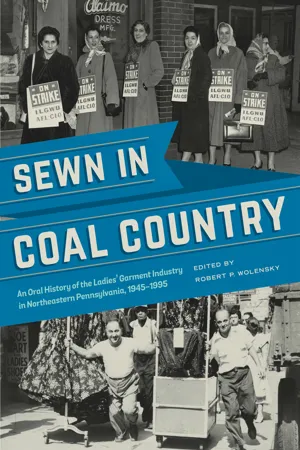
Sewn in Coal Country
An Oral History of the Ladies’ Garment Industry in Northeastern Pennsylvania, 1945–1995
- English
- PDF
- Available on iOS & Android
Sewn in Coal Country
An Oral History of the Ladies’ Garment Industry in Northeastern Pennsylvania, 1945–1995
About this book
By the mid-1930s, Pennsylvania's anthracite coal industry was facing a steady decline. Mining areas such as the Wyoming Valley around the cities of Wilkes-Barre and Pittston were full of willing workers (including women) who proved irresistibly attractive to New York City's "runaway shops"—ladies' apparel factories seeking lower labor and other costs. The International Ladies' Garment Workers' Union (ILGWU) soon followed, and the Valley became a thriving hub of clothing production and union activity. This volume tells the story of the area's apparel industry through the voices of men and women who lived it.
Drawing from an archive of over sixty audio-recorded interviews within the Northeastern Pennsylvania Oral and Life History Collection, Sewn in Coal Country showcases sixteen stories told by workers, shop owners, union leaders, and others. The interview subjects recount the ILGWU-led movement to organize the shops, the conflicts between the district union and the national office in New York, the solidarity unionism approach of leader Min Matheson, the role of organized crime within the business, and the failed efforts to save the industry in the 1980s and 1990s. Robert P. Wolensky places the narratives in the larger context of American clothing manufacturing during the period and highlights their broader implications for the study of labor, gender, the working class, and oral history.
Highly readable and thoroughly enlightening, this significant contribution to the study of labor history and women's history will appeal to anyone interested in the relationships among workers, unions, management, and community; the effects of economic change on an area and its residents; the role of organized crime within the industry; and Pennsylvania history—especially the social history of industrialization and deindustrialization during the twentieth century.
Frequently asked questions
- Essential is ideal for learners and professionals who enjoy exploring a wide range of subjects. Access the Essential Library with 800,000+ trusted titles and best-sellers across business, personal growth, and the humanities. Includes unlimited reading time and Standard Read Aloud voice.
- Complete: Perfect for advanced learners and researchers needing full, unrestricted access. Unlock 1.4M+ books across hundreds of subjects, including academic and specialized titles. The Complete Plan also includes advanced features like Premium Read Aloud and Research Assistant.
Please note we cannot support devices running on iOS 13 and Android 7 or earlier. Learn more about using the app.
Information
Table of contents
- COVER front
- Copyright Page
- Table of Contents
- List of Illustrations
- Preface
- Notes to Preface
- Acknowledgments
- Introduction: Northeastern Pennsylvania and the Garment Industry
- Notes to Introduction
- Chapter 1: Dorothy “Dot” Ney: Garment Worker, Union Organizer, and Business Agent
- Notes to Chapter 1
- Chapter 2: William “Bill” Cherkes: Garment Shop Owner and Garment Association President
- Notes to Chapter 2
- Chapter 3: Minnie “Min” Matheson: Labor Leader, Social Activist, and ILGWU District Manager
- Notes to Chapter 3
- Chapter 4: Angelo “Rusty” “Bill” DePasquale: Mineworker and ILGWU Organizer and “Enforcer”
- Notes to Chapter 4
- Chapter 5: Anthony “Tony” D’Angelo: Garment Presser and Barber
- Notes to Chapter 5
- Chapter 6: Alice Reca: Garment Worker, Union Organizer, and Business Agent
- Notes to Chapter 6
- Chapter 7: John “Johnny” Justin: Garment Worker, Labor Organizer, and ILGWU District Manager
- Notes to Chapter 7
- Chapter 8: Clementine “Clem” Lyons: Garment Worker, Business Agent, and Chorus Performer and Director
- Notes to Chapter 8
- Gallery
- Chapter 9: Helen Weiss: Garment Worker, Business Agent, and Chorus Performer
- Notes to Chapter 9
- Chapter 10: George and Lucy Zorgo: Union Printers and Labor Advocates
- Notes to Chapter 10
- Chapter 11: Philomena “Minnie” Caputo: Garment Worker, Union Activist, Chairlady, and Floorlady
- Notes to Chapter 11
- Chapter 12: Dr. Albert Schiowitz: Physician and Director of the Wyoming Valley ILGWU Health Center
- Notes to Chapter 12
- Chapter 13: Leo Gutstein: Family Garment Shop Owner and Garment Association President
- Notes to Chapter 13
- Chapter 14: Pearl Novak: Garment Worker, Union Organizer, and Social Activist
- Notes to Chapter 14
- Chapter 15: Betty Greenberg: Mother, Spouse, Activist, and the Mathesons’ Daughter
- Notes to Chapter 15
- Chapter 16: Labor, Working-Class,Gender, and Oral History
- Notes to Chapter 16
- Appendix 1
- Notes to Appendix 1
- Appendix 2
- Appendix 3
- Notes
- Bibliography
- Index