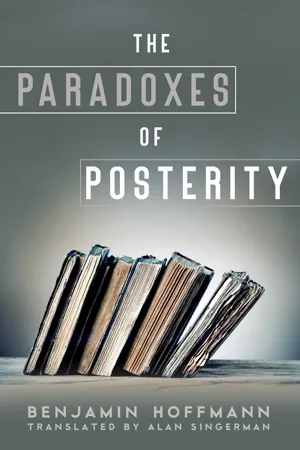
The impetus for literary creation has often been explained as an attempt to transcend the mortality of the human condition through a work addressed to future generations. Failing to obtain literal immortality, or to turn their hope toward the spiritual immortality promised by religious systems, literary creators seek a symbolic form of perpetuity granted to the intellectual side of their person in the memory of those not yet born while they write. In this book, Benjamin Hoffmann illuminates the paradoxes inherent in the search for symbolic immortality, arguing that the time has come to find a new answer to a perennial question: Why do people write?
Exploring the fields of digital humanities and book history, Hoffmann describes posterity as a network of interconnected memories that constantly evolves by reserving a variable and continuously renegotiated place for works and authors of the past. In other words, the perpetual safeguarding of texts is delegated to a collectivity that is nonexistent at the moment when a writer addresses it, one whose nature is characterized by impermanence and instability. Focusing on key works by Denis Diderot, Étienne-Maurice Falconet, Giacomo Casanova, François-René de Chateaubriand, and Jean-Paul Sartre, Hoffmann considers the authors' representations of posterity, the representation of authors by posterity, and how to register and preserve works in the network of memories. In doing so, Hoffmann reveals the three great paradoxes in the quest for symbolic immortality: the paradoxes of belief, of identity, and of mediation.
Theoretically sophisticated and convincingly argued, this book contends that there is only one truly serious literary problem: the transmission of texts to posterity. It will appeal to specialists in literature, in particular eighteenth-century French literature, as well as scholars and students of philosophy and book history.