A New Handbook of Rhetoric
eBook - PDF

A New Handbook of Rhetoric

Inverting the Classical Vocabulary

  1. English
  2. PDF
  3. Available on iOS & Android
eBook - PDF

A New Handbook of Rhetoric

Inverting the Classical Vocabulary

About this book

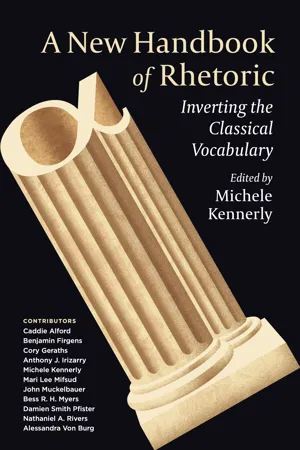
Like every discipline, Rhetorical Studies relies on a technical vocabulary to convey specialized concepts, but few disciplines rely so deeply on a set of terms developed so long ago. Pathos, kairos, doxa, topos—these and others originate from the so-called classical world, which has conferred on them excessive authority. Without jettisoning these rhetorical terms altogether, this handbook addresses critiques of their ongoing relevance, explanatory power, and exclusionary effects.

A New Handbook of Rhetoric inverts the terms of classical rhetoric by applying to them the alpha privative, a prefix that expresses absence. Adding the prefix ?- to more than a dozen of the most important terms in the field, the contributors to this volume build a new vocabulary for rhetorical inquiry. Essays on apathy, akairos, adoxa, and atopos, among others, explore long-standing disciplinary habits, reveal the denials and privileges inherent in traditional rhetorical inquiry, and theorize new problems and methods. Using this vocabulary in an analysis of current politics, media, and technology, the essays illuminate aspects of contemporary culture that traditional rhetorical theory often overlooks.

Innovative and groundbreaking, A New Handbook of Rhetoric at once draws on and unsettles ancient Greek rhetorical terms, opening new avenues for studying values, norms, and phenomena often stymied by the tradition.

In addition to the editor, the contributors include Caddie Alford, Benjamin Firgens, Cory Geraths, Anthony J. Irizarry, Mari Lee Mifsud, John Muckelbauer, Bess R. H. Myers, Damien Smith Pfister, Nathaniel A. Rivers, and Alessandra Von Burg.

Frequently asked questions

Yes, you can cancel anytime from the Subscription tab in your account settings on the Perlego website. Your subscription will stay active until the end of your current billing period. Learn how to cancel your subscription.
No, books cannot be downloaded as external files, such as PDFs, for use outside of Perlego. However, you can download books within the Perlego app for offline reading on mobile or tablet. Learn more here.
Perlego offers two plans: Essential and Complete
  • Essential is ideal for learners and professionals who enjoy exploring a wide range of subjects. Access the Essential Library with 800,000+ trusted titles and best-sellers across business, personal growth, and the humanities. Includes unlimited reading time and Standard Read Aloud voice.
  • Complete: Perfect for advanced learners and researchers needing full, unrestricted access. Unlock 1.4M+ books across hundreds of subjects, including academic and specialized titles. The Complete Plan also includes advanced features like Premium Read Aloud and Research Assistant.
Both plans are available with monthly, semester, or annual billing cycles.
We are an online textbook subscription service, where you can get access to an entire online library for less than the price of a single book per month. With over 1 million books across 1000+ topics, we’ve got you covered! Learn more here.
Look out for the read-aloud symbol on your next book to see if you can listen to it. The read-aloud tool reads text aloud for you, highlighting the text as it is being read. You can pause it, speed it up and slow it down. Learn more here.
Yes! You can use the Perlego app on both iOS or Android devices to read anytime, anywhere — even offline. Perfect for commutes or when you’re on the go.
Please note we cannot support devices running on iOS 13 and Android 7 or earlier. Learn more about using the app.
Yes, you can access A New Handbook of Rhetoric by Michele Kennerly in PDF and/or ePUB format, as well as other popular books in Languages & Linguistics & Greek Ancient History. We have over one million books available in our catalogue for you to explore.

Table of contents

  1. COVER Front
  2. Copyright Page
  3. Table of Contents
  4. Acknowledgments
  5. Chapter 1: Introduction
  6. Chapter 2: Atechnē
  7. Chapter 3: Asignification
  8. Chapter 4: Atopos
  9. Chapter 5: Anostos
  10. Chapter 6: Akairos
  11. Chapter 7: Adoxa
  12. Chapter 8: Aporia
  13. Chapter 9: Agnostic
  14. Chapter 10: Apathy
  15. Chapter 11: Aphantasia
  16. Bibliography
  17. Index