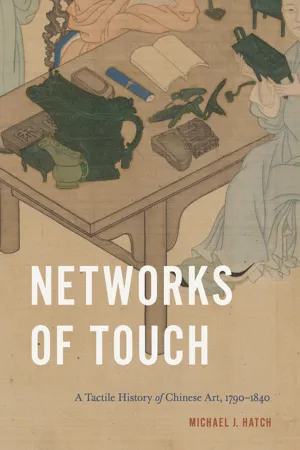
Networks of Touch
eBook - ePub

Networks of Touch

A Tactile History of Chinese Art, 1790–1840

  1. English
  2. ePUB (mobile friendly)
  3. Available on iOS & Android
eBook - ePub

Networks of Touch

A Tactile History of Chinese Art, 1790–1840

About this book

In early nineteenth-century China, a remarkable transformation took place in the art world: artists among China's educated elites began to use touch to forge a more authentic relationship to the past, to challenge stagnant artistic canons, and to foster deeper human connections. Networks of Touch is an engaging exploration of this sensory turn.

In this book, Michael J. Hatch examines the artistic network of Ruan Yuan (1764–1849), a scholar-official whose patronage supported a generation of artists and learned people who prioritized epigraphic research as a means of truing the warped contours of Confucian heritage. Their work instigated an "epigraphic aesthetic"—an appropriation of the stylistic, material, and tactile features of ancient inscribed objects and their reproductive technologies—in late eighteenth- and early nineteenth-century artwork. Rubbings, a reduplicative technology, challenged the dominance of brushwork as the bearer of artistic authority. While brushwork represented the artist's physical presence through ink and paper, rubbings were direct facsimiles of tactile experiences with objects. This shift empowered artists and scholars to transcend traditional conventions and explore new mediums, uniting previously separate image-making practices while engaging audiences through the senses.

Centering on touch and presenting a fresh perspective on early nineteenth-century literati art in China, this volume sheds light on a period often dismissed as lacking innovation and calls into question optical realism's perceived supremacy in reshaping the sensory experience of the modern Chinese viewer.

Frequently asked questions

Yes, you can cancel anytime from the Subscription tab in your account settings on the Perlego website. Your subscription will stay active until the end of your current billing period. Learn how to cancel your subscription.
No, books cannot be downloaded as external files, such as PDFs, for use outside of Perlego. However, you can download books within the Perlego app for offline reading on mobile or tablet. Learn more here.
Perlego offers two plans: Essential and Complete
  • Essential is ideal for learners and professionals who enjoy exploring a wide range of subjects. Access the Essential Library with 800,000+ trusted titles and best-sellers across business, personal growth, and the humanities. Includes unlimited reading time and Standard Read Aloud voice.
  • Complete: Perfect for advanced learners and researchers needing full, unrestricted access. Unlock 1.4M+ books across hundreds of subjects, including academic and specialized titles. The Complete Plan also includes advanced features like Premium Read Aloud and Research Assistant.
Both plans are available with monthly, semester, or annual billing cycles.
We are an online textbook subscription service, where you can get access to an entire online library for less than the price of a single book per month. With over 1 million books across 1000+ topics, we’ve got you covered! Learn more here.
Look out for the read-aloud symbol on your next book to see if you can listen to it. The read-aloud tool reads text aloud for you, highlighting the text as it is being read. You can pause it, speed it up and slow it down. Learn more here.
Yes! You can use the Perlego app on both iOS or Android devices to read anytime, anywhere — even offline. Perfect for commutes or when you’re on the go.
Please note we cannot support devices running on iOS 13 and Android 7 or earlier. Learn more about using the app.
Yes, you can access Networks of Touch by Michael J. Hatch in PDF and/or ePUB format, as well as other popular books in Art & Asian Art. We have over one million books available in our catalogue for you to explore.

Information

eBook ISBN
9780271096216
Topic
Art
Subtopic
Asian Art

Table of contents

  1. Cover
  2. Title Page
  3. Copyright
  4. Dedication
  5. Contents
  6. List of Illustrations
  7. Acknowledgments
  8. Introduction
  9. 1. Calligraphy’s New Past
  10. 2. Obliterated Texts
  11. 3. Epigraphic Painting
  12. 4. Tactile Images
  13. 5. A Tactful Literatus
  14. 6. The Limits of Touch
  15. Epilogue: Modern Horizons
  16. Glossary of Names
  17. Glossary of Foreign Terms
  18. Notes
  19. Bibliography
  20. Index