Explores the ever-present experiences of risk that characterized the daily existence of individuals, communities, and societies in the late Roman world
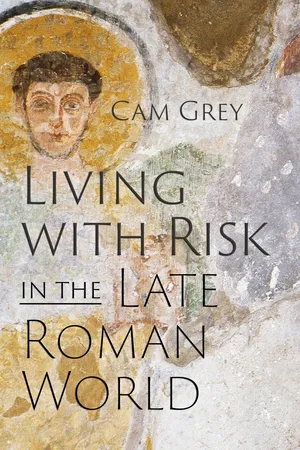
Living with Risk in the Late Roman World explores the ever-present experiences of risk that characterized the daily existence of individuals, communities, and societies in the late Roman world (late third century CE through mid-sixth century CE). Recognizing the vital role of human agency, author Cam Grey bases his argument on the concept of the riskscape: the collection of risks that constitute everyday lived experience, the human perception of those risks, and the actions that exploit, mitigate, or exacerbate them. In contrast to recent grand narratives of the fate of the late Roman Empire, Living with Risk in the Late Roman World focuses on the quotidian practices of mitigation and management, foreknowledge and prediction, and mobilization and manipulation of risks at the individual and community levels.
Grey illustrates the ubiquity of these practices through a collection of anecdotes that emphasize the highly localized, heterogeneous, and complementary nature of riskscapes: members of local communities enlisting figures of power to neutralize the hazards posed by imminent catastrophes, be it a tsunami, earthquake, or volcanic eruption; Christian holy figures both suffering and imposing bodily affliction as part of their claims to control such hazards and thereby to exercise influence in these communities; intimate experiences of seasonality and weather that shaped local practices of subsistence but also of self-representation; and geographically specific and fiercely contested claims to special knowledge and control of water.
Multidisciplinary in its methodology and provocative in its argumentation, Living with Risk in the Late Roman World demonstrates that human communities in the ancient past were inextricably intertwined with the world around them, and that the actions they took simultaneously responded to and shaped the risks—both hazardous and favorable—that they perceived.
- 384 pages
- English
- ePUB (mobile friendly)
- Available on iOS & Android
eBook - ePub
About this book
Information
Subtopic
Roman Ancient HistoryIndex
HistoryTable of contents
- Cover
- Series Page
- Title Page
- Copyright
- Contents
- Prologue
- Chapter 1. Cultures of Risk
- Chapter 2. Seismicity and Society
- Chapter 3. Weathering the Weather
- Chapter 4. Living with Water
- Chapter 5. Writing Riskscapes
- Epilogue
- Notes
- Bibliography
- Index
- Acknowledgments
Trusted by 375,005 students
Access to over 1.5 million titles for a fair monthly price.
Study more efficiently using our study tools.
Frequently asked questions
Yes, you can cancel anytime from the Subscription tab in your account settings on the Perlego website. Your subscription will stay active until the end of your current billing period. Learn how to cancel your subscription
No, books cannot be downloaded as external files, such as PDFs, for use outside of Perlego. However, you can download books within the Perlego app for offline reading on mobile or tablet. Learn how to download books offline
Perlego offers two plans: Essential and Complete
- Essential is ideal for learners and professionals who enjoy exploring a wide range of subjects. Access the Essential Library with 800,000+ trusted titles and best-sellers across business, personal growth, and the humanities. Includes unlimited reading time and Standard Read Aloud voice.
- Complete: Perfect for advanced learners and researchers needing full, unrestricted access. Unlock 1.5M+ books across hundreds of subjects, including academic and specialized titles. The Complete Plan also includes advanced features like Premium Read Aloud and Research Assistant.
We are an online textbook subscription service, where you can get access to an entire online library for less than the price of a single book per month. With over 1.5 million books across 990+ topics, we’ve got you covered! Learn about our mission
Look out for the read-aloud symbol on your next book to see if you can listen to it. The read-aloud tool reads text aloud for you, highlighting the text as it is being read. You can pause it, speed it up and slow it down. Learn more about Read Aloud
Yes! You can use the Perlego app on both iOS and Android devices to read anytime, anywhere — even offline. Perfect for commutes or when you’re on the go.
Please note we cannot support devices running on iOS 13 and Android 7 or earlier. Learn more about using the app
Please note we cannot support devices running on iOS 13 and Android 7 or earlier. Learn more about using the app
Yes, you can access Living with Risk in the Late Roman World by Cam Grey,Cam Grey in PDF and/or ePUB format, as well as other popular books in History & Roman Ancient History. We have over 1.5 million books available in our catalogue for you to explore.