When applying human ingenuity and experience to natural resources and processes, scientists and researchers can maximize the potential of nature for human benefit. In that vein, this book explores the latest breakthroughs in natural biopolymers, green composites, and green nanocomposites, a field that is rapidly expanding. The volume looks at bio-based polymers and composites for environmental sustainability, such as in bioremediation and for wastewater treatment. It discusses natural polymers from waste products and considers the use of bio-based polymers and composites in fertilization in horticulture as well as in industry and construction, such as for recycling of concrete, for gas sensing applications for safety, for fiber-reinforced epoxy composites, etc.
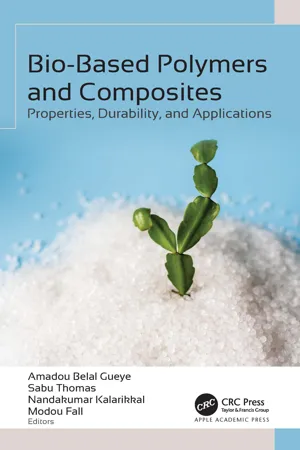
eBook - ePub
Bio-Based Polymers and Composites
Properties, Durability, and Applications
- 334 pages
- English
- ePUB (mobile friendly)
- Available on iOS & Android
eBook - ePub
Bio-Based Polymers and Composites
Properties, Durability, and Applications
About this book
Information
Table of contents
- Cover Page
- Half Title Page
- Title Page
- Copyright Page
- About the Editors
- Contents
- Contributors
- Abbreviations
- Preface
- Chapter 1 Biopolymer-Derived Superabsorbent for Environmental Sustainability: A Review
- Chapter 2 Applications of Green Nanocomposites in Polycyclic Aromatic Hydrocarbons (PAHs) Bioremediation: Current Status and Future direction
- Chapter 3 Lignin- and Chitosan-Based Biosorbents for Waste Water Treatment
- Chapter 4 Advancement of Natural Polymers from Waste and Their Biotechnological Applications
- Chapter 5 Pectin–Carbon Nanosphere: A Green Nanocomposite for the Sensing of Glucose
- Chapter 6 Structural and Functional Diversities of Lactic Acid Bacterial Polysaccharide
- Chapter 7 Comparison of Thermal Resistance by Insulation Board Made from Rice Husk and Bagasse Waste
- Chapter 8 Effect of Micro- and Nanofillers on Polarization, Depolarization Currents, and Dielectric Properties in Fiber-Reinforced Epoxy Composites
- Chapter 9 Ni/Co/Cu and TiO2 Incorporate Ragi Husk-Derived Biosilica Nanocomposite as Photocatalyst and Adsorbent for the Degradation of Methyl Blue Dye
- Chapter 10 Effect of Zinc Oxide Nanoparticles on Polymerization Shrinkage and Mechanical Properties of ORMO-48
- Chapter 11 Structural and Optical Characterization of PVP-Stabilized Ag-Doped CuO Nanoflakes via Hydrothermal Method
- Chapter 12 PVA-Stabilized Zn-Doped CoS/Graphene Nanocomposites as Active Electrode Materials for Supercapacitors and Excellent Nano-Photocatalists
- Chapter 13 Antimicrobial Activity of Poly Vinyl Pyrrolidine-Assisted Pure and Transition Metals (Fe/Zn/Ag)-Doped CuO Nanocomposites
- Chapter 14 Effect of Sulfur Sources on the Properties of PVA-Stabilized Indium Sulfide for Photo Degradation Application
- Chapter 15 PLA Stabilized/Graphene-Based Copper Sulfide-Hole Transport Material for Organic Photovoltaics
- Chapter 16 Structural Properties of Ag-Doped PVP-Stabilized SnO2 Engineered with TiO2 for Gas Sensing Applications
- Chapter 17 Struvite Fertilization in Horticulture as the Closed Phosphorus Cycle
- Index
Trusted by 375,005 students
Access to over 1.5 million titles for a fair monthly price.
Study more efficiently using our study tools.
Frequently asked questions
Yes, you can cancel anytime from the Subscription tab in your account settings on the Perlego website. Your subscription will stay active until the end of your current billing period. Learn how to cancel your subscription
No, books cannot be downloaded as external files, such as PDFs, for use outside of Perlego. However, you can download books within the Perlego app for offline reading on mobile or tablet. Learn how to download books offline
We are an online textbook subscription service, where you can get access to an entire online library for less than the price of a single book per month. With over 1.5 million books across 990+ topics, we’ve got you covered! Learn about our mission
Look out for the read-aloud symbol on your next book to see if you can listen to it. The read-aloud tool reads text aloud for you, highlighting the text as it is being read. You can pause it, speed it up and slow it down. Learn more about Read Aloud
Yes! You can use the Perlego app on both iOS and Android devices to read anytime, anywhere — even offline. Perfect for commutes or when you’re on the go.
Please note we cannot support devices running on iOS 13 and Android 7 or earlier. Learn more about using the app
Please note we cannot support devices running on iOS 13 and Android 7 or earlier. Learn more about using the app
Yes, you can access Bio-Based Polymers and Composites by Amadou Belal Gueye,Sabu Thomas,Nandakumar Kalarikkal,Modou Fall in PDF and/or ePUB format, as well as other popular books in Technology & Engineering & Science General. We have over 1.5 million books available in our catalogue for you to explore.