In the second half of 2020 and continuing into 2021, protests against racial injustice spread across the United States after the death of George Floyd while in the custody of Minneapolis Police Department officers. Members of the press covered these demonstrations, documenting what transpired and conveying the important messages involved. In so doing, the news media held law enforcement accountable through critical reporting on the actions of the police, with police officers responding in part by intimidating journalists in the field using force and arrest—this in the name of keeping the peace and protecting the public from further harm.
What transpired during this troubled time cast a bright light on the contemporary relationship between the press and police in the United States. The relationship between these two fundamental institutions is, however, a long and complicated one, dating back to colonial British North America. In the mid-19th century, (1830s–1850s) both the press and the police began to take their modern forms, and since then have continued to develop, routinely interacting with each other as journalists and police officers often found themselves responding to the same crimes and events. At times, members of both institutions managed to co-exist or even cooperate and made efforts to help one another, while at other times they butted heads to the point of conflict, the professional boundaries between journalists and police officers seemingly blurred.
As both the press and the police have fallen under deep scrutiny in more modern times, the present moment marks what is, perhaps, an opportune time to focus on the political, economic, social, and technological problems they face. In "Pressing the Police and Policing the Press," Scott Memmel offers the first book-length study of the history and legal landscape of the press-police relationship. Each chapter focuses on interactions between the press and the police during a particular era, introducing relevant societal context and how both institutions evolved and responded to that context. Memmel concludes his study with recommendations on how, going forward, the press and the police might work together to tackle some of the similar issues they face and better serve the public.
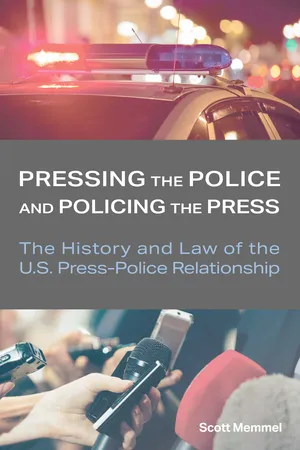
eBook - ePub
Pressing the Police and Policing the Press
The History and Law of the U.S. Press-Police Relationship
- 394 pages
- English
- ePUB (mobile friendly)
- Available on iOS & Android
eBook - ePub
Pressing the Police and Policing the Press
The History and Law of the U.S. Press-Police Relationship
About this book
Information
Table of contents
- Cover Page
- Half Title Page
- Title Page
- Copyright Page
- Dedication
- Contents
- Preface
- Acknowledgments
- Introduction: Understanding the U.S. Press-Police Relationship
- Chapter 1. Rise of the Modern Press and Police, 1630s–1850s
- Chapter 2. New Opportunities, New Problems, 1860s–1890s
- Chapter 3. Reform and Separation, 1900s–1910s
- Chapter 4. Greater Partnerships, 1920s–1950s
- Chapter 5. Adversarial Relationship, 1960s–1970s
- Chapter 6. Rebuilding a Complicated Relationship, 1980s–2020s
- Chapter 7. Legal Landscape of the U.S. Press-Police Relationship
- Conclusion: The Future of the Press-Police Relationship
- Notes
- Bibliography
- Index
Trusted by 375,005 students
Access to over 1.5 million titles for a fair monthly price.
Study more efficiently using our study tools.
Frequently asked questions
Yes, you can cancel anytime from the Subscription tab in your account settings on the Perlego website. Your subscription will stay active until the end of your current billing period. Learn how to cancel your subscription
No, books cannot be downloaded as external files, such as PDFs, for use outside of Perlego. However, you can download books within the Perlego app for offline reading on mobile or tablet. Learn how to download books offline
Perlego offers two plans: Essential and Complete
- Essential is ideal for learners and professionals who enjoy exploring a wide range of subjects. Access the Essential Library with 800,000+ trusted titles and best-sellers across business, personal growth, and the humanities. Includes unlimited reading time and Standard Read Aloud voice.
- Complete: Perfect for advanced learners and researchers needing full, unrestricted access. Unlock 1.5M+ books across hundreds of subjects, including academic and specialized titles. The Complete Plan also includes advanced features like Premium Read Aloud and Research Assistant.
We are an online textbook subscription service, where you can get access to an entire online library for less than the price of a single book per month. With over 1.5 million books across 990+ topics, we’ve got you covered! Learn about our mission
Look out for the read-aloud symbol on your next book to see if you can listen to it. The read-aloud tool reads text aloud for you, highlighting the text as it is being read. You can pause it, speed it up and slow it down. Learn more about Read Aloud
Yes! You can use the Perlego app on both iOS and Android devices to read anytime, anywhere — even offline. Perfect for commutes or when you’re on the go.
Please note we cannot support devices running on iOS 13 and Android 7 or earlier. Learn more about using the app
Please note we cannot support devices running on iOS 13 and Android 7 or earlier. Learn more about using the app
Yes, you can access Pressing the Police and Policing the Press by Scott Memmel in PDF and/or ePUB format, as well as other popular books in Languages & Linguistics & Journalism. We have over 1.5 million books available in our catalogue for you to explore.